
Letters to a Friend, Written to Mrs. Ezra S. Carr, 1866-1879
John Muir
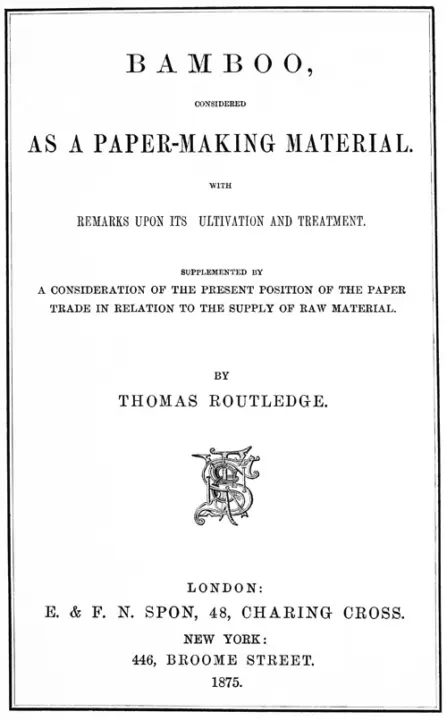
THE CLASSIC COLLECTION · 1875
"Bamboo, Considered as a Paper-making Material" by Thomas Routledge is a scientific publication written in the late 19th century. The book examines the potential of bamboo as a sustainable and economically viable raw material for the paper-making industry, emphasizing its cultivation and processing methods. Routledge argues that bamboo can meet the growing demands for paper due to its rapid growth, high yield, and low cost compared to traditional fibers. In this detailed treatise, Routledge discusses the characteristics of bamboo, including its growth patterns and the chemistry involved in converting it into paper stock. He stresses the importance of harvesting bamboo at an early stage to utilize its fibrous properties before it becomes too woody. Additionally, the book outlines a systematic approach to processing bamboo into paper stock, advocating for a production model that leverages its abundant availability in suitable climates. By juxtaposing bamboo with other fibrous plants like esparto, the author presents a compelling case for its adoption in the paper industry, predicting a significant shift toward this environmentally friendly and efficient source of material.
Introduction adapted from the source catalogue; source summaries may be automatically generated.
Free to read · English · 8,832 words · No account needed
MAKE TIME FOR A GOOD BOOK
On by default. Untick to stop anonymous reading totals. Each page counts after 10 seconds in view. How this works.
Anonymous counting is on unless you have switched it off.
The daily increasing demand for PAPER being recognized, and the impending if not immediate scarcity of Raw Material available for its manufacture, up to the present time, having been shown, to what quarter must the Trade look for an extended supply?
This it must be admitted has become an important question for consideration, it being evident that unless some "New Material" suitable for the purpose is speedily introduced, the "PAPER TRADE," one of the most important in the UNITED KINGDOM, will be seriously crippled; meanwhile of necessity high prices are maintained, and as a natural consequence the consumer suffers.
The high value of land precludes the cultivation of any fibrous material exclusively for paper-making in England, even if this climate was suitable for its growth; with the exception indeed of "FLAX" and "HEMP," it would appear that northern latitudes are not favourable for the production of fibre-producing plants, and therefore it is to warm or tropical countries alone any reliable supply of "NEW MATERIAL" can be looked for.
In the East, and West Indies, in her Colonies and Dependencies, England possesses an inexhaustible supply of fibre-producing plants; in India especially, almost every plant abounds more or less in fibre.
In China and Japan, as also in India, from the earliest times, paper has been made exclusively from raw indigenous virgin fibres, and the paper produced in these countries is in consequence generally extremely strong and tough, and although unbleached, and not made in a fashion adapted to European requirements, affords ample and conclusive evidence of the valuable supply of material at our disposal.
VEGETABLE FIBROUS, or FIBRE-PRODUCING PLANTS, are divided by BOTANISTS into two distinct CLASSES or DIVISIONS: ENDOGENS, or inside growers; EXOGENS, or outside growers.
From the former are obtained the fibres known as "MANILLA HEMP" or "ABACA" (from the Musa textilis or Plantain), the "ALOE," "AGAVÉ" (or "Pita Fibre"), the "YUCCA," "BROMELIA PENGUIN," "SISAL HEMP" (or Hannequin); "PINA FIBRE" from the "PINE APPLE" (Ananassa sativa), "MAROOL or MOORVA" (Sanseveira Zeylanica), "NEW ZEALAND FLAX" (Phormium tenax), &c.; "MAIZE" (or Indian Corn), "RICE," and other "CEREAL STRAWS," "ESPARTO," "DISS," and various "Sedges," "Reeds," and "Grasses," the latter including "BAMBOO," and "SUGAR CANE," are also comprised in this Class.
The FIBRES, or FIBROUS TISSUE enveloping the Stems of Herbaceous Plants, known as "HEMP," "FLAX," "JUTE," "HIBISCUS," (Gombo or Okhro), "RHEA," or "CHINA-GRASS" (Urtica nivea), "SUNN HEMP" (Cratolaria juncea), &c., as also the LACE BARKS (so called), such as the "ADANSONIA DIGITATAS" (from the Baobab tree), the "NEPAL PAPER PLANT" (Daphne cannabina), the "PAPER MULBERRY" (Broussonetia papyrifera), &c., constitute the latter Class.
Your reading position is saved on this browser. Take it to another device with a library code. Reading pages adapt to text, rather than matching a printed edition.
BEHIND THE BOOK
This eBook is for the use of anyone anywhere in the United States and most other parts of the world at no cost and with almost no restrictions whatsoever. You may copy it, give it away or re-use it under the terms of the Project Gutenberg License included with this eBook or online at www.gutenberg.org. If you are not located in the United States, you will have to check the laws of the country where you are located before using this eBook. Read the source licence.
The original source file, including credits and licence, is retained by this library. Request an original-format copy at no charge. Please include the book title and Project Gutenberg identifier #54090.
KEEP YOUR CURIOSITY GOING
John Muir

Asa Gray
Asa Gray

Florence Nightingale
Elizabeth Robins Pennell
Denison Olmsted