THE CLASSIC COLLECTION✦The MonsterCLASSIC FREE BOOKS
The Monster
Edgar Saltus
THE CLASSIC COLLECTION · 1884
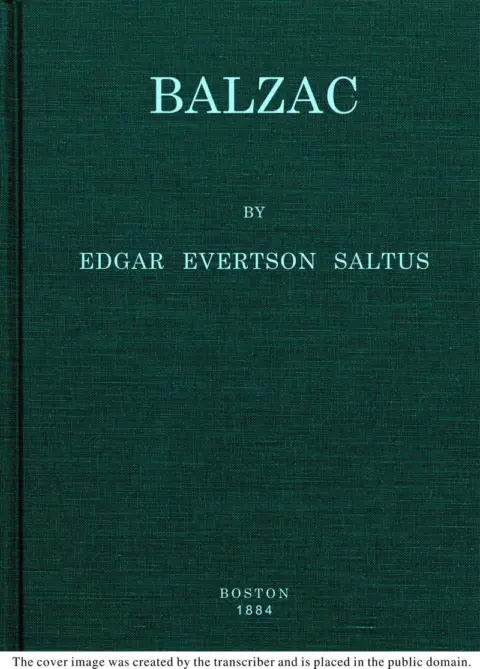
"Balzac" by Edgar Saltus is a biography written in the late 19th century. The book explores the life and genius of the renowned French novelist Honoré de Balzac, covering his formative years, literary struggles, and eventual rise to fame as a pivotal figure in literature with his expansive work, "La Comédie Humaine." Saltus delves into Balzac’s eccentricities, profound obsessions, and creative process, painting a vivid picture of the man behind the novels that shaped French literature. The opening of "Balzac" introduces us to Honoré de Balzac's early life and formative experiences that shaped his literary journey. Born in Tours in 1799, Balzac is depicted as a precocious child, engrossed in books and music, showing early signs of brilliance despite being viewed as a dullard in school. Saltus details Balzac's struggles with confinement in conventional education, his eventual resolve to pursue a life of literature despite familial expectations, and the hardships he faced, including financial difficulties and the challenges of gaining recognition in literary circles. The narrative sets up a foundation for understanding Balzac's profound influence on the literary world, highlighting early hints of his ambitious nature and relentless dedication to his craft.
Introduction adapted from the source catalogue; source summaries may be automatically generated.
Free to read · English · 43,407 words · No account needed
MAKE TIME FOR A GOOD BOOK
On by default. Untick to stop anonymous reading totals. Each page counts after 10 seconds in view. How this works.
Anonymous counting is on unless you have switched it off.
Human justice is, I think, the development of the thought which floats
through space.
Through an inexplicable phenomenon, there are many who have hope, but are lacking in faith. Hope is the flower of desire; faith is the fruit of certainty.
A petty work engenders pride, while modesty is born of great
achievements.
The problem of eternal beatitude is one whose solution is known but to God. Here below, poets bore their readers to death with their pictures of Paradise.
It costs more to satisfy a vice than to feed a family.
A husband should never permit himself to say anything against his wife in the presence of a third person.
Love prefers contrasts to similitudes.
The sentiment of wrong doing is in proportion to the purity of the conscience, and an act which to one is barely a fault will assume to another the dimensions of a crime.
Woman lives by sentiment, where man lives by action.
Probity, like virtue, should be divided into two classes: to wit, negative and positive. The former would refer to those who are honest so long as no occasion to enrich themselves is offered; while the latter would refer to those who face temptation and resist it.
Woman, as a rule, feels, enjoys, and judges successively; hence, three distinct periods, of which the last coincides with the melancholy approach of old age.
A lover is never in the wrong.
Distrust a woman who speaks of her virtue.
In love, there is nothing so persuasive as courageous stupidity.
Weak natures are reassured as easily as they are alarmed.
The most incurable wounds are those which are made by the tongue or the eye, by mockery or by disdain.
To two lovers the rest of the world is but landscape.
Expiation is not obliteration.
A virtuous woman has a fibre more or a fibre less than other women. She
is stupid or sublime.
Language in the magnificence of its phases has nothing as varied and as eloquent as the correspondence of the eyes and the harmony of smiles.
The slave has his vanities; he would prefer to obey only the greatest
of despots.
Customs are the hypocrisies of nations.
It is not enough for a man to be honest; he must appear so.
If a man is superstitious he is never thoroughly miserable. A
superstition is a hope.
Expressionless beauty is an imposture.
A lack of taste in dress is a defect inseparable from a false
conception of religion.
It is more difficult to explain the difference which exists between those who are swell and those who are not than it is for those who are not to efface the difference.
Your reading position is saved on this browser. Take it to another device with a library code. Reading pages adapt to text, rather than matching a printed edition.
Edgar Saltus
Edgar Saltus
Edgar Saltus
Edgar Saltus
BEHIND THE BOOK
This eBook is for the use of anyone anywhere in the United States and most other parts of the world at no cost and with almost no restrictions whatsoever. You may copy it, give it away or re-use it under the terms of the Project Gutenberg License included with this eBook or online at www.gutenberg.org. If you are not located in the United States, you will have to check the laws of the country where you are located before using this eBook. Read the source licence.
The original source file, including credits and licence, is retained by this library. Request an original-format copy at no charge. Please include the book title and Project Gutenberg identifier #46859.
KEEP YOUR CURIOSITY GOING
John L. Ransom
Herman W. Mudgett

Harriet Monroe
Daniel Dulany Addison
Charles Lanman

Harold Rosher