THE CLASSIC COLLECTION✦The MonsterCLASSIC FREE BOOKS
The Monster
Edgar Saltus
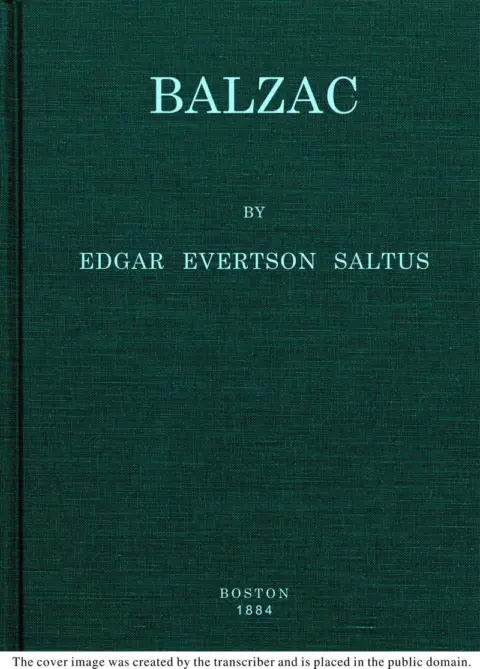
THE CLASSIC COLLECTION · 1884
"Balzac" by Edgar Saltus is a biography written in the late 19th century. The book explores the life and genius of the renowned French novelist Honoré de Balzac, covering his formative years, literary struggles, and eventual rise to fame as a pivotal figure in literature with his expansive work, "La Comédie Humaine." Saltus delves into Balzac’s eccentricities, profound obsessions, and creative process, painting a vivid picture of the man behind the novels that shaped French literature. The opening of "Balzac" introduces us to Honoré de Balzac's early life and formative experiences that shaped his literary journey. Born in Tours in 1799, Balzac is depicted as a precocious child, engrossed in books and music, showing early signs of brilliance despite being viewed as a dullard in school. Saltus details Balzac's struggles with confinement in conventional education, his eventual resolve to pursue a life of literature despite familial expectations, and the hardships he faced, including financial difficulties and the challenges of gaining recognition in literary circles. The narrative sets up a foundation for understanding Balzac's profound influence on the literary world, highlighting early hints of his ambitious nature and relentless dedication to his craft.
Introduction adapted from the source catalogue; source summaries may be automatically generated.
Free to read · English · 43,407 words · No account needed
MAKE TIME FOR A GOOD BOOK
On by default. Untick to stop anonymous reading totals. Each page counts after 10 seconds in view. How this works.
Anonymous counting is on unless you have switched it off.
“Un écrivain doit se regarder comme un instituteur des hommes.”—BONALD.
Balzac, to borrow a Hindu expression, was “an artificer who built like a giant and finished like a jeweler.” The groundwork of the “Comédie Humaine” was grandly conceived and admirably executed; and though a few of the balconies of its superb superstructure are incomplete, yet as, happily, masterpieces are ever eternally young, it shows no signs of decay, and there is little danger of its falling in ruins.
For the decoration of this work, Balzac brought a subtle analysis of men, women, and things, and adorned it all with brilliant ideas and profound reflections, of which the saddest were dug from his own sufferings, and not, as a great writer has said, from the hearts of his mistresses.
As everything that he wrote is more or less worthy of attention, a complete collection of his theories and teachings would be as impossible, as an arrangement of Emerson’s best thoughts, and in any event would ill befit the unpretentious character of this treatise. For his elaborate monographs on religion, morality, society, politics, science, and art, the reader must turn to the complete edition of his writings; for in these pages the attempt will be made to render only a handful of unsorted aphorisms and reflections, taken at random, of which the majority will be found to touch merely upon every-day topics, and that in the lightest possible vein.
With this brief explanation, for which your indulgence is requested, the crier gives way to the thinker.
A woman is to her husband that which her husband has made her.
It is still a question, both in politics and marriage, whether empires are overthrown and happiness destroyed through over-confidence or through too great severity.
A husband risks nothing in affecting to believe his wife, and in
patiently holding his tongue. Of all things, silence worries a woman
most.
It is, perhaps, only those who believe in God who do good in secret.
Statesmen, thinkers, men who have commanded armies,—in a word, those who are really great,—are natural and unaffected, and their simplicity places one at once on an equality with them.
Comprehension is equality.
Discussion weakens all things.
Genius is intuition.
The most striking effects of art are but rough counterfeits of nature.
To the despair of man, he can do nothing, either for good or for evil, but that which is imperfect. His every work, be it intellectual or physical, is stamped with the mark of destruction.
Avarice begins where poverty ends.
Dignity is but the screen of pride; from behind it we rage at our ease.
Your reading position is saved on this browser. Take it to another device with a library code. Reading pages adapt to text, rather than matching a printed edition.
Edgar Saltus
Edgar Saltus
Edgar Saltus
Edgar Saltus
BEHIND THE BOOK
This eBook is for the use of anyone anywhere in the United States and most other parts of the world at no cost and with almost no restrictions whatsoever. You may copy it, give it away or re-use it under the terms of the Project Gutenberg License included with this eBook or online at www.gutenberg.org. If you are not located in the United States, you will have to check the laws of the country where you are located before using this eBook. Read the source licence.
The original source file, including credits and licence, is retained by this library. Request an original-format copy at no charge. Please include the book title and Project Gutenberg identifier #46859.
KEEP YOUR CURIOSITY GOING
John L. Ransom
Herman W. Mudgett

Harriet Monroe
Daniel Dulany Addison
Charles Lanman

Harold Rosher