THE CLASSIC COLLECTION✦An outlaw’s diary: the CommuneCLASSIC FREE BOOKS
An outlaw’s diary: the Commune
Cécile Tormay
THE CLASSIC COLLECTION · 1886
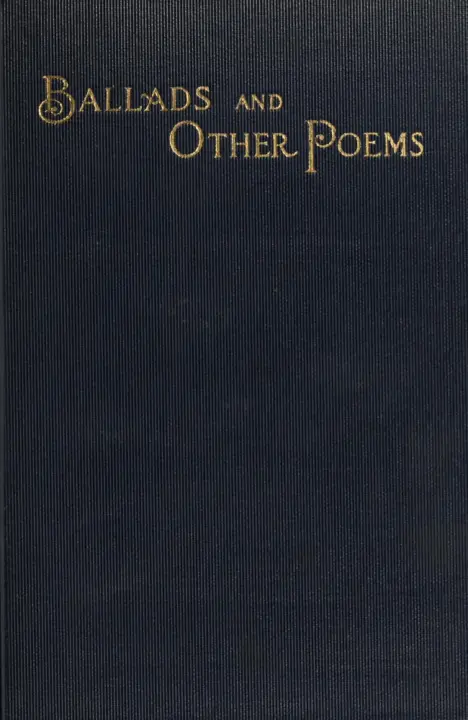
"Ballads and Other Poems" by George Lansing Raymond is a collection of poetry written in the late 19th century. The work features ballads that capture the spirit and events leading to the American War for Independence, showcasing a blend of historical narrative and poetic expression. The opening portion of the collection focuses on the theme of rebellion against British authority, prominently featuring the imposition of the Stamp Act and the colonial response to this taxation without representation. Through a series of poems, Raymond vividly recounts the events surrounding the first break with the British, illustrating both the fervent desires for freedom among the colonists and the emerging unity in their resistance. Characters such as Benjamin Franklin and James Otis are invoked, emphasizing the grassroots movement that fueled the revolution. The energetic tone and compelling historical details invite readers into the emotional landscape of a nation on the brink of independence.
Introduction adapted from the source catalogue; source summaries may be automatically generated.
Free to read · English · 71,627 words · No account needed
MAKE TIME FOR A GOOD BOOK
On by default. Untick to stop anonymous reading totals. Each page counts after 10 seconds in view. How this works.
Anonymous counting is on unless you have switched it off.
So, soon, to draw her thoughts out, baiting mine,
Some slur I dropt, suggested by a church:
It touch’d a theatre. “Extremes,” I said,
“Have met.”
“Extremes have met,” she said, “before!
I take your meaning. Elbert has disclosed—
Not what I am, but what I seem to be
To those who will not view me as I am.
You join their lists?—I hoped for better things.”
“But was it right to keep me ignorant?”
“I hoped it right,” she said, “to keep you wise. What Elbert thought, I knew. With you, had hopes, That she who might not seem so wholly wrong Might better represent a class unknown,—”
“Without design, might represent amiss,” I answer’d. “As for you, however class’d, I fear no class could claim you, all in all. For all rules have exceptions.” “Take but rules For this time,” said she. “Did you ever find That ever, when the seers look forth through heaven, They view there pews and pulpits?—Nay, not so: Yet oft they note a stage and galleries, All throng’d with white-robed hosts attendant there. So these, you see, at times may hint of good.”
“They may,” I said, “but do they, as a rule?”
“Ah, as a rule,” she said, “they hint of life—”
“But mainly life to laugh at or to fear,”
I answer’d.
“When emotion swells and shrinks,
The spirit’s wings are moving,” she replied.
“And that art moves them most, which mirrors most
The life that is, and therefore is the truth.
So often have I heard my father say:
‘We read of truth who spell from nature’s page;
And art can best make out the meanings there;
For ’tis the artist’s thought that finds each form
A form of thought,—imagination’s glass
That views the infinite in the finite fact.
Here moves a man, you say. What see you?—man?—
Nay, nay; that guise material fashions there
The image only of his manliness.
And you can only know his life within,
As from the image you imagine it.
Yon little girl that skips beside the porch,—
I know her, love her, not, save as I pass
Behind that face to reach a region rare
Where dolls are sentient babes, and brothers kings.
And yonder maidens, musing in delight,
I know not, love not, till, in sacrifice,
My spirit seems to yield to their desires,
To wait a watchful servant unto them,
To move with motives that inspire their deeds,
To look through their own eyes and see their views,
And thrill with rhythm when their ear-drums throb;
Then, joining all with all, imagine thus
The movements of their hidden inner moods.
Thus too, through all of life, how know we more?
All things are fitful images alone,
Reflecting glory from the Absolute;
And he who can imagine from the part
What marks the whole, walks in the light of heaven.
Find then a life where every child becomes
Earth’s animated toy of manliness,
Each man the mass from which to mould a god,
And earth the pit whence all heaven’s wealth is mined,
You find for thought a life worth living for,
A life the artist gives us: it is he
Discerns a spirit always veil’d in shape,
A soul in man, and reason everywhere.’”
Your reading position is saved on this browser. Take it to another device with a library code. Reading pages adapt to text, rather than matching a printed edition.
BEHIND THE BOOK
This eBook is for the use of anyone anywhere in the United States and most other parts of the world at no cost and with almost no restrictions whatsoever. You may copy it, give it away or re-use it under the terms of the Project Gutenberg License included with this eBook or online at www.gutenberg.org. If you are not located in the United States, you will have to check the laws of the country where you are located before using this eBook. Read the source licence.
The original source file, including credits and licence, is retained by this library. Request an original-format copy at no charge. Please include the book title and Project Gutenberg identifier #67152.
KEEP YOUR CURIOSITY GOING
Cécile Tormay

Moritz Busch
John L. Ransom
Frances Wright
Cécile Tormay

Mabel Potter Daggett