
The Writing of News A Handbook with Chapters on Newspaper Correspondence and Copy Reading
Charles G. (Charles Griffith) Ross
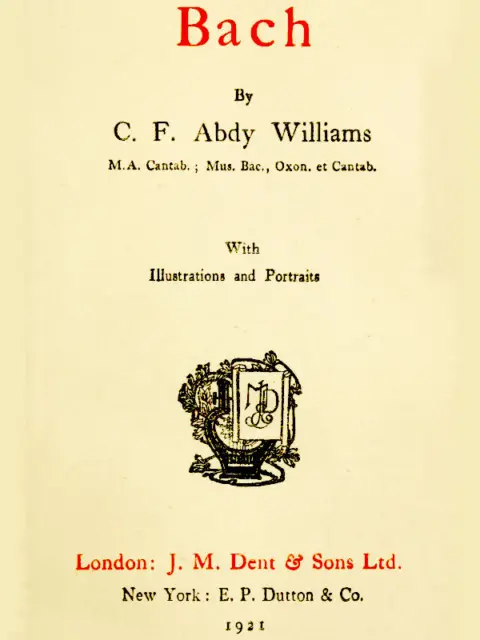
THE CLASSIC COLLECTION · 1900
"Bach" by C. F. Abdy Williams is a comprehensive biography written in the late 19th century. This work chronicles the life and legacy of Johann Sebastian Bach, focusing on both the esteemed musician's family background and his profound contributions to the world of music. It not only highlights his musical compositions but also delves into his personal life and struggles, providing a well-rounded view of his character. The opening of the book introduces the reader to the Bach family tree, tracing their lineage back to the 16th century in Thuringia, a region in Germany known for its musical legacy. C. F. Abdy Williams discusses the unique position of Johann Sebastian Bach within this large family of musicians, detailing his ancestry and the musical roles his forebears played. As the narrative begins, the reader is invited to appreciate the rich history and the cultural environment that shaped Bach into one of the most influential composers in Western music history.
Introduction adapted from the source catalogue; source summaries may be automatically generated.
Free to read · English · 56,536 words · No account needed
MAKE TIME FOR A GOOD BOOK
On by default. Untick to stop anonymous reading totals. Each page counts after 10 seconds in view. How this works.
Anonymous counting is on unless you have switched it off.
“And if the world were full of devils, who would devour us, we need not fear much, for we shall conquer. The prince of this world, however sour he may appear, can do nothing against us: a word is able to slay him,” &c.
[Sidenote: A Notable Chorale]
This is one of the chorales assigned to the Festival of the Reformation, and one can imagine with what force it would appeal to those disposed towards Luther’s teaching. Its well-known melody was composed by Luther, and it was used by Bach as the foundation of a cantata which is considered by Zelter to have been composed in celebration of the 200th anniversary of the Reformation in 1717, but the composer re-arranged it in 1730. The orchestra contains three trumpets, one flute, two oboes, one oboe di caccia, two violins, viola, violoncello, organ and figured bass.
The first chorus set to the words of the first verse has the following vigorous opening, the orchestra playing an independent accompaniment. (For convenience of English readers we quote from Novello’s octavo edition.)
[Music: A stronghold sure our God re-]
[Music:
A stronghold sure our God remains,
A shield and hope unfailing
][57]
This is worked in bold fugato (both chorus and orchestra taking the subject or the counter-subject), for thirty-six bars, which are then repeated, note for note, to the words: “In need His help our freedom gains, o’er all we fear prevailing.”
A short quotation may serve to give some idea of the fulness of the writing and the boldness of the counterpoint, of which the effect, when sung with proper energy, is overwhelming.
[Music: In need his help our freedom gains]
The words “our old malignant foe” follow, with the new fugue subject
[Music: Our old malignant foe]
occupying twenty-four bars.
Then
[Music:
Would fain work us woe
would fain]
&c. treated fugato for twenty bars; and each line is worked in the same
way.
[Sidenote: A Massive Chorus]
The whole chorus is 221 bars in length, and is a masterpiece of massive choral and orchestral writing, in keeping with the sentiment of the words. It opens with three trumpets, drums, violoncello, and organ manual, the pedal being silent for the first twenty-three bars. At the twenty-fourth bar (the first quoted on page 97) the pedal enters with the 16 feet Posaune, and makes a bold canon of eight bars, with the melody played in the highest register of the trumpet. The canon concludes with a drum passage on the dominant; and fresh canons between trumpet and pedal occur at bars 49, 88, 122, 147, 178 and 200.
Your reading position is saved on this browser. Take it to another device with a library code. Reading pages adapt to text, rather than matching a printed edition.
BEHIND THE BOOK
This eBook is for the use of anyone anywhere in the United States and most other parts of the world at no cost and with almost no restrictions whatsoever. You may copy it, give it away or re-use it under the terms of the Project Gutenberg License included with this eBook or online at www.gutenberg.org. If you are not located in the United States, you will have to check the laws of the country where you are located before using this eBook. Read the source licence.
The original source file, including credits and licence, is retained by this library. Request an original-format copy at no charge. Please include the book title and Project Gutenberg identifier #43650.
KEEP YOUR CURIOSITY GOING
Charles G. (Charles Griffith) Ross
Hannah Webster Foster

Emily Lawless
Edwin Hamlin Carr

Charles De Lano Hine
Andrew Ure