
The Writing of News A Handbook with Chapters on Newspaper Correspondence and Copy Reading
Charles G. (Charles Griffith) Ross
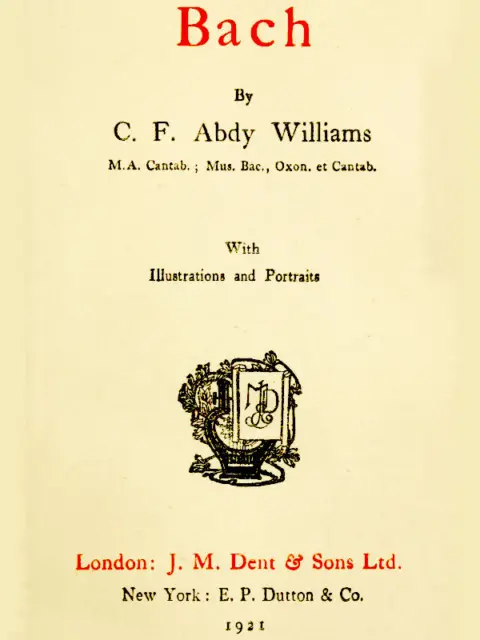
THE CLASSIC COLLECTION · 1900
"Bach" by C. F. Abdy Williams is a comprehensive biography written in the late 19th century. This work chronicles the life and legacy of Johann Sebastian Bach, focusing on both the esteemed musician's family background and his profound contributions to the world of music. It not only highlights his musical compositions but also delves into his personal life and struggles, providing a well-rounded view of his character. The opening of the book introduces the reader to the Bach family tree, tracing their lineage back to the 16th century in Thuringia, a region in Germany known for its musical legacy. C. F. Abdy Williams discusses the unique position of Johann Sebastian Bach within this large family of musicians, detailing his ancestry and the musical roles his forebears played. As the narrative begins, the reader is invited to appreciate the rich history and the cultural environment that shaped Bach into one of the most influential composers in Western music history.
Introduction adapted from the source catalogue; source summaries may be automatically generated.
Free to read · English · 56,536 words · No account needed
MAKE TIME FOR A GOOD BOOK
On by default. Untick to stop anonymous reading totals. Each page counts after 10 seconds in view. How this works.
Anonymous counting is on unless you have switched it off.
The Organs in Leipsic Churches--Bach’s Method of Accompanying--The
Pitch of Organs.
[Sidenote: Thomas Church Organ]
There were two organs in the Thomas Church, the larger of which dated from 1525. In 1721 it was enlarged by Scheibe, a builder of whom Bach had a very good opinion. In 1730 it was again improved, by giving the choir organ a keyboard of its own, instead of its being acted on by the great key-board as was formerly the case.
The organ contained:--
1. Principal (open diapason), 16 ft.
2. Principal (open diapason), 8 „
3. Quintadena, 16 „
4. Octave (our principal), 4 „
5. Quinta, 3 „
6. Superoctava (our fifteenth), 2 „
7. Spiel-Pfeiffe, 8 „
8. Sesquialtera gedoppelt,
9. Mixture, 6, 8 and 10 ranks.
1. Grobgedackt, 8 ft.
2. Principal (open diapason), 4 „
3. Nachthorn, 4 ft.
4. Nasal, 3 „
5. Gemshorn, 2 „
6. Cymbal, 2 ranks.
7. Sesquialtera,
8. Regal, 8 ft.
9. Geigenregal, 4 „
1. Principal, 8 ft.
2. Quintadena 8 „
3. Lieblich Gedacktes, 8 „
4. Klein Gedacktes, 4 „
5. Traversa, 4 „
6. Violino, 2 „
7. Raschquint gedoppelt,
8. Mixtur, 4 ranks.
9. Sesquialtera,
10. Spitzflöt, 4 ft.
11. Schallflöt, 1 „
12. Krumbhorn, 16 „
13. Trommet, 8 „
1. Sub-bass von Metall, 16 ft.
2. Posaune Bass, 16 „
3. Trommeten Bass, 8 „
4. Schalmeyen Bass, 4 „
5. Cornet, 3 „
There were also Tremulant, Vogelgesang, Zimbelstern-Ventils and ten bellows. The organ loft has been twice enlarged, first in 1802, and afterwards in 1823. It now accommodates the whole of the large double chorus and double orchestra employed in performance of the Passion music on Good Friday.
The smaller organ was built in 1489. In Bach’s time it stood in a gallery opposite the large organ. It was of very little use, and in 1740 was sold to St John’s Hospital. It had three manuals, pedal, and twenty-one stops, and was only employed on high festivals. As it was at a considerable distance from the other organ, difficulty was felt in keeping the two choirs together. This gallery remained, and was used for musical purposes, till 1886.
The organ of the Nicolai Church was built in 1598, repaired in 1692, and in 1725 was thoroughly renewed by Scheibe at a cost of 600 thalers.
[Sidenote: Leipsic University Organ]
The organ at the University Church was the best in Leipsic at that
time. It consisted of:--
1. Principal (open diapason), 16 ft.
2. Quintatön, 16 „
3. Principal (open diapason), 8 „
4. Schalmei, 8 „
5. German Flute, 8 „
6. Gemshorn, 8 „
7. Octave, 4 „
8. Quinte, 3 „
9. Quintnasat, 3 „
10. Octavina, 2 „
11. Waldflöte, 2 ft.
12. Mixture, 5 and 6 ranks.
13. Cornet, 3 ranks.
14. Zink, 2 „
1. Principal, 8 ft.
2. Gamba, 8 „
3. Grobgedackt, 8 „
4. Octave, 4 „
5. Rohrflöte, 4 ft.
6. Octave (fifteenth), 2 „
7. Nasat, 2 „
8. Sedesima, 1 „
9. Schweizer Pfeife, 1 „
10. Largo (No. of feet not stated).
11. Mixture, 3 ranks.
12. Clear Cymbal, 2 „
1. Lieblich Gedackt, 8 ft.
2. Quintatön, 8 „
3. Flûte douce, 4 „
4. Quinta Decima, 4 „
5. Decima Nona, 3 „
6. Hohlflöte, 2 „
7. Viola, 2 „
8. Vigesima Nona, 1-1/2 „
9. Weitpfeife, 1 „
10. Mixtur, 3 ranks.
11. Helle Cymbal, 2 ft.
12. Sertin (perhaps serpent), 8 „
1. Principal, 16 ft. 2. Quintatön, 16 „ 3. Octave, 8 „ 4. Octave, 4 „ 5. Quinte, 3 „ 6. Mixtur, 5 and 6 ranks 7. Quinten-bass, 6 ft. 8. Jubal, 8 „ 9. Nachthorn, 4 „ 10. Octave, 2 „ 11. 2nd Principal, 16 „ 12. Sub-bass, 16 „ 13. Posaune, 16 „ 14. Trompete, 8 „ 15. Hohlflöte, 1 „ 16. Mixtur, 4 ranks.
Your reading position is saved on this browser. Take it to another device with a library code. Reading pages adapt to text, rather than matching a printed edition.
BEHIND THE BOOK
This eBook is for the use of anyone anywhere in the United States and most other parts of the world at no cost and with almost no restrictions whatsoever. You may copy it, give it away or re-use it under the terms of the Project Gutenberg License included with this eBook or online at www.gutenberg.org. If you are not located in the United States, you will have to check the laws of the country where you are located before using this eBook. Read the source licence.
The original source file, including credits and licence, is retained by this library. Request an original-format copy at no charge. Please include the book title and Project Gutenberg identifier #43650.
KEEP YOUR CURIOSITY GOING
Charles G. (Charles Griffith) Ross
Hannah Webster Foster

Emily Lawless
Edwin Hamlin Carr

Charles De Lano Hine
Andrew Ure