
The Writing of News A Handbook with Chapters on Newspaper Correspondence and Copy Reading
Charles G. (Charles Griffith) Ross
THE CLASSIC COLLECTION · 1900
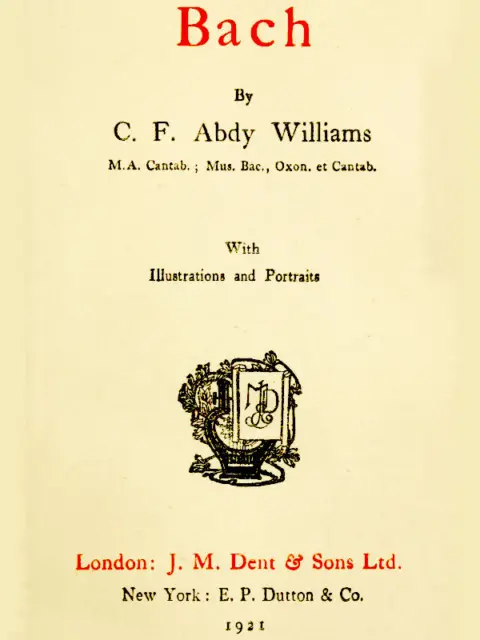
"Bach" by C. F. Abdy Williams is a comprehensive biography written in the late 19th century. This work chronicles the life and legacy of Johann Sebastian Bach, focusing on both the esteemed musician's family background and his profound contributions to the world of music. It not only highlights his musical compositions but also delves into his personal life and struggles, providing a well-rounded view of his character. The opening of the book introduces the reader to the Bach family tree, tracing their lineage back to the 16th century in Thuringia, a region in Germany known for its musical legacy. C. F. Abdy Williams discusses the unique position of Johann Sebastian Bach within this large family of musicians, detailing his ancestry and the musical roles his forebears played. As the narrative begins, the reader is invited to appreciate the rich history and the cultural environment that shaped Bach into one of the most influential composers in Western music history.
Introduction adapted from the source catalogue; source summaries may be automatically generated.
Free to read · English · 56,536 words · No account needed
MAKE TIME FOR A GOOD BOOK
On by default. Untick to stop anonymous reading totals. Each page counts after 10 seconds in view. How this works.
Anonymous counting is on unless you have switched it off.
Johann Bernhard Bach (No. 18), born at Erfurt, was at first organist in his native town, then at Magdeburg and afterwards succeeded Johann Christoph (No. 13) in 1703, as Court and town organist at Eisenach, and was also made Chamber Musician to the Duke of Sax-Eisenach. Of his compositions there remain four suites for orchestra, some small pieces for cembalo and some chorale arrangements. According to Spitta he was one of the most able composers of his time, following the lines of Pachelbel. His orchestral works were so esteemed by John Sebastian that he copied them, and the copies still exist.
Johann Christoph Bach (No. 19) was “Raths-Musikdirector” (Town Council Musical-director) at Erfurt, in succession to Ægidius.
Johann Nicolaus Bach (No. 20), a surgeon, settled in East Prussia, where he brought up a numerous family.
Johann Valentin Bach (No. 21) was town musician and head watchman at
Schweinfurt.
Of Johann Christian Bach (No. 22), and Johann Georg (No. 23), nothing
is known.
Johann Christoph Bach (No. 24), the elder brother of Sebastian, organist and schoolmaster at Ohrdruf, was a pupil of Pachelbel, and appears to have made some reputation as a musician, since he refused an invitation to go to Gotha as organist, on account of an increase of salary being given him at Ohrdruf.[6]
[Sidenote: More of the Family]
Johann Jacob Bach (No. 25) entered the Swedish guard as oboe-player. He followed Charles II. of Sweden, and took part in the battle of Pultawa, and, after a stay at Bender in Turkey, retired to Stockholm as Court musician.
Johann Sebastian Bach (No. 26).
Johann Ernst Bach (No. 27) was organist at Arnstadt, while Johann Christoph Bach (No. 28) went into the grocery trade.
Johann Nicolaus Bach (No. 29) was University and Town organist at Jena, and after having travelled to Italy for study, returned to Jena, where he remained till his death at the age of eighty-four. He was an able composer, of whose works, however, only a mass remains, which is much praised by Spitta.
Johann Christoph Bach (No. 30) taught music in Hamburg, Rotterdam, and
finally in England.
Johann Friedrich Bach (No. 31) succeeded J. Sebastian as organist at Mühlhausen, the only member of his family who is mentioned as unsatisfactory in character, he being given to drink. Gerber calls him by mistake Johann Christoph.
Johann Michael Bach (No. 32) was an organ-builder. He went to Sweden, and all traces of him were lost.
Johann Ludwig Bach (No. 33) held the post of capellmeister to the Duke of Sax-Meiningen. His compositions were highly valued by Johann Sebastian, who copied many of them. Hilgenfeldt distinguishes him as a fine church-composer.
Johann Samuel Bach (No. 34), and Johann Christian Bach (No. 35), settled at Sondershausen as musicians.
Your reading position is saved on this browser. Take it to another device with a library code. Reading pages adapt to text, rather than matching a printed edition.
BEHIND THE BOOK
This eBook is for the use of anyone anywhere in the United States and most other parts of the world at no cost and with almost no restrictions whatsoever. You may copy it, give it away or re-use it under the terms of the Project Gutenberg License included with this eBook or online at www.gutenberg.org. If you are not located in the United States, you will have to check the laws of the country where you are located before using this eBook. Read the source licence.
The original source file, including credits and licence, is retained by this library. Request an original-format copy at no charge. Please include the book title and Project Gutenberg identifier #43650.
KEEP YOUR CURIOSITY GOING
Charles G. (Charles Griffith) Ross
Hannah Webster Foster

Emily Lawless
Edwin Hamlin Carr

Charles De Lano Hine
Andrew Ure