
The Writing of News A Handbook with Chapters on Newspaper Correspondence and Copy Reading
Charles G. (Charles Griffith) Ross
THE CLASSIC COLLECTION · 1900
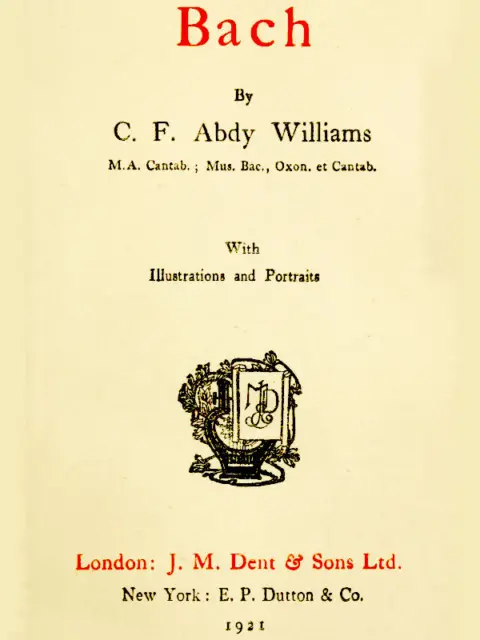
"Bach" by C. F. Abdy Williams is a comprehensive biography written in the late 19th century. This work chronicles the life and legacy of Johann Sebastian Bach, focusing on both the esteemed musician's family background and his profound contributions to the world of music. It not only highlights his musical compositions but also delves into his personal life and struggles, providing a well-rounded view of his character. The opening of the book introduces the reader to the Bach family tree, tracing their lineage back to the 16th century in Thuringia, a region in Germany known for its musical legacy. C. F. Abdy Williams discusses the unique position of Johann Sebastian Bach within this large family of musicians, detailing his ancestry and the musical roles his forebears played. As the narrative begins, the reader is invited to appreciate the rich history and the cultural environment that shaped Bach into one of the most influential composers in Western music history.
Introduction adapted from the source catalogue; source summaries may be automatically generated.
Free to read · English · 56,536 words · No account needed
MAKE TIME FOR A GOOD BOOK
On by default. Untick to stop anonymous reading totals. Each page counts after 10 seconds in view. How this works.
Anonymous counting is on unless you have switched it off.
~Violetta.~ This instrument occurs in the cantata “Herr Gott dich loben wir” as an alternative of the “oboe di caccia.” It is described by Walther as a fiddle (Geige) playing an inner part, constructed like a viola, or small viola da gamba.
~Violino~ piccolo. A small violin whose lowest string was a fourth higher than that of the violin. Its tuning was therefore C, G, D, A, an octave above the viola. It frequently occurs in Bach’s scores.
~Violoncello~ piccolo, with five strings. This instrument occurs in the score of a tenor aria in cantata No. 41, “Jesu nur sei gepreiset.” The additional string was tuned to E, and enabled the performer to execute the very florid high passages which Bach writes.
~Ziegler~, Christiane Mariane von, who wrote words for some of the cantatas was born in 1695 at Leipsic. Began to publish poems when she was fifteen. Left a widow in 1722, she devoted herself to writing poetry and the practice of the keyboard instruments and lute, and flute, and was held in honour by the most artistic society of her time. Spitta gives an account of her life in Curtius’ Historische Aufsätze, 1884. See p. 197.
Index
Abel, Chr. F., 50
„ Karl Friedrich, id.
Accompanying, his method of, 103, 104
Ahle, Johann Georg, 33
Altnikol, Johann C., 170
Anhalt-Cöthen, appointed capellmeister to Prince Leopold of, 48
Arnstadt, appointed organist at, 25;
details of organ at, 26, 27;
troubles with Consistory of, 29-33
“Art of Fugue,” 134, 135
“Bach Choir,” 143
Bach as “Familien-Vater,” 170
Bach Family, 3-18
Bach Gesellschaft, 148
Bach, Maria Barbara, his cousin, 33;
marries her, id.;
her death, 51
Bach Society, English, 142
Bachs of Thuringia, the, 1, 2
Bibliography, 202-204
Birnbaum, his reply to Scheibe’s attack on Bach, 85
Birth, his, 21
Blindness, his, 88
Böhm, becomes a pupil of, 23
Books and instruments, his, 80, 81
Börner, 25
Burial, his place of, 89
Buxtehude, visit to, 28
Cantatas and the chorale, 91
Carlsbad, visit to, 51
Cassel, visit to, 44
Catalogue of Instrumental Works, 191-195
Orchestra, 194, 195
Organ, 191-194
Catalogue of Vocal Works, 177-190
Church Cantatas, 177-188
Funeral Ode, 188
Lost Works, 190
Motets, 188
Secular Cantatas, 189
Cembalo, Clavichord, Spinet, &c., Works for, 196-201
Keyed instruments with accompaniment, 200
Other instruments, 200, 201
Children, his, 57
Choirmaster, as, 171
Christmas Oratorio, the, 144
Clavichord, his favourite instrument, 78
“Clavier, the Wohltemperirte,” 131
Cöthen, appointed capellmeister at, 48;
leaves, 56
Death, his, 89;
notice of in the Leipsic Chronicle, id.
Death of his Father, 21
Death of his first wife, 51
Dresden, competition with Marchand at, 46, 47;
journey to, 46;
plays organ at, 84
Drese, Samuel, 48
Early studies, 22
Easter oratorio, 145
Effler, Johann, 25
Eilmar, G. C., 38
English Bach Society, 142
Erdmann, G., 46
Ernesti, Johann August, 81;
troubles with, 82, 83
Eyesight, failing, 88;
he becomes blind, id.
“Familien-Vater,” Bach as, 170
Fasch, 65
Father, death of his, 21
Figured bass, his method of playing from, 165
Final illness and death, 89;
notice in the Leipsic Chronicle, id.
Your reading position is saved on this browser. Take it to another device with a library code. Reading pages adapt to text, rather than matching a printed edition.
BEHIND THE BOOK
This eBook is for the use of anyone anywhere in the United States and most other parts of the world at no cost and with almost no restrictions whatsoever. You may copy it, give it away or re-use it under the terms of the Project Gutenberg License included with this eBook or online at www.gutenberg.org. If you are not located in the United States, you will have to check the laws of the country where you are located before using this eBook. Read the source licence.
The original source file, including credits and licence, is retained by this library. Request an original-format copy at no charge. Please include the book title and Project Gutenberg identifier #43650.
KEEP YOUR CURIOSITY GOING
Charles G. (Charles Griffith) Ross
Hannah Webster Foster

Emily Lawless
Edwin Hamlin Carr

Charles De Lano Hine
Andrew Ure