
The Writing of News A Handbook with Chapters on Newspaper Correspondence and Copy Reading
Charles G. (Charles Griffith) Ross
THE CLASSIC COLLECTION · 1900
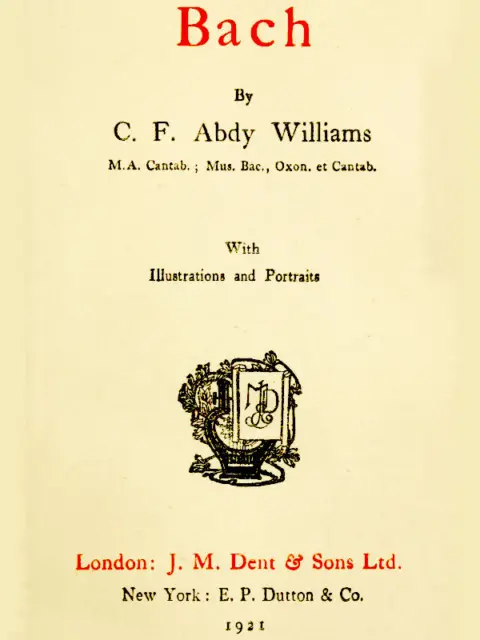
"Bach" by C. F. Abdy Williams is a comprehensive biography written in the late 19th century. This work chronicles the life and legacy of Johann Sebastian Bach, focusing on both the esteemed musician's family background and his profound contributions to the world of music. It not only highlights his musical compositions but also delves into his personal life and struggles, providing a well-rounded view of his character. The opening of the book introduces the reader to the Bach family tree, tracing their lineage back to the 16th century in Thuringia, a region in Germany known for its musical legacy. C. F. Abdy Williams discusses the unique position of Johann Sebastian Bach within this large family of musicians, detailing his ancestry and the musical roles his forebears played. As the narrative begins, the reader is invited to appreciate the rich history and the cultural environment that shaped Bach into one of the most influential composers in Western music history.
Introduction adapted from the source catalogue; source summaries may be automatically generated.
Free to read · English · 56,536 words · No account needed
MAKE TIME FOR A GOOD BOOK
On by default. Untick to stop anonymous reading totals. Each page counts after 10 seconds in view. How this works.
Anonymous counting is on unless you have switched it off.
Fantasia in G minor (215).
Capriccio in E (215). “In honour of J. C. Bach of
Ohrdruf.”
Fantasia con imitazione in B minor (216). It is doubtful whether this is intended for organ or pedal harpsichord.
Sonata in D (216). Modelled on Kuhnau.
Two Fugues in A (216).
Three Minuets (216).
Minuet in G minor (1959).
Adagio and Presto in D minor (1959).
Prelude in E flat (1959).
Fugue in B flat (1959). From a fugue by J. C. Erselius.
Sixty-nine Chorale Melodies with figured bass. Published in
1736.
Of doubtful authenticity (1959):
Sarabande with 16 Partite.
Passacaille in D minor.
Suite in B flat.
Allemande }
Courante } in A.
Gigue }
Fantasia. Through all keys. Attributed to J. D. Heinichen.
Fantasia in G minor. In five movements.
Fantasia and Fugue in D minor.
Fugue in G minor.
Scherzo in D minor.
Andante in G minor.
Fugue in B flat. An extension of a sonata movement in
Reinken’s “Hortus Musicus.”
Fugues--
In C.
„ E minor.
„ (a) E minor.
„ (b) E minor.
Chaconnes--
In A.
Of works not already mentioned, the “Bachgesellschaft” publishes in vol. xlii., Part II., the following apparently authentic compositions:--
Prelude and Fugue in A minor.
Concerto and Fugue in C minor.
Prelude in B minor.
Of more doubtful authenticity:
Fantasia in C minor. Molto allegro.
Toccata quasi fantasia con fuga, A major.
Partie, A major.
Allemande in C minor.
Gigue, F minor.
Allemande and Courante, A major.
Allemande in A minor.
Two Fantasias and Fughettas.
An Unfinished Fugue in E minor.
Concerto in F (248). For clavecin and two flutes concertante, with accompaniment for two violins, viola and bass.
Concerto in G minor (249). For clavecin, with accompaniment for two violins, viola, violoncello and bass.
Concerto in F minor (250). For clavecin, with accompaniment for two violins, viola and bass.
Concerto in D major (251). For clavecin, with accompaniment for two violins, viola and bass.
Concerto in A major (252). For clavecin, with accompaniment for two violins, viola, violoncello and bass.
Concerto in E major (253). For clavecin, with accompaniment for two violins, viola and bass.
Concerto in D minor (254). For clavecin, with accompaniment for two violins, viola and bass. The first allegro is arranged as the introductory symphony of the Cantata, “Wir müssen durch viel Trübsal.”
Concerto in A minor (255). For clavecin, flute and violin, with accompaniment for two violins, viola, violoncello and bass.
Concerto in C (256). For two clavecins, with two violins,
viola and bass.
Concerto in C minor (257). For two clavecins, with two
violins, viola and bass.
Concerto in C minor (257b). For two clavecins, with two violins, viola and bass. Arranged from the concerto for two violins.
Concerto in D minor (258). For three clavecins, with two
violins, viola and bass.
Your reading position is saved on this browser. Take it to another device with a library code. Reading pages adapt to text, rather than matching a printed edition.
BEHIND THE BOOK
This eBook is for the use of anyone anywhere in the United States and most other parts of the world at no cost and with almost no restrictions whatsoever. You may copy it, give it away or re-use it under the terms of the Project Gutenberg License included with this eBook or online at www.gutenberg.org. If you are not located in the United States, you will have to check the laws of the country where you are located before using this eBook. Read the source licence.
The original source file, including credits and licence, is retained by this library. Request an original-format copy at no charge. Please include the book title and Project Gutenberg identifier #43650.
KEEP YOUR CURIOSITY GOING
Charles G. (Charles Griffith) Ross
Hannah Webster Foster

Emily Lawless
Edwin Hamlin Carr

Charles De Lano Hine
Andrew Ure