
The Writing of News A Handbook with Chapters on Newspaper Correspondence and Copy Reading
Charles G. (Charles Griffith) Ross
THE CLASSIC COLLECTION · 1900
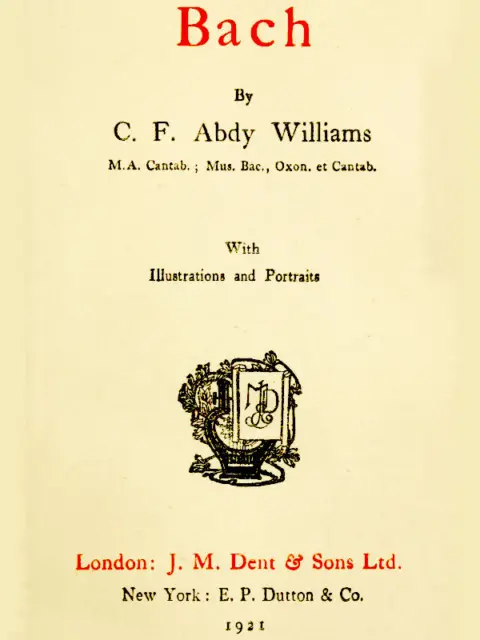
"Bach" by C. F. Abdy Williams is a comprehensive biography written in the late 19th century. This work chronicles the life and legacy of Johann Sebastian Bach, focusing on both the esteemed musician's family background and his profound contributions to the world of music. It not only highlights his musical compositions but also delves into his personal life and struggles, providing a well-rounded view of his character. The opening of the book introduces the reader to the Bach family tree, tracing their lineage back to the 16th century in Thuringia, a region in Germany known for its musical legacy. C. F. Abdy Williams discusses the unique position of Johann Sebastian Bach within this large family of musicians, detailing his ancestry and the musical roles his forebears played. As the narrative begins, the reader is invited to appreciate the rich history and the cultural environment that shaped Bach into one of the most influential composers in Western music history.
Introduction adapted from the source catalogue; source summaries may be automatically generated.
Free to read · English · 56,536 words · No account needed
MAKE TIME FOR A GOOD BOOK
On by default. Untick to stop anonymous reading totals. Each page counts after 10 seconds in view. How this works.
Anonymous counting is on unless you have switched it off.
Ehre sei dir Gott gesungen. Part V. of Christmas oratorio.
English edition, Novello.
Ehre sei Gott in der Höhe. Christmas. Incomplete.
80 Ein feste Burg ist unser Gott. Reformation Festival, English edition, “A Stronghold Sure,” Novello. Composed 1717, when Bach went to Cöthen. This was the first cantata published in the nineteenth century. It was also arranged to Latin words, beginning, “Gaudete, omnes populi.”
134 Ein Herz, das Seinen. Wednesday in Easter Week. Cöthen,
between 1717 and 1723.
24 Ein ungefärbt Gemüthe. Fourth Sunday after Trinity.
136 Erforsche mich Gott, und erfahre. Eighth Sunday after Trinity. Leipsic, 1737 or 1738.
66 Erfreut euch, ihr Herzen! Tuesday in Easter Week.
83 Erfreute Zeit im neuen Bunde. Purification.
126 Erhalt’ uns, Herr, bei deinem Wort. Sexagesima.
Chorale Cantata.
173 Erhöhtes Fleisch und Blut. Tuesday in Whitsun-week. The music was originally written for a Serenade for the birthday of Prince Leopold of Cöthen. The MS. Serenade is in the Royal Library at Berlin.
175 Er rufet seinen Schafen mit. Wednesday in Whitsun-week. Solo Cantata for tenor and bass.
172 Erschallet,ihr Lieder. Whitsunday.
184 Erwünschtes Freudenlicht. Wednesday in Whitsun-week.
19 Es erbub sich ein Streit. Michaelmas Day.
9 Es ist das Heil uns kommen her. Sixth Sunday after
Trinity.
45 Es ist dir gesagt, Mensch, was gut ist. Eighth Sunday
after Trinity.
176 Es ist ein trotzig und verzagt Ding. Trinity Sunday.
108 Es ist euch gut, dass ich hingehe. Fourth Sunday after
Easter (Cantata).
25 Es ist nichts Gesundes an meinem Leibe. Fourteenth Sunday after Trinity. Edition with English words, “Lo, there is no soundness within my body.” Rieter-Biedermann.
90 Es reifet euch ein schrecklich. Twenty-fifth Sunday
after Trinity.
187 Es wartet Alles auf dich. Seventh Sunday after Trinity, 1737. Music is used for Mass in G minor.
Fallt mit Danken. Part IV. of Christmas oratorio. English edition,
Novello.
52 Falsche Welt, dir trau. Twenty-third Sunday after
Trinity. Solo Cantata for soprano.
30 Freue dich, erlöste Schaar. St John’s Day, originally a “Dramma per Musica” in honour of the Saxon Minister, Von Hennicke. Composed in 1737, and arranged as a church cantata, 1738, after Bach had received the title of Court Composer. It is in the “Lombardic” style introduced by Vivaldi, consisting of frequent syncopation.
35 Geist und Seele wird. Twelfth Sunday after Trinity.
129 Gelobet sei der Herr, mein Gott. Trinity Sunday.
91 Gelobet seist du, Jesus Christ. Christmas. Chorale
Cantata. Words by Martin Luther.
18 Gleich wie der Regen und. Sexagesima. The orchestration is unusual, consisting of four violas, fagotto, violoncello and organ.
191 Gloria in excelsis Deo. Christmas. Rearranged from
the B minor Mass.
79 Gott der Herr, ist Sonn’ und Schild. Reformation Festival.
106 Gottes Zeit ist die allerbeste Zeit. For no special season. English edition, “God’s time is the best,” Novello. Called “Actus tragicus,” probably a funeral cantata. Mühlhausen about 1708.
Your reading position is saved on this browser. Take it to another device with a library code. Reading pages adapt to text, rather than matching a printed edition.
BEHIND THE BOOK
This eBook is for the use of anyone anywhere in the United States and most other parts of the world at no cost and with almost no restrictions whatsoever. You may copy it, give it away or re-use it under the terms of the Project Gutenberg License included with this eBook or online at www.gutenberg.org. If you are not located in the United States, you will have to check the laws of the country where you are located before using this eBook. Read the source licence.
The original source file, including credits and licence, is retained by this library. Request an original-format copy at no charge. Please include the book title and Project Gutenberg identifier #43650.
KEEP YOUR CURIOSITY GOING
Charles G. (Charles Griffith) Ross
Hannah Webster Foster

Emily Lawless
Edwin Hamlin Carr

Charles De Lano Hine
Andrew Ure