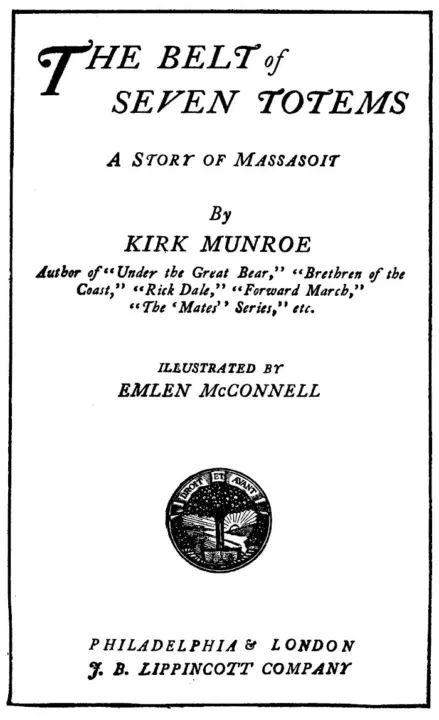
The Belt of Seven Totems: A Story of Massasoit
Kirk Munroe
THE CLASSIC COLLECTION · 1895
"At War with Pontiac; Or, The Totem of the Bear: A Tale of Redcoat and Redskin" by Kirk Munroe is a historical novel written in the late 19th century. The story is set during the tumultuous period of conflict between British colonizers and Native American tribes, focusing on the lives of the Hester family, particularly Major Graham Hester and his son Donald. The narrative unfolds against the backdrop of Pontiac's War, intricately weaving themes of loyalty, cultural clash, and the struggle for survival between the English and indigenous peoples. The opening of the tale introduces Tawtry House, the recent homestead of Major Hester, who, along with his wife, reflects on their newfound life amidst the wilderness of New York. As they enjoy a peaceful summer evening with their two-year-old son, a sudden commotion draws their attention. An injured Ottawa Indian, Songa, fleeing from pursuing warriors, is rescued by Major Hester, setting the stage for future conflicts. This decision marks a crucial turning point for the family and symbolizes the complex relationships that will develop between the characters as the story progresses. The chapter establishes a tense atmosphere with an impending sense of danger, emphasizing the challenges faced by the settlers and the Native Americans during this historical era.
Introduction adapted from the source catalogue; source summaries may be automatically generated.
Free to read · English · 73,534 words · No account needed
MAKE TIME FOR A GOOD BOOK
On by default. Untick to stop anonymous reading totals. Each page counts after 10 seconds in view. How this works.
Anonymous counting is on unless you have switched it off.
When Major Hester slowly and thoughtfully returned to his quarters after witnessing the departure of his son, he found sitting on the doorstep, and patiently awaiting his coming, a Canadian woman. Beside her stood her stolid-looking husband, whom the major recognized as a well-to-do farmer of the settlement, to whom he had granted some trifling favors while in command of the post.
"Good-morning, madame. Good-morning, St. Aubin. To what am I indebted for the honor of this early call? What can I do for you?" asked the old soldier, in answer to the humble salutations with which they greeted his approach.
"Ah! monsieur, we have come," began the woman.
"Certainment, we have come," echoed her husband.
"Jean!"
"Pardon, Marie."
"We have come with despair on account of the previous abounding kindness of monsieur, to divulge him--"
"A secret! A secret terrible!" exploded the old man, who was nervously standing first on one foot and then on the other.
"Jean!"
"Oui, Marie."
"If you have an important secret to confide, had we not better enter the house?" suggested the major, who saw from the excited earnestness of the worthy couple that something very unusual had occurred to agitate them.
They accepted this invitation, and the major finally gleaned from their combined and interjectory statements that on the previous day Madame St. Aubin, visiting the Ottawa village, had surprised a number of warriors in the act of cutting off the long barrels of their guns, until the entire length of each weapon was not more than a yard. Moreover, she had overheard an Indian who was somewhat under the influence of liquor boast that ere many days he would have English scalps with which to fringe his leggings.
"Has any one else seen these things or noted symptoms of uneasiness among the Indians?" demanded the major.
"Yes. Basil, the blacksmith, has been troubled for days by Indians
begging for loans of files and saws, for what purpose they would not
state."
"But why do you not carry this matter to Major Gladwyn, who is in command, instead of to me, who now possess no authority?"
"Because, monsieur, the commandant makes of us a jest and cares not to listen. Aussi, because we care not for him; but to you, monsieur, who have formerly turned many of our sorrows into joys, we wish not that harm should come. For ourselves, we have no fear. The savages will not harm the French. But for the English, whom they love not--well, there it is different."
"You think, then, that the fort is in danger?"
"Of an attack, monsieur. Yes."
"How soon?"
"Who can tell? Perhaps in one week. Perhaps even to-morrow."
Your reading position is saved on this browser. Take it to another device with a library code. Reading pages adapt to text, rather than matching a printed edition.
BEHIND THE BOOK
This eBook is for the use of anyone anywhere in the United States and most other parts of the world at no cost and with almost no restrictions whatsoever. You may copy it, give it away or re-use it under the terms of the Project Gutenberg License included with this eBook or online at www.gutenberg.org. If you are not located in the United States, you will have to check the laws of the country where you are located before using this eBook. Read the source licence.
The original source file, including credits and licence, is retained by this library. Request an original-format copy at no charge. Please include the book title and Project Gutenberg identifier #19223.
KEEP YOUR CURIOSITY GOING
Cécile Tormay

Moritz Busch
Coulson Kernahan
John L. Ransom

Maurice Baring
Frances Wright