
Letters to a Friend, Written to Mrs. Ezra S. Carr, 1866-1879
John Muir
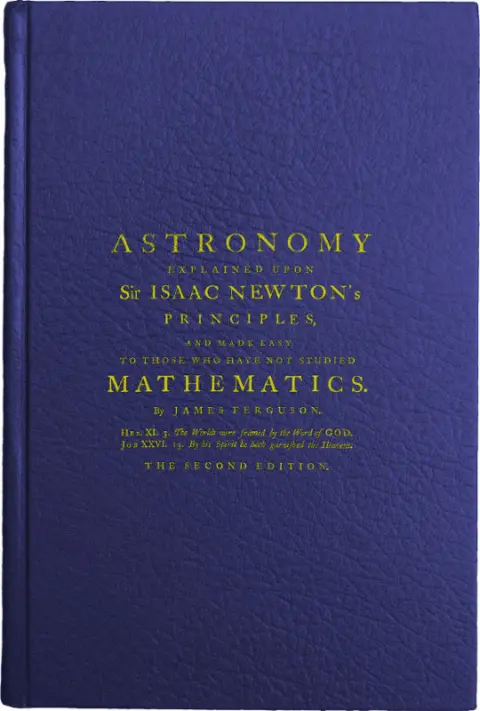
THE CLASSIC COLLECTION · 1756
"Astronomy Explained Upon Sir Isaac Newton's Principles" by James Ferguson is a scientific publication written in the mid-18th century. This work delves into the principles of astronomy as established by Isaac Newton, making complex astronomical concepts accessible to those who lack a mathematical background. The book covers the solar system's structure, the nature of celestial bodies, and various astronomical phenomena, emphasizing the scientific significance and beauty of the universe. The beginning of the book introduces astronomy as the most sublime and useful of sciences, detailing its impact on human understanding and the vastness of the universe. Ferguson aims to convey not only the mechanics of celestial movements but also the grandeur of the cosmos, evoking a sense of wonder about the relationship between humanity and the divine. He emphasizes the infinitude of stars and systems, setting the tone for an exploration of the solar system's structure and properties, which unfolds in subsequent chapters.
Introduction adapted from the source catalogue; source summaries may be automatically generated.
Free to read · English · 129,260 words · No account needed
MAKE TIME FOR A GOOD BOOK
On by default. Untick to stop anonymous reading totals. Each page counts after 10 seconds in view. How this works.
Anonymous counting is on unless you have switched it off.
[Sidenote: Zones.]
199. The broad Space lying between the Tropics, like a girdle surrounding the Globe, is called the torrid Zone, of which the Equator is in the middle, all around. The Space between the Tropic of Cancer and Arctic Circle is called the North temperate Zone. That between the Tropic of Capricorn and the Antarctic Circle, the South temperate Zone. And the two circular Spaces bounded by the Polar Circles are the two Frigid Zones; denominated north or south, from that Pole which is in the center of the one or the other of them.
200. Having acquired this easy branch of knowledge, the learner may proceed to make the following experiment with his terrestrial ball; which will give him a plain idea of the diurnal and annual motions of the Earth, together with the different lengths of days and nights, and all the beautiful variety of seasons, depending on those motions.
[Sidenote: Fig. III.
A pleasant experiment shewing the different lengths of days and nights, and the variety of seasons.
Summer Solstice.]
Take about seven feet of strong wire, and bend it into a circular form, as abcd, which being viewed obliquely, appears elliptical as in the Figure. Place a lighted candle on a table, and having fixed one end of a silk thread K, to the north pole of a small terrestrial Globe H, about three inches diameter, cause another person to hold the wire circle so that it may be parallel to the table, and as high as the flame of the candle I, which should be in or near the center. Then, having twisted the thread as towards the left hand, that by untwisting it may turn the Globe round eastward, or contrary to the way that the hands of a watch move; hang the Globe by the thread within this circle, almost contiguous to it; and as the thread untwists, the Globe (which is enlightened half round by the candle as the Earth is by the Sun) will turn round it’s Axis, and the different places upon it will be carried through the light and dark Hemispheres, and have the appearance of a regular succession of days and nights, as our Earth has in reality by such a motion. As the Globe turns, move your hand slowly so as to carry the Globe round the candle according to the order of the letters abcd, keeping it’s center even with the wire circle; and you will perceive, that the candle being still perpendicular to the Equator will enlighten the Globe from pole to pole in it’s motion round the circle; and that every place on the Globe goes equally through the light and the dark, as it turns round by the untwisting of the thread, and therefore has a perpetual Equinox. The Globe thus turning round represents the Earth turning round it’s Axis; and the motion of the Globe round the candle represents the Earth’s annual motion round the Sun, and shews, that if the Earth’s Orbit had no inclination to it’s Axis, all the days and nights of the year would be equally long, and there would be no different seasons. But now, desire the person who holds the wire to hold it obliquely in the position ABCD, raising the side ♋ just as much as he depresses the side ♑, that the flame may be still in the plane of the circle; and twisting the thread as before, that the Globe may turn round it’s Axis the same way as you carry it round the candle; that is, from west to east, let the Globe down into the lowermost part of the wire circle at ♑, and if the circles be properly inclined, the candle will shine perpendicularly on the Tropic of Cancer, and the frigid Zone, lying within the arctic or north polar Circle, will be all in the light, as in the Figure; and will keep in the light let the Globe turn round it’s Axis ever so often. From the Equator to the north polar Circle all the places have longer days and shorter nights; but from the Equator to the south polar Circle just the reverse. The Sun does not set to any part of the north frigid Zone, as shewn by the candle’s shining on it so that the motion of the Globe can carry no place of that Zone into the dark: and at the same time the south frigid Zone is involved in darkness, and the turning of the Globe brings none of it’s places into the light. If the Earth were to continue in the like part of it’s Orbit, the Sun would never set to the inhabitants of the north frigid Zone, nor rise to those of the south. At the Equator it would be always equal day and night; and as the places are gradually more and more distant from the Equator, towards the arctic Circle, they would have longer days and shorter nights, whilst those on the south side of the Equator would have their nights longer than their days. In this case there would be continual summer on the north side of the Equator, and continual winter on the south side of it.
Your reading position is saved on this browser. Take it to another device with a library code. Reading pages adapt to text, rather than matching a printed edition.
BEHIND THE BOOK
This eBook is for the use of anyone anywhere in the United States and most other parts of the world at no cost and with almost no restrictions whatsoever. You may copy it, give it away or re-use it under the terms of the Project Gutenberg License included with this eBook or online at www.gutenberg.org. If you are not located in the United States, you will have to check the laws of the country where you are located before using this eBook. Read the source licence.
The original source file, including credits and licence, is retained by this library. Request an original-format copy at no charge. Please include the book title and Project Gutenberg identifier #60619.
KEEP YOUR CURIOSITY GOING
John Muir

Asa Gray
Asa Gray

Florence Nightingale
Elizabeth Robins Pennell
Denison Olmsted