
Letters to a Friend, Written to Mrs. Ezra S. Carr, 1866-1879
John Muir
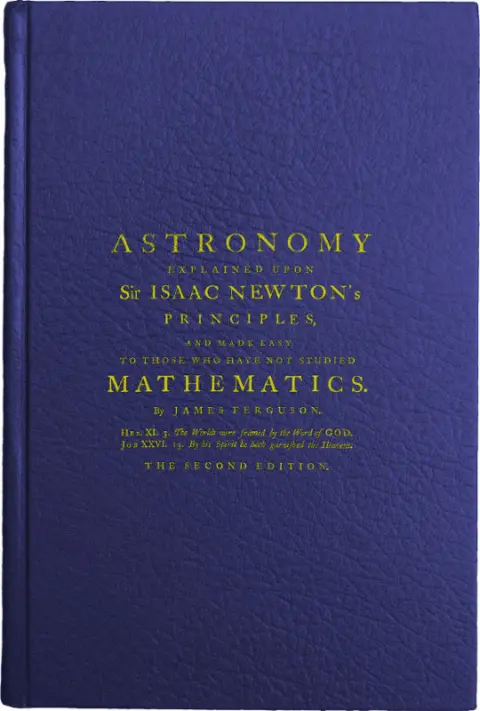
THE CLASSIC COLLECTION · 1756
"Astronomy Explained Upon Sir Isaac Newton's Principles" by James Ferguson is a scientific publication written in the mid-18th century. This work delves into the principles of astronomy as established by Isaac Newton, making complex astronomical concepts accessible to those who lack a mathematical background. The book covers the solar system's structure, the nature of celestial bodies, and various astronomical phenomena, emphasizing the scientific significance and beauty of the universe. The beginning of the book introduces astronomy as the most sublime and useful of sciences, detailing its impact on human understanding and the vastness of the universe. Ferguson aims to convey not only the mechanics of celestial movements but also the grandeur of the cosmos, evoking a sense of wonder about the relationship between humanity and the divine. He emphasizes the infinitude of stars and systems, setting the tone for an exploration of the solar system's structure and properties, which unfolds in subsequent chapters.
Introduction adapted from the source catalogue; source summaries may be automatically generated.
Free to read · English · 129,260 words · No account needed
MAKE TIME FOR A GOOD BOOK
On by default. Untick to stop anonymous reading totals. Each page counts after 10 seconds in view. How this works.
Anonymous counting is on unless you have switched it off.
375. Make a line of Sines equal in length to Ng or Nh, and take off with your Compasses from it the Sine of the Sun’s distance from the nearest Solstice, which in the present case is 77° 51ʹ § 367, and set that distance to the right hand, from N to P, on the line gNh, because the Sun being in Aries § 359, the Earth’s Axis lies to the right hand of the Axis of the Ecliptic § 374: then draw the straight line CXIIP, for the Earth’s Axis and the Universal Meridian; of both which P is the North Pole.
[Sidenote: Path of a given Place on the Disc as seen from the Sun.]
376. To draw the parallel of Latitude of any given Place (suppose London) which parallel is the visible Path of the Place On the Disc, as seen from the Sun, from the time that the Sun rises till it sets; subtract the Latitude of the Place (London) 51-1/2 degrees from 90 degrees, and there remains 38-1/2; which take from the Line of Chords in your Compasses, and set it from h (where the Universal Meridian CP cuts the periphery of the Semi-disc) to VI and VI; and draw the occult Line VILVI. Then, on the left hand of the Earth’s Axis, set off the Chord of the Sun’s Declination 4° 48ʹ 5ʺ § 367, from VI to D and to F; set off the same on the right hand from VI to E and to G; and draw the occult Lines DsE and FXIIG parallel to VI L VI.
[Sidenote: Situation of the Place on the Disk from Sun-rise to Sun-set.]
377. Bisect s XII in K, and through the point K draw the black Line VIKV1 parallel to the occult or dotted Line VILVI. Then, making AC the Radius or length of a Line of Lines, set off the Sine of 38-1/2 degrees, the Co-Latitude of London, from K to VI and VI; and with that extent as a Radius, describe the Semi-Circle VI 7 8 9 &c. and divide it into 12 equal parts, beginning at VI. From these divisions, draw the occult Lines 7m, 8l, 9k, &c. all to the Line VIKVI, and parallel to CXIIP. Then, with KXII as a Radius, describe the Circle abcdef, round the Center K, and divide the Quadrant aXII into six equal parts, as ab, bc, cd, de, &c. Then, through these points of division b, c, d, e, and f, draw the occult Lines VIIbV, VIIIcIIII, IXdIII, &c. intersecting the former Lines 7m, 8l, 9k, 10i, &c. in the points VII, VIII, IX, X, XI, &c. which points mark the situation of London on the Earth’s Disc as seen from the Sun at these hours respectively, from six in the morning till six at night: and if the elliptic Curve VI, VII, VIII, &c. be drawn through these points, it will represent the parallel of London, or the path it seems to describe as viewed from the Sun, from Sun-rise to Sun-set. N.B. When the Sun’s Declination is North, the said Curve is the diurnal Path of London; and the opposite part VIsVI is it’s nocturnal Path behind the Disc, or in the obscure part thereof, § 338, 339. But if the Sun’s Declination had been South, the Curve VIsVI would have been the diurnal path of London; in which case the Lines 7m, 8l, &c. must have been continued thro’ the right Line VIKVI, and their lengths beyond that line determined by dividing the Quadrant s a of the little Circle abcd into six equal parts, and drawing the parallels VIIb, VIIIc &c. through that division, in the same manner as done on the side K XII; and the Curve VII, VIII, IX, &c. would have been the nocturnal Path. It is requisite to divide the hours of the diurnal Path into quarters, as in the Diagram; and if possible into minutes also.
Your reading position is saved on this browser. Take it to another device with a library code. Reading pages adapt to text, rather than matching a printed edition.
BEHIND THE BOOK
This eBook is for the use of anyone anywhere in the United States and most other parts of the world at no cost and with almost no restrictions whatsoever. You may copy it, give it away or re-use it under the terms of the Project Gutenberg License included with this eBook or online at www.gutenberg.org. If you are not located in the United States, you will have to check the laws of the country where you are located before using this eBook. Read the source licence.
The original source file, including credits and licence, is retained by this library. Request an original-format copy at no charge. Please include the book title and Project Gutenberg identifier #60619.
KEEP YOUR CURIOSITY GOING
John Muir

Asa Gray
Asa Gray

Florence Nightingale
Elizabeth Robins Pennell
Denison Olmsted