
Letters to a Friend, Written to Mrs. Ezra S. Carr, 1866-1879
John Muir
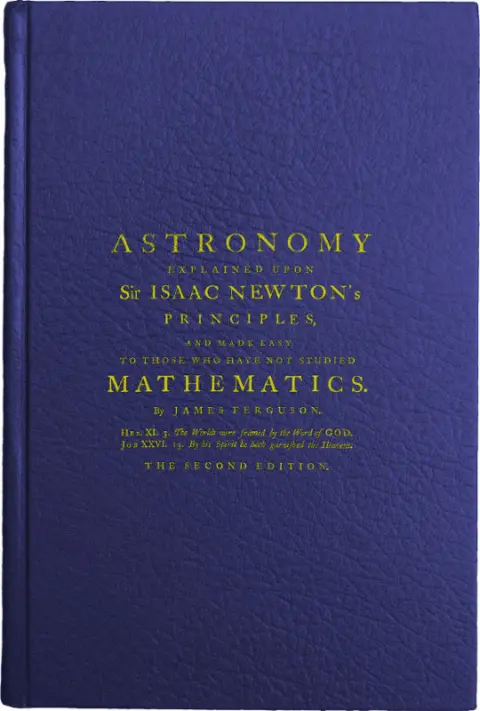
THE CLASSIC COLLECTION · 1756
"Astronomy Explained Upon Sir Isaac Newton's Principles" by James Ferguson is a scientific publication written in the mid-18th century. This work delves into the principles of astronomy as established by Isaac Newton, making complex astronomical concepts accessible to those who lack a mathematical background. The book covers the solar system's structure, the nature of celestial bodies, and various astronomical phenomena, emphasizing the scientific significance and beauty of the universe. The beginning of the book introduces astronomy as the most sublime and useful of sciences, detailing its impact on human understanding and the vastness of the universe. Ferguson aims to convey not only the mechanics of celestial movements but also the grandeur of the cosmos, evoking a sense of wonder about the relationship between humanity and the divine. He emphasizes the infinitude of stars and systems, setting the tone for an exploration of the solar system's structure and properties, which unfolds in subsequent chapters.
Introduction adapted from the source catalogue; source summaries may be automatically generated.
Free to read · English · 129,260 words · No account needed
MAKE TIME FOR A GOOD BOOK
On by default. Untick to stop anonymous reading totals. Each page counts after 10 seconds in view. How this works.
Anonymous counting is on unless you have switched it off.
+------------------------------------------------------------+ | | | Years in which the Harvest-Moons are least beneficial. | | | | N L S | | 1751 1752 1753 1754 1755 1756 1757 1758 1759 | | 1770 1771 1772 1773 1774 1775 1776 1777 1778 | | 1788 1789 1790 1791 1792 1793 1794 1795 1796 1797 | | 1807 1808 1809 1810 1811 1812 1813 1814 1815 | | 1826 1827 1828 1829 1830 1831 1832 1833 1834 | | 1844 1845 1846 1847 1848 1849 1850 1851 1852 | | | | Years in which they are most beneficial. | | | | S M N | | 1760 1761 1762 1763 1764 1765 1766 1767 1768 1769 | | 1779 1780 1781 1782 1783 1784 1785 1786 1787 | | 1798 1799 1800 1801 1802 1803 1804 1805 1806 | | 1816 1817 1818 1819 1820 1821 1822 1823 1824 1825 | | 1835 1836 1837 1838 1839 1840 1841 1842 1843 | | 1853 1854 1855 1856 1857 1858 1859 1860 1861 | +------------------------------------------------------------+
[Sidenote: PL. VIII.]
293. At the Polar Circles, when the Sun touches the Summer Tropic, he continues 24 hours above the Horizon; and 24 hours below it when he touches the Winter Tropic. For the same reason the Full Moon neither rises in Summer, nor sets in Winter, considering her as moving in the Ecliptic. For the Winter Full Moon being as high in the Ecliptic as the Summer Sun, must therefore continue as long above the Horizon; and the Summer Full Moon being as low in the Ecliptic as the Winter Sun, can no more rise than he does. But these are only the two Full Moons which happen about the Tropics, for all the others rise and set. In Summer the Full Moons are low, and their stay is short above the Horizon, when the nights are short, and we have least occasion for Moon-light: in Winter they go high, and stay long, above the Horizon when the nights are long, and we want the greatest quantity of Moon-light.
[Sidenote: The long continuance of Moon-light at the Poles.
Fig. V.]
294. At the Poles, one half of the Ecliptic never sets, and the other half never rises: and therefore, as the Sun is always half a year in describing one half of the Ecliptic, and as long in going through the other half, ’tis natural to imagine that the Sun continues half a year together above the Horizon of each Pole in it’s turn, and as long below it; rising to one Pole when he sets to the other. This would be exactly the case if there were no refraction: but by the Atmosphere’s refracting the Sun’s rays, he becomes visible some days sooner § 183, and continues some days longer in sight than he would otherwise do: so that he appears above the Horizon of either Pole before he has got below the Horizon of the other. And, as he never goes more than 23-1/2 degrees below the Horizon of the Poles, they have very little dark night: it being twilight there as well as at all other places till the Sun be 18 degrees below the Horizon, § 177. The Full Moon being always opposite to the Sun, can never be seen while the Sun is above the Horizon, except when the Moon falls in the northern half of her Orbit; for whenever any point of the Ecliptic rises the opposite point sets. Therefore, as the Sun is above the Horizon of the north Pole from the 20th of March till the 23d of September, it is plain that the Moon, when Full, being opposite to the Sun, must be below the Horizon during that half of the year. But when the Sun is in the southern half of the Ecliptic he never rises to the north Pole, during which half of the year, every Full Moon happens in some part of the northern half of the Ecliptic, which never sets. Consequently, as the polar Inhabitants never see the Full Moon in Summer, they have her always in the Winter, before, at, and after the Full, shining for 14 of our days and nights. And when the Sun is at his greatest depression below the Horizon, being then in Capricorn, the Moon is at her First Quarter in Aries, Full in Cancer, and at her Third Quarter in Libra. And as the beginning of Aries is the rising point of the Ecliptic, Cancer the highest, and Libra the setting point, the Moon rises at her First Quarter in Aries, is most elevated above the Horizon, and Full in Cancer, and sets at the beginning of Libra in her Third Quarter, having continued visible for 14 diurnal rotations of the Earth. Thus the Poles are supplied one half of the winter time with constant Moon-light in the Sun’s absence; and only lose sight of the Moon from her Third to her First Quarter, while she gives but very little light; and could be but of little, and sometimes of no service to them. A bare view of the Figure will make this plain; in which let S be the Sun, e the Earth in Summer when it’s north Pole n inclines toward the Sun, and E the Earth in Winter, when it’s north Pole declines from him. SEN and NWS is the Horizon of the north Pole, which is coincident with the Equator; and, in both these positions of the Earth, ♈♋♎♑ is the Moon’s Orbit, in which she goes round the Earth, according to the order of the letters abcd, ABCD. When the Moon is at a she is in her Third Quarter to the Earth at e, and just rising to the north Pole n; at b she changes, and is at the greatest height above the Horizon, as the Sun likewise is; at c she is in her First Quarter, setting below the Horizon; and is lowest of all under it at d, when opposite to the Sun, and her enlightened side toward the Earth. But then she is full in view to the south Pole p; which is as much turned from the Sun as the north Pole inclines towards him. Thus in our Summer, the Moon is above the Horizon of the north Pole whilst she describes the northern half of the Ecliptic ♈♋♎, or from her Third Quarter to her First; and below the Horizon during the progress through the southern half ♎♑♈; highest at the Change, most depressed at the Full. But in winter, when the Earth is at E, and it’s north Pole declines from the Sun, the New Moon at D is at her greatest depression below the Horizon NWS, and the Full Moon at B at her greatest height above it; rising at her First Quarter A, and keeping above the Horizon till she comes to her Third Quarter C. At a mean state she is 23-1/2 degrees above the Horizon at B and b, and as much below it at D and d, equal to the inclination of the Earth’s Axis F. S♋ and S♑ are, as it were, a ray of light proceeding from the Sun to the Earth; and shews that when the Earth is at e, the Sun is above the Horizon, vertical to the Tropic of Cancer; and when the Earth is at E, he is below the Horizon, vertical to the Tropic of Capricorn.
Your reading position is saved on this browser. Take it to another device with a library code. Reading pages adapt to text, rather than matching a printed edition.
BEHIND THE BOOK
This eBook is for the use of anyone anywhere in the United States and most other parts of the world at no cost and with almost no restrictions whatsoever. You may copy it, give it away or re-use it under the terms of the Project Gutenberg License included with this eBook or online at www.gutenberg.org. If you are not located in the United States, you will have to check the laws of the country where you are located before using this eBook. Read the source licence.
The original source file, including credits and licence, is retained by this library. Request an original-format copy at no charge. Please include the book title and Project Gutenberg identifier #60619.
KEEP YOUR CURIOSITY GOING
John Muir

Asa Gray
Asa Gray

Florence Nightingale
Elizabeth Robins Pennell
Denison Olmsted