
The Writing of News A Handbook with Chapters on Newspaper Correspondence and Copy Reading
Charles G. (Charles Griffith) Ross
THE CLASSIC COLLECTION · 1914
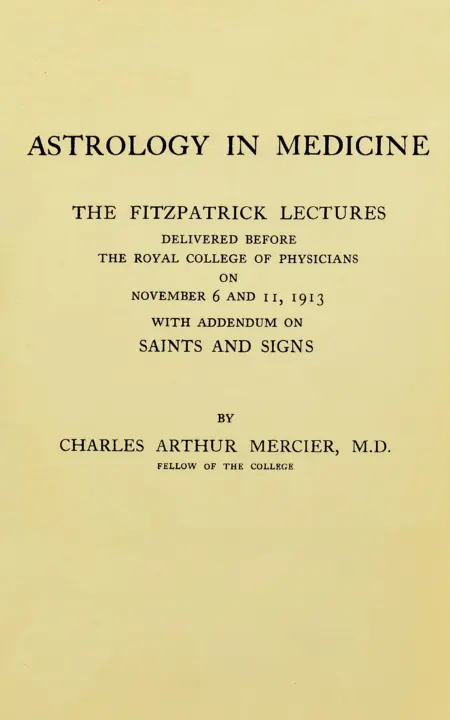
"Astrology in Medicine" by Charles Arthur Mercier is a scholarly lecture series written in the early 20th century. It explores how astrological doctrine was built and why it once seemed indispensable to physicians, laying out its technical system (signs, planets, houses, aspects, and humours) and arguing that it hindered medical progress even as it shaped practice for centuries.
The opening of the work surveys astrology’s vast historical reach and abrupt extinction, then sets out its basic machinery so readers can see how it was meant to guide doctors. Mercier explains the four elemental qualities and the zodiac arranged by triplicities, linking each sign to humours, life stages, and body parts. He introduces the seven traditional planets, their “fortunate” or “unfortunate” character, and their sweeping jurisdictions (including animals, plants, metals), then shows how a planet’s power varies by sign, house, aspect, motion, and hour. He defines the twelve Houses of Heaven and their meanings, details aspects from conjunction to opposition, and notes practical rules like planetary days and hours (tracing the Rx/Jupiter symbol atop prescriptions). To illustrate how an astrologer would reason, he interprets a nativity to predict a warlike career crowned with disaster—an example used to reveal both the system’s internal logic and its arbitrariness.
Introduction adapted from the source catalogue; source summaries may be automatically generated.
Free to read · English · 19,959 words · No account needed
MAKE TIME FOR A GOOD BOOK
On by default. Untick to stop anonymous reading totals. Each page counts after 10 seconds in view. How this works.
Anonymous counting is on unless you have switched it off.
Still, whatever unaccountable prejudices may exist at Rome against the canonisation of this great and good man, I cannot see that we are any nearer a solution of the most important, and indeed vital question, What did men do for patrons before they had saints to fly to? This, gentlemen, is the great and epoch-making discovery that I have to announce to you on this memorable evening. This is the brilliant result of years of laborious research. This is the golden fruit of a lifetime of very insufficiently rewarded toil. Why should I repine that the paltry metal counters that I exhibited at the beginning of this address are so scarce and rare, when I have garnered so abundantly rewards so much more precious? What did men do for patronage and protection before they had saints to place themselves under? Why, this was what they did. Not to keep you in suspense any longer, I will at once reveal that they sought the protection of the Signs of the Zodiac and of the Planets; and as far as it is possible to judge, the protection they obtained therefrom was as ample, as efficient, and as abundant, as that of all the saints in the calendar.
Many centuries before a single saint had been canonised, the system of patronage by the heavenly bodies was completely organised—was, if I may so put it, in full swing; and all the Christian hagiology did was to adopt this system, ousting the heavenly bodies, and filling their places with saints. Long before St Louis, or St Andrew, or that successful commissary St George, was born or thought of, every nation and city of antiquity had its patron Sign. Every calling had its own patron Sign or Planet; every part of the body its patron Sign or Planet: and every illness had a double process of cure, being remediable not only by certain drugs, but according to the position and movement of the Planets among the Signs when the drugs were collected and when they were administered. The series of saints and the series of Signs present a complete parallel, and it is evident that in this as in other things Christianity took advantage of a pre-existing organisation and adapted it to its own uses. It took the institution of patronage by celestial personages, as it took the institution of periodical festivals; emptied them of their previous contents, and filled them with Christian matter, leaving the pagan form unaltered. Thus it took the great annual winter festival, and altered it arbitrarily to Christmas day, pretending that it is the anniversary of the birth of Christ, for which there is not one tittle of evidence; but it could not, or did not, alter the minor weekly festival which still has its name from the greatest of the Planets. In these cases the supersession was either complete or none at all, but in other matters, and especially in the matter of patronage and protection, the struggle was very prolonged, and for ages the two systems of patronage existed side by side; and alongside the priests, who were experts in advising as to the appropriate saint to invoke, were the astrologers, experts in advising the proper conjunction or disposition of the heavenly bodies to wait for before beginning any undertaking or altering any course of action, and also for the purpose of determining whether a course of action was or was not judicious, and calculated to be successful. Between the two sets of practitioners there was a natural jealousy. The Church forbad recourse being had to the aid of Astrology, and threatened excommunication to anyone who consulted the rival expert, just as at present the orthodox physician boycotts the homœopath. On the other hand the astrologer, who was often an infidel, often a Jew or an Arab, despised and ridiculed the pretensions of the saints. Whatever faith, or want of faith, either sect had in its own ministrations, neither was without an uneasy feeling that the other might, after all, have something in it. The astrologers were not above invoking the aid of the saints in their own personal difficulties, and the very Popes who issued bulls fulminating against Astrology and its practitioners, yet kept their own private astrologers, whom they consulted on the sly. In spite of their mutual antagonism, however, the two systems existed side by side for many centuries, and neither can boast of a complete triumph over the other. Astrology is dead, it is true, but in Protestant countries the invocation of saints perished long before its rival, and the influence of the heavenly bodies was consulted by very many who would have scorned to invoke a saint.
Your reading position is saved on this browser. Take it to another device with a library code. Reading pages adapt to text, rather than matching a printed edition.
BEHIND THE BOOK
This eBook is for the use of anyone anywhere in the United States and most other parts of the world at no cost and with almost no restrictions whatsoever. You may copy it, give it away or re-use it under the terms of the Project Gutenberg License included with this eBook or online at www.gutenberg.org. If you are not located in the United States, you will have to check the laws of the country where you are located before using this eBook. Read the source licence.
The original source file, including credits and licence, is retained by this library. Request an original-format copy at no charge. Please include the book title and Project Gutenberg identifier #78150.
KEEP YOUR CURIOSITY GOING
Charles G. (Charles Griffith) Ross
Hannah Webster Foster

Emily Lawless
Edwin Hamlin Carr

Charles De Lano Hine
Andrew Ure