
The Writing of News A Handbook with Chapters on Newspaper Correspondence and Copy Reading
Charles G. (Charles Griffith) Ross
THE CLASSIC COLLECTION · 1914
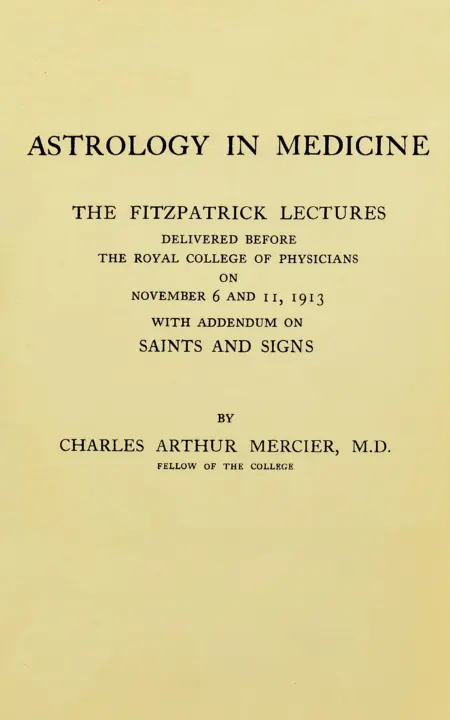
"Astrology in Medicine" by Charles Arthur Mercier is a scholarly lecture series written in the early 20th century. It explores how astrological doctrine was built and why it once seemed indispensable to physicians, laying out its technical system (signs, planets, houses, aspects, and humours) and arguing that it hindered medical progress even as it shaped practice for centuries.
The opening of the work surveys astrology’s vast historical reach and abrupt extinction, then sets out its basic machinery so readers can see how it was meant to guide doctors. Mercier explains the four elemental qualities and the zodiac arranged by triplicities, linking each sign to humours, life stages, and body parts. He introduces the seven traditional planets, their “fortunate” or “unfortunate” character, and their sweeping jurisdictions (including animals, plants, metals), then shows how a planet’s power varies by sign, house, aspect, motion, and hour. He defines the twelve Houses of Heaven and their meanings, details aspects from conjunction to opposition, and notes practical rules like planetary days and hours (tracing the Rx/Jupiter symbol atop prescriptions). To illustrate how an astrologer would reason, he interprets a nativity to predict a warlike career crowned with disaster—an example used to reveal both the system’s internal logic and its arbitrariness.
Introduction adapted from the source catalogue; source summaries may be automatically generated.
Free to read · English · 19,959 words · No account needed
MAKE TIME FOR A GOOD BOOK
On by default. Untick to stop anonymous reading totals. Each page counts after 10 seconds in view. How this works.
Anonymous counting is on unless you have switched it off.
Of course, in those days as in these, the fee had to be considered. Guineas had not then been coined, and payment was usually made in candles, burnt at the shrine of the saint, a mode of remuneration that, for my own part, I am glad to say has been abandoned. This method of payment was rather after that of the sister profession than of modern medicine. The saint had a number of candles marked on his brief, as it were, and unless the retainer was satisfactory, he refused to look at the papers. No doubt there were needy saints, not too scrupulous, who would undertake any case for a candle or two, whether they were qualified to treat it or not; just as now there are sixpenny doctors, and surgeons who will undertake a case of mental disease; but it is to be hoped that the leaders of the profession had more conscience, and that a saint who specialised on blindness, for instance, would no more undertake a dislocation or a fracture than a Chancery leader would undertake the defence of a prisoner at the Old Bailey, or a reputable surgeon would treat a patient suffering from mental disorder.
So far, then, our mediæval ancestors were thoroughly well provided with patrons. There was scarcely any occasion in life that had not a saint who had specialised in its requirements and was ready to supply them for a consideration—for a sufficient number of candles. But it is evident that such a complete equipment of saints could not have been suddenly, nor even rapidly constituted. It must have been the growth of years and of generations; and moreover, we must remember that there was a time, at the beginning of the Christian era, when, though sins were very many, saints were very few, and until the large additions made to the noble army of martyrs in the reign of Diocletian, there could not possibly have been saints enough to go round; and if we go further back, and recede from the penumbra of early A.D. to the outer darkness of B.C., we enter a benighted world in which there were no saints at all. The prospect appals! We might almost as well contemplate a world in which there were no barristers. The question presents itself, and presses upon us with irresistible force—What did our unhappy ancestors do in a world in which there were no saints? It is clear that patrons or protectors of some kind they must have had, for in pre-Christian, no more than in mediæval times, was there any conviction or knowledge of the operation of natural laws. How do we know this? We have it on unexceptionable authority. A contemporary writer, who is generally believed to have been inspired, asserts ‘He hath not dealt so with any nation, neither have the heathen any knowledge of his laws.’ Consequently, there was the same lack of any rule or governance in the happening of events. Everything went by chance, according as the devil or the saints were paying attention, or got the upper hand at the moment. But there were no saints. Hence it would appear that the devil must have had it all his own way, and that the affairs of men must have been uniformly and invariably unfortunate. But they were not, for man survived. He not only survived, but he prospered and flourished. He increased and multiplied exceedingly. Men organised themselves into great nations, built great cities, and were subject to mighty kings. Egypt, Nineveh, Babylon, Assyria, Persia, the Empire of India and the greater Empire of China, all attest that, long before there were saints to interest themselves in him, man succeeded, somehow or other, in antagonising the devil and getting the better of him. It is of the utmost interest and importance to discover how he did this, and what were the means that he employed; and this brings me to the middle of my song, and the second part of my paper. I am now done with Saints. It is clear that they were not as indispensable as they made themselves out; and—I say it with reluctance, but—I have grave doubts whether they did not lay claim, if not to powers they did not possess, at any rate to the exclusive possession of powers by no means peculiar to them. We know, indeed, that on one historical occasion, St Dunstan did seize the devil by the nose with a pair of tongs; and we are told, on less unimpeachable authority, but we are told, that St Nicholas kicked him on a place which is described as being near the spot where the tail joins on to the small of the back; but with these exceptions, though he was constantly outwitted, and indeed he appears to be a kind of Simple Simon, easily gulled by the most transparent device, and no more astute than the victims of the confidence trick—with these exceptions, I say, there are few, if any, records of personal encounters with the devil till we come down to Martin Luther; and Martin Luther was not a saint. He was never, I understand, canonised, and I am informed on good authority, in reply to inquiry made in the highest quarters, that any application to Rome for his canonisation would have little or no chance of success.
Your reading position is saved on this browser. Take it to another device with a library code. Reading pages adapt to text, rather than matching a printed edition.
BEHIND THE BOOK
This eBook is for the use of anyone anywhere in the United States and most other parts of the world at no cost and with almost no restrictions whatsoever. You may copy it, give it away or re-use it under the terms of the Project Gutenberg License included with this eBook or online at www.gutenberg.org. If you are not located in the United States, you will have to check the laws of the country where you are located before using this eBook. Read the source licence.
The original source file, including credits and licence, is retained by this library. Request an original-format copy at no charge. Please include the book title and Project Gutenberg identifier #78150.
KEEP YOUR CURIOSITY GOING
Charles G. (Charles Griffith) Ross
Hannah Webster Foster

Emily Lawless
Edwin Hamlin Carr

Charles De Lano Hine
Andrew Ure