THE CLASSIC COLLECTION✦An outlaw’s diary: the CommuneCLASSIC FREE BOOKS
An outlaw’s diary: the Commune
Cécile Tormay
THE CLASSIC COLLECTION · 1906
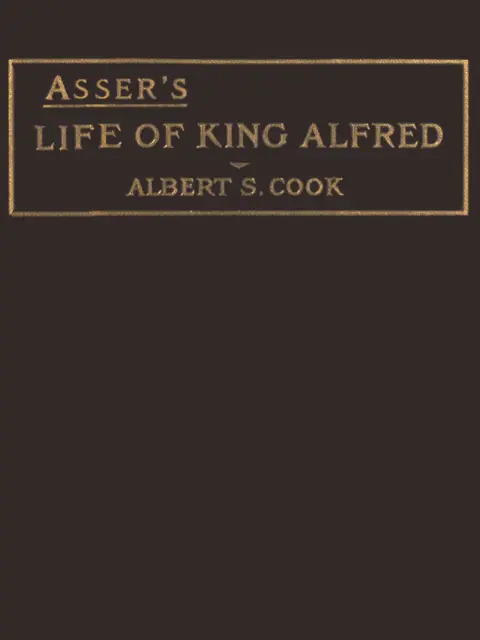
"Asser's Life of King Alfred" by John Asser is a biography written in 893. A Welsh monk recruited to Alfred the Great's scholarly court, Asser composed the only substantial contemporary account of England's legendary king. This work reveals Alfred's character, achievements, and daily life in remarkable detail—information unavailable for any other early English ruler. Though the original manuscript perished in a 1731 fire, earlier transcriptions preserved this invaluable portrait. The biography's authenticity has sparked debate, but scholars now widely accept it as genuine.
Introduction adapted from the source catalogue; source summaries may be automatically generated.
Free to read · English · 25,696 words · No account needed
MAKE TIME FOR A GOOD BOOK
On by default. Untick to stop anonymous reading totals. Each page counts after 10 seconds in view. How this works.
Anonymous counting is on unless you have switched it off.
[101] Among the Germans there were Colonies (Scholæ) of the Frisians, Franks, and Lombards, as well as of the Saxons.
[102] Now Santo Spirito in Sassia, near the Vatican.
[103] From the Chronicle.
[104] The valley of the Clyde.
[105] Here spelled Gothrum.
[106] From the Chronicle.
[107] Chiefly from the Chronicle.
[108] In Dorsetshire.
[109] Dorchester.
[110] For the usual Dornsæte.
[111] Here the Chronicle has ‘on the holy arm-ring,’ on which the Danes, it would seem, were accustomed to swear.
[112] Here the Chronicle has: ‘They, the mounted army, stole away from the fierd [the English forces] in the night into Exeter.’ This, of course, is the true account, while the statement in Asser is incredible.
[113] Exe.
[114] From the Chronicle.
[115] See chap. 46.
[116] Largely from the Chronicle.
[117] At this point Archbishop Parker interpolated, from the Annals of St. Neots, the story of Alfred and the cakes. This story, however, cannot be proved to antedate the Norman Conquest.
[118] The first clause from the Chronicle; the rest original.
[119] Name unknown.
[120] Hingwar.
[121] Or South Wales. See chap. 80.
[122] Site unknown.
[123] Mostly from the Chronicle.
[124] In Somersetshire.
[125] Unknown.
[126] Or perhaps better, Iglea; see Stevenson’s note on the word, p. 270 of his edition. He says: ‘It is probably an older name of Southleigh Wood, or of part of it.’
[127] Based upon the Chronicle.
[128] In Wiltshire.
[129] Supplied by Stevenson from the Chronicle.
[130] Properly, as one of thirty, according to the Chronicle.
[131] Chrism is the term employed for the mixture of oil and balsam employed in the rite of confirmation, and sometimes for the ceremony of confirmation itself. In the early church, this ceremony immediately followed baptism, and was performed by the laying on of hands. In the Roman church it is obligatory on all Catholics, and no baptism is theoretically complete without it. It is performed by a bishop (only exceptionally by a priest). The ceremony begins with the bishop’s rising and facing the person or persons to be confirmed, his pastoral staff in his hand, and saying: ‘May the Holy Ghost come upon you, and the power of the Holy Ghost keep you from sins’ (Handbook to Christian and Ecclesiastical Rome: Liturgy in Rome, London, 1897, pp. 169–171). The rite is described in Egbert’s Pontifical, which may be taken as representing the custom in the church of Alfred’s time. Lingard says (Anglo-Saxon Church, London, 1858, 1. 297): ‘According to that pontifical, the bishop prayed thus: “Almighty and Everlasting God, who hast granted to this thy servant to be born again of water and the Holy Ghost, and hast given to him remission of his sins, send down upon him thy sevenfold Holy Spirit, the Paraclete from heaven, Amen. Give to him the spirit of wisdom and understanding, Amen--the spirit of counsel and fortitude, Amen--the spirit of knowledge and piety, Amen. Fill him with the spirit of the fear of God and our Lord Jesus Christ, and mercifully sign him with the sign of the holy cross for life eternal.” The bishop then marked his forehead with chrism, and proceeded thus: “Receive this sign of the holy cross with the chrism of salvation in Christ Jesus unto life eternal.” The head was then bound with a fillet of new linen to be worn seven days, and the bishop resumed: “O God, who didst give thy Holy Spirit to thine apostles, that by them and their successors he might be given to the rest of the faithful, look down on the ministry of our lowliness, and grant that into the heart of him whose forehead we have this day anointed, and confirmed with the sign of the cross, thy Holy Spirit may descend; and that, dwelling therein, he may make it the temple of his glory, through Christ our Lord.” The confirmed then received the episcopal blessing, and communicated during the mass.’
Your reading position is saved on this browser. Take it to another device with a library code. Reading pages adapt to text, rather than matching a printed edition.
BEHIND THE BOOK
This eBook is for the use of anyone anywhere in the United States and most other parts of the world at no cost and with almost no restrictions whatsoever. You may copy it, give it away or re-use it under the terms of the Project Gutenberg License included with this eBook or online at www.gutenberg.org. If you are not located in the United States, you will have to check the laws of the country where you are located before using this eBook. Read the source licence.
The original source file, including credits and licence, is retained by this library. Request an original-format copy at no charge. Please include the book title and Project Gutenberg identifier #63384.
KEEP YOUR CURIOSITY GOING
Cécile Tormay

Moritz Busch
John L. Ransom
Frances Wright
Cécile Tormay

Mabel Potter Daggett