THE CLASSIC COLLECTION✦An outlaw’s diary: the CommuneCLASSIC FREE BOOKS
An outlaw’s diary: the Commune
Cécile Tormay
THE CLASSIC COLLECTION · 1906
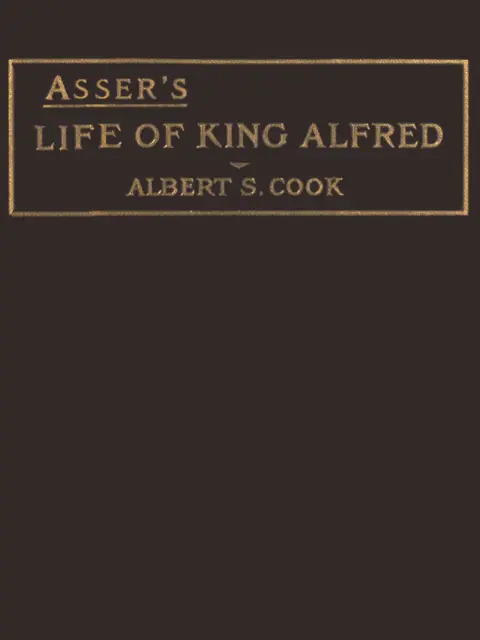
"Asser's Life of King Alfred" by John Asser is a biography written in 893. A Welsh monk recruited to Alfred the Great's scholarly court, Asser composed the only substantial contemporary account of England's legendary king. This work reveals Alfred's character, achievements, and daily life in remarkable detail—information unavailable for any other early English ruler. Though the original manuscript perished in a 1731 fire, earlier transcriptions preserved this invaluable portrait. The biography's authenticity has sparked debate, but scholars now widely accept it as genuine.
Introduction adapted from the source catalogue; source summaries may be automatically generated.
Free to read · English · 25,696 words · No account needed
MAKE TIME FOR A GOOD BOOK
On by default. Untick to stop anonymous reading totals. Each page counts after 10 seconds in view. How this works.
Anonymous counting is on unless you have switched it off.
[59] The liberal arts were seven, consisting of the trivium--grammar, logic, and rhetoric--and the quadrivium--arithmetic, geometry, music, and astronomy. This course of study was introduced in the sixth century. Asser here employs the singular, artem, which might be translated by ‘education.’
[60] See Alfred’s own statement in Appendix I, p. 69.
[61] Original.
[62] Alfred says (Preface to the Pastoral Care): ‘Thanks be to Almighty God that we have any teachers among us now.’ In this same Preface he mentions, among those who aided him in the translation, Archbishop Plegmund, Bishop Asser, our author, and the two priests Grimbold and John. Cf. chaps. 77, 78, 79, 81, 88, and Appendix I, p. 71.
[63] Stevenson brackets this clause.
[64] Mostly from the Chronicle.
[65] This clause must refer to the first line of the chapter, as there is no previous mention of the Northumbrians.
[66] From the Chronicle.
[67] Original.
[68] ‘Subarravit, formed from sub and arrha, represents literally the English verb wed, which refers to the giving of security upon the engagement of marriage.... [It] is glossed by beweddian in Napier’s Old English Glosses’ (Stevenson).
[69] William of Malmesbury calls her Æthelswith.
[70] Of the Gaini nothing is known.
[71] Largely from the Chronicle.
[72] ‘A compound of tig (Modern Welsh tŷ, “house”), and guocobauc (Modern Welsh gogofawg), an adjective derived from gogof, “cave.” ... The name ... is certainly applicable to Nottingham, which has long been famous for the houses excavated out of the soft sandstone upon which it stands’ (Stevenson). The word Nottingham itself, however, has not this meaning.
[73] Here and elsewhere in the text often spelled Æthered.
[74] From the Chronicle.
[75] In Norfolk.
[76] Mostly from the Chronicle.
[77] Chiefly from the Chronicle.
[78] Five and one-half miles southwest of Reading.
[79] Added from Florence of Worcester by Stevenson.
[80] Chiefly from the Chronicle.
[81] The Berkshire Downs (Stevenson).
[82] Stevenson is convinced that Æscesdun, though interpreted as ‘mons fraxini,’ cannot mean ‘the hill of the ash,’ but that Ash is here a man’s name.
[83] Perhaps mediam is a scribal error for unam or primam
(Stevenson).
[84] There is a note on the Germanic shield-wall in my edition of Judith (305ª), in the Belles Lettres Series.
[85] All original except final clause.
[86] Supplied by Stevenson from Florence of Worcester.
[87] Mostly original.
[88] Probably Reading.
[89] From the Chronicle.
[90] Before this sentence occurs the following in the Latin: Quibus cum talia præsentis vitæ dispendia alienigenis perperam quærentibus non sufficerent. This may represent a sentence in the author’s draft that was intended, owing to change of construction, to be omitted (Stevenson).
[91] In Hampshire.
[92] Mostly from the Chronicle.
[93] In Dorsetshire.
[94] Paraphrased and amplified from the Chronicle.
[95] A tributary of the Nadder, which it joins near Wilton.
[96] Or, perhaps, ‘fewness,’ reading paucitatem for peraudacitatem
(Stevenson).
[97] Mostly from the Chronicle.
[98] From the Chronicle.
[99] Chiefly from the Chronicle.
[100] In Derbyshire.
Your reading position is saved on this browser. Take it to another device with a library code. Reading pages adapt to text, rather than matching a printed edition.
BEHIND THE BOOK
This eBook is for the use of anyone anywhere in the United States and most other parts of the world at no cost and with almost no restrictions whatsoever. You may copy it, give it away or re-use it under the terms of the Project Gutenberg License included with this eBook or online at www.gutenberg.org. If you are not located in the United States, you will have to check the laws of the country where you are located before using this eBook. Read the source licence.
The original source file, including credits and licence, is retained by this library. Request an original-format copy at no charge. Please include the book title and Project Gutenberg identifier #63384.
KEEP YOUR CURIOSITY GOING
Cécile Tormay

Moritz Busch
John L. Ransom
Frances Wright
Cécile Tormay

Mabel Potter Daggett