THE CLASSIC COLLECTION✦White Lotus, the legend of the cat’s eyeCLASSIC FREE BOOKS
White Lotus, the legend of the cat’s eye
Carlo de Fornaro
THE CLASSIC COLLECTION · 1902
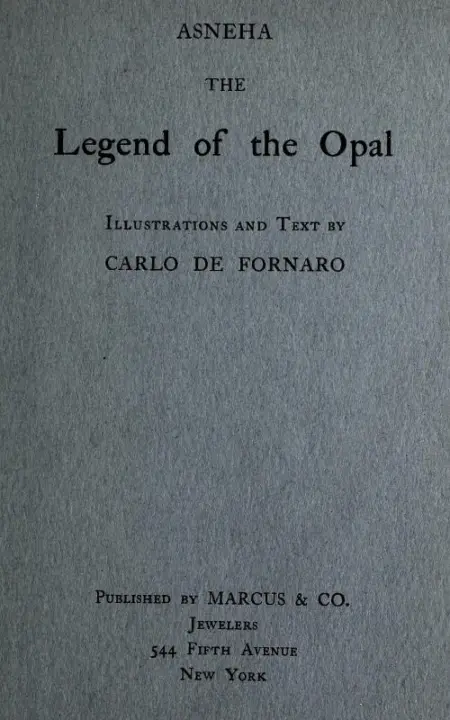
"Asneha, the Legend of the Opal" by Carlo de Fornaro is a fantastical tale likely crafted in the early 20th century. This enchanting novel merges elements of folklore and mythology, focusing on a gifted musician and poet named Asneha, whose profound connection to music and spirituality leads him on an extraordinary journey. The story elegantly explores themes of devotion, the power of art, and the transcendent nature of music. The narrative centers around Asneha, a poor musician who, after losing his flute, encounters a mystical Golden Bird that gifts him the ability to create divine music from reeds in the jungle. His enchanting melodies draw audiences and ultimately reach the Maharajah, who is captivated by Asneha's skill. Asneha's fame attracts the attention of the gods, culminating in an encounter with Indra, the ruler of the gods. Asneha must showcase his talent before them, resulting in a powerful and emotive performance that earns him immortality and the legendary opal, a gem embodying all harmonies. The story is a lyrical exploration of the intersections between art, spirituality, and the divine, highlighting how music has the power to connect mortals with the celestial.
Introduction adapted from the source catalogue; source summaries may be automatically generated.
Free to read · English · 1,869 words · No account needed
MAKE TIME FOR A GOOD BOOK
On by default. Untick to stop anonymous reading totals. Each page counts after 10 seconds in view. How this works.
Anonymous counting is on unless you have switched it off.
One by one, as do the reeds after the violent gust of wind has blown over, they raised themselves, but not quite so erect as before. The musicians approached him humbly, and breaking their instruments, threw them at his feet, salaaming and promising never to play again from that day on.
Then Rajah Nila spoke: “Oh Asneha! Thou art indeed a great musician, and thou shalt be rewarded as befits a king; my riches, my kingdom, my daughter, are thine for thy choosing!”
“Oh, Rajah!” answered Asneha, “I am only a poor man and a musician by divine grace, but I am not a beggar, and have no desire for thy kingly gifts and thy fair daughter!”
The astonished Nila replied: “Assuredly thou art richer than am I, for thou art freed of all desires! But let me be a beggar for once, and entreat thee for another song!”
One day Pavana, the messenger of the gods, appeared to Asneha mounted on his white antelope, a flag in one hand, in the other an arrow, with a command from Indra to present himself immediately to the gods. So he mounted the antelope, and in less time than it takes to think it, he was carried to the eastern spur of the great Mount Meru, which is Swargra, in the City of Asmaravati, the heaven of Indra. All the gods had assembled there. Above all towered the great and mighty Indra, the Ruler of the gods and Lord of the Firmament, mounted on his elephant Airavata, at his right his dog Surana, and at his left his wife Indrani. Farther to the left was Surya, the god of the Sun, on his winged horse Tarkshya. Agni, the god of Fire, on a blue ram, and Varuna, the god of Waters, on his terrible Makara.
At Indra’s right was Yama, the god of Death, on a blue buffalo, with his twin sisters, the Yamunis, at their feet, the Sarameyas, their faithful watchdogs.
On Yama’s right was Kuvera, the god of Wealth, with his sister Kuveri, in their aerial car of jeweled lapis-lazuli.
Then Soma, the god of the Moon, on a white antelope, and Mangala, the god
of War.
Also the goddess of Love, Radha, and all the lesser gods in magnificent array, in all their splendor, in all their beauty and power, watching silently Asneha.
Indra patted Airavata, and then spoke:
“Oh Asneha! Thou hast conquered the world with thy songs, and thou hast boasted to conquer the gods too! Now make thy boast good, or thou shalt go into the keeping of Yama!”
Your reading position is saved on this browser. Take it to another device with a library code. Reading pages adapt to text, rather than matching a printed edition.
BEHIND THE BOOK
This eBook is for the use of anyone anywhere in the United States and most other parts of the world at no cost and with almost no restrictions whatsoever. You may copy it, give it away or re-use it under the terms of the Project Gutenberg License included with this eBook or online at www.gutenberg.org. If you are not located in the United States, you will have to check the laws of the country where you are located before using this eBook. Read the source licence.
The original source file, including credits and licence, is retained by this library. Request an original-format copy at no charge. Please include the book title and Project Gutenberg identifier #62512.
KEEP YOUR CURIOSITY GOING
Coulson Kernahan

Maurice Baring
Frances Wright
Cécile Tormay
Francis Greenleaf Allinson & Anne C. E. (Anne Crosby Emery) Allinson

Frederic Jesup Stimson