THE CLASSIC COLLECTION✦White Lotus, the legend of the cat’s eyeCLASSIC FREE BOOKS
White Lotus, the legend of the cat’s eye
Carlo de Fornaro
THE CLASSIC COLLECTION · 1902
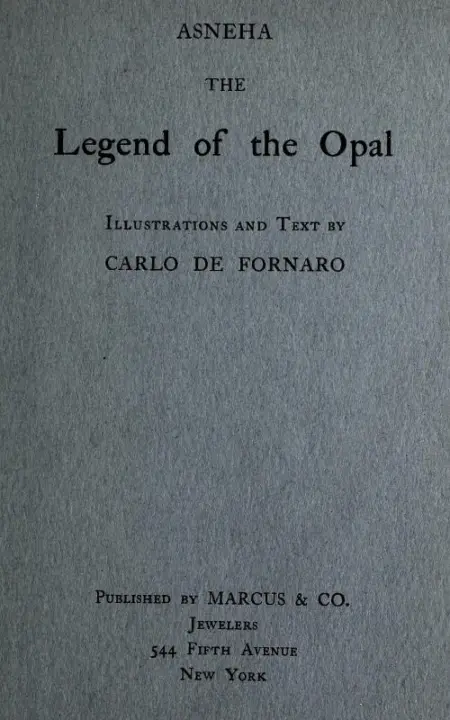
"Asneha, the Legend of the Opal" by Carlo de Fornaro is a fantastical tale likely crafted in the early 20th century. This enchanting novel merges elements of folklore and mythology, focusing on a gifted musician and poet named Asneha, whose profound connection to music and spirituality leads him on an extraordinary journey. The story elegantly explores themes of devotion, the power of art, and the transcendent nature of music. The narrative centers around Asneha, a poor musician who, after losing his flute, encounters a mystical Golden Bird that gifts him the ability to create divine music from reeds in the jungle. His enchanting melodies draw audiences and ultimately reach the Maharajah, who is captivated by Asneha's skill. Asneha's fame attracts the attention of the gods, culminating in an encounter with Indra, the ruler of the gods. Asneha must showcase his talent before them, resulting in a powerful and emotive performance that earns him immortality and the legendary opal, a gem embodying all harmonies. The story is a lyrical exploration of the intersections between art, spirituality, and the divine, highlighting how music has the power to connect mortals with the celestial.
Introduction adapted from the source catalogue; source summaries may be automatically generated.
Free to read · English · 1,869 words · No account needed
MAKE TIME FOR A GOOD BOOK
On by default. Untick to stop anonymous reading totals. Each page counts after 10 seconds in view. How this works.
Anonymous counting is on unless you have switched it off.
So he incised on his flute this motto:
“Once upon a time the Golden Bird sang to me, Now I shall sing a golden song to the gods.”
He went from village to village, from city to city, playing with the generosity of an inspired poet, followed by man, woman, child and beast alike, whenever he put his flute to his lips. They offered him their homes, their riches, their dearest possessions, but he scorned all, accepting only a little rice with spices, partaking of shelter with the humblest when the tempest-beaten jungle forbade his sleeping out of doors.
Quickly his fame had spread, and reached the ears of the Maharajah, who bade him appear at the palace, to vie with the court musicians, who were the most famous in the land. The court musicians, in their ignorance, eyed the half-naked poet with a defiant leer, as one by one they began playing, while nearby sat the Maharajah with his daughter, the fair Mahismati, and the courtiers around, all fairly laden with gems, appearing as enormous glistening scarabei.
They sang and drummed, they scratched their fiddles and twanged their guitars, they played the harps and clanked the cymbals to the admiring assemblage of noblemen, who wondered how this miserable, half-starved vagabond dared to compete with his wretched little instrument.
When the musicians had ended, Asneha got up, announcing the Song of Songs.
It began imperceptibly, but as insinuatingly as the language of a couple of loving eyes whispers to another loved pair; so indistinct to the ear that it was as the incipient melody in the mind of the composer.
Then it continued, soothing and muffled as the patter of small naked feet dancing the nautch on the marble flooring; rattled speedily as an incessant cascade of rubies, diamonds, sapphires, pearls and emeralds on a basin of gold. Steadily it flowed, like a Song of Desire and Voluptuousness, filling the hall with a scarlet inundation of light; heavy and numbing as the exhalation of soporific flowers.
But now it ascended to healthier altitudes like a Song of Victory and Exultation, direct and concise, in a blast of crystal trumpets, higher, slowly, in the manner of the eagle.
It rang forth agitated and sonorous as a gong, yet farther, solitary,
inaccessible.
Then as if it had grown in magnitude by the ascent, it roared like a planet as it shoots into space to restore the equilibrium of the Universe, and suddenly, unexpectedly, in the fashion of the shooting star, it stopped short, carrying in its wake the exhausted assemblage of listeners to the floor as a mass of inert flesh.
Your reading position is saved on this browser. Take it to another device with a library code. Reading pages adapt to text, rather than matching a printed edition.
BEHIND THE BOOK
This eBook is for the use of anyone anywhere in the United States and most other parts of the world at no cost and with almost no restrictions whatsoever. You may copy it, give it away or re-use it under the terms of the Project Gutenberg License included with this eBook or online at www.gutenberg.org. If you are not located in the United States, you will have to check the laws of the country where you are located before using this eBook. Read the source licence.
The original source file, including credits and licence, is retained by this library. Request an original-format copy at no charge. Please include the book title and Project Gutenberg identifier #62512.
KEEP YOUR CURIOSITY GOING
Coulson Kernahan

Maurice Baring
Frances Wright
Cécile Tormay
Francis Greenleaf Allinson & Anne C. E. (Anne Crosby Emery) Allinson

Frederic Jesup Stimson