THE CLASSIC COLLECTION✦Mr. Sponge’s Sporting TourCLASSIC FREE BOOKS
Mr. Sponge’s Sporting Tour
Robert Smith Surtees
THE CLASSIC COLLECTION · 1858
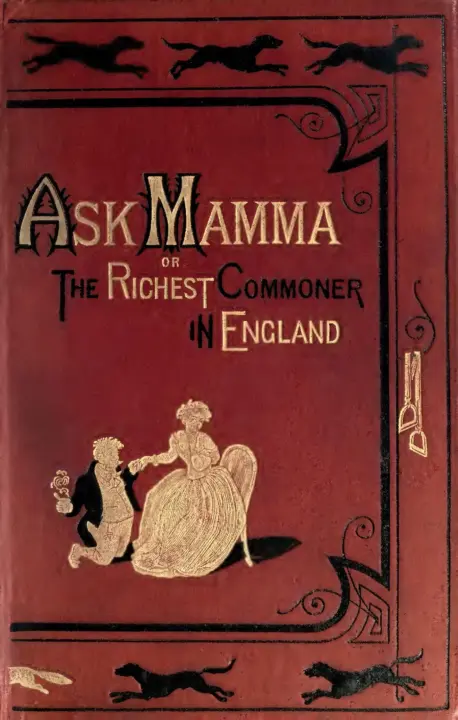
"Ask Mamma; or, The Richest Commoner In England" by Robert Smith Surtees is a novel written in the mid-19th century. The story centers around Billy Pringle, who aspires to be seen as a gentleman, despite his humble origins as part of a trading family. As he navigates social situations filled with humor and satire, themes of ambition, social class, and identity emerge. The opening of the novel introduces us to Billy Pringle, fondly referred to as "Fine Billy," who is characterized by his attempts to embody gentility despite his humble background. The narrative provides a glimpse into his interactions with various members of his family, revealing their dynamics and his desire to fit into a more affluent social circle. We also meet Miss Willing, a lady's maid with aspirations of her own, who captures Billy's attention during a coach journey. Their budding acquaintance sets the stage for the humorous and often absurd twists of social class and romance that will unfold throughout the story.
Introduction adapted from the source catalogue; source summaries may be automatically generated.
Free to read · English · 179,335 words · No account needed
MAKE TIME FOR A GOOD BOOK
On by default. Untick to stop anonymous reading totals. Each page counts after 10 seconds in view. How this works.
Anonymous counting is on unless you have switched it off.
The third is a mare, a black mare, called Star, late the property of Mr. Hazey, the horse-dealing master of the Squeezington hounds. Hazey sold her in his usual course of horse-dealing cheating to young Mr. Sprigginson, of Marygold Lodge, for a hundred and twenty guineas (the shillings back), Hazey’s discrimination enabling him to see that she was turning weaver, and Sprigginson not liking her, returned her on the warranty; when, of course, Hazey refusing to receive her, she was sent to the Eclipse Livery and Bait Stables at Hinton, where, after weaving her head off, she was sold at the hammer to the Major for twenty-nine pounds. Sprig then brought an action against Hazey for the balance, bringing half-a-dozen witnesses to prove that she wove when she came; Hazey, of course, bringing a dozen to swear that she never did nothin’ ‘o the sort with him, and must have learnt it on the road; and the jury being perplexed, and one of them having a cow to calve, another wanting to see his sweetheart, and the rest wanting their dinners, they just tossed up for it, “Heads!” for Sprig; “Tails!” for Hazey, and Sprig won. There she goes, you see, weaving backwards and forwards like a caged panther in a den. Still she is far from being the worst that the Major has; indeed, we are not sure that she is not about the best, only, as Solomon says, with reference to her weaving, she gets the “langer the warser.”
Number four is a handsome whole coloured bright bay horse, “Napoleon the Great,” as the Major calls him, in hopes that his illustrious name will sell him, for of all bad tickets he ever had, the Major thinks Nap is the worst. At starting, he is all fire, frisk, and emulation, but before he has gone five miles, he begins to droop, and in hunting knocks up entirely before he has crossed half-a-dozen fields. He is a weak, watery, washy creature, wanting no end of coddling, boiled corn, and linseed tea. One hears of two days a-week horses, but Napoleon the Great is a day in two weeks one. The reader will wonder how the Major came to get such an animal, still more how he came to keep him; above all, how he ever came to have him twice. The mystery, however, is explained on the old bartering, huckstering, half-and-half system. The Major got him first from Tom Brandysneak, a low public-house-keeping leather-plater, one of those sporting men, not sportsmen, who talk about supporting the turf, as if they did it like the noblemen of old, upon principle, instead of for what they can put into their own pockets; and the Major gave Sneak an old green dog-cart, a melon frame, sixteen volumes of the “Racing Calendar,” bound in calf, a ton of seed-hay, fifty yards of Croggon’s asphalt roofing felt, and three “golden sovereigns” for him. Nap was then doing duty under the title of Johnny Raw, his calling being to appear at different posts whenever the cruel conditions of a race required a certain number of horses to start in order to secure the added money; but Johnny enacted that office so often for the benefit of the “Honourable Society of Confederated Legs,” that the stewards of races framed their conditions for excluding him; and Johnny’s occupation being gone, he came to the Major in manner aforesaid. Being, however, a horse of prepossessing appearance, a good bay, with four clean black legs, a neat well set-on head, with an equally neat set-on tail, a flowing mane, and other &c’s, he soon passed into the possession of young Mr. Tabberton, of Green Linnet Hill, whose grandmamma had just given him a hundred guineas wherewith to buy a good horse—a real good one he was to be—a hundred-guinea-one in fact. Tabberton soon took all the gay insolence out of Johnny’s tail, and brought him back to the Major, sadly dilapidated—a sad satire upon his former self.
Your reading position is saved on this browser. Take it to another device with a library code. Reading pages adapt to text, rather than matching a printed edition.
BEHIND THE BOOK
This eBook is for the use of anyone anywhere in the United States and most other parts of the world at no cost and with almost no restrictions whatsoever. You may copy it, give it away or re-use it under the terms of the Project Gutenberg License included with this eBook or online at www.gutenberg.org. If you are not located in the United States, you will have to check the laws of the country where you are located before using this eBook. Read the source licence.
The original source file, including credits and licence, is retained by this library. Request an original-format copy at no charge. Please include the book title and Project Gutenberg identifier #44822.
KEEP YOUR CURIOSITY GOING
Coulson Kernahan

Maurice Baring
Frances Wright
Cécile Tormay

Frederic Jesup Stimson

W. H. P. (William Henry Pope) Jarvis