THE CLASSIC COLLECTION✦Mr. Sponge’s Sporting TourCLASSIC FREE BOOKS
Mr. Sponge’s Sporting Tour
Robert Smith Surtees
THE CLASSIC COLLECTION · 1858
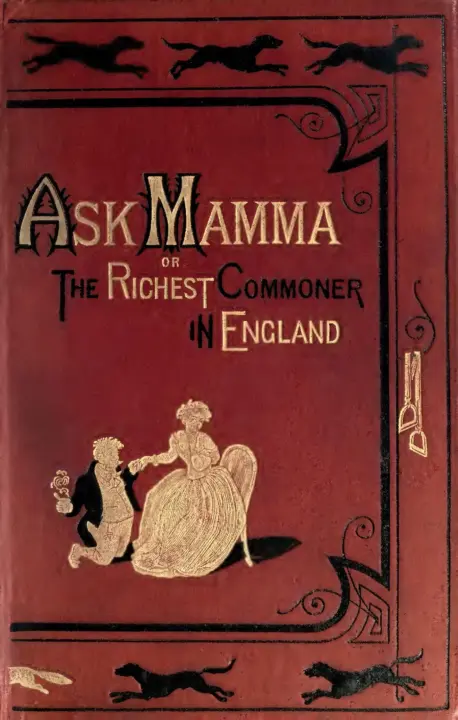
"Ask Mamma; or, The Richest Commoner In England" by Robert Smith Surtees is a novel written in the mid-19th century. The story centers around Billy Pringle, who aspires to be seen as a gentleman, despite his humble origins as part of a trading family. As he navigates social situations filled with humor and satire, themes of ambition, social class, and identity emerge. The opening of the novel introduces us to Billy Pringle, fondly referred to as "Fine Billy," who is characterized by his attempts to embody gentility despite his humble background. The narrative provides a glimpse into his interactions with various members of his family, revealing their dynamics and his desire to fit into a more affluent social circle. We also meet Miss Willing, a lady's maid with aspirations of her own, who captures Billy's attention during a coach journey. Their budding acquaintance sets the stage for the humorous and often absurd twists of social class and romance that will unfold throughout the story.
Introduction adapted from the source catalogue; source summaries may be automatically generated.
Free to read · English · 179,335 words · No account needed
MAKE TIME FOR A GOOD BOOK
On by default. Untick to stop anonymous reading totals. Each page counts after 10 seconds in view. How this works.
Anonymous counting is on unless you have switched it off.
The Major is proud of his cows, and against the whitewashed wall he has pasted the description of a perfect one, in order that people may compare the originals with the portrait. Thus it runs:—
She’s long in the face, she’s fine in the horn, She’ll quickly get fat without cake or corn; She’s clean in her jaws, and full in her chine, She’s heavy in flank, and wide in her loin; She’s broad in her ribs, and long in her rump, A straight and flat back without ever a hump; She’s wide in her hips, and calm in her eyes, She’s fine in her shoulders, and thin in her thighs; She’s light in her neck, and small in her tail, She’s wide at the breast, and good at the pail. She’s fine in her bone and silky of skin. She’s a grazier’s without, and a butcher’s within.
Now for the stable; this way, through the saddle-room, and mind the whitening on the walls. Stoop yonr head, for the Major being low himself, has made the door on the principle of all other people being low too. There, there you are, you see, in a stable as neat and clean as a London dealer’s; a Newmarket straw plait, a sanded floor with a roomy bench against the wall on which the Major kicks his legs and stutters forth the merits of his steeds. They are six in number, and before he comes we will just run the reader through the lot, with the aid of truth for an accompaniment.
This grey, or rather white one next the wall, White Surrey, as he calls him, is the old quivering tailed horse he rode on the de Glancey day, and pulled up to save, from the price-depressing inconvenience of being beat. He is eighteen years old, the Major having got him when he was sixteen, in a sort of part purchase, part swap, part barter deal. He gave young Mr. Meggison of Spoonbill Park thirteen pounds ten shillings, an old mahogany Piano-Forte, by Broadwood, six and a half octaves, a Squirrel Cage, two Sun-blinds, and a very feeble old horse called Nonpareil, that Tom Rivett the blacksmith declared it would be like robbing Meggison to put new shoes on to, for him. He is a game good shaped old horse, but having frequently in the course of a chequered career, been in that hardest of all hard places, the hands of young single horse owners, White Surrey has done the work of three or four horses. He has been fired and blistered, and blistered and fired, till his legs are as round and as callous as those of a mahogany dining-table; still it is wonderful how they support him, and as he has never given the Major a fall, he rides him as if he thought he never would. His price is sometimes fifty, sometimes forty, sometimes thirty, and there are times when he might be bought for a little less—two sovereigns, perhaps, returned out of the thirty. The next one to him—the white legged brown,—is of the antediluvian order too. He is now called Woodpecker, but he may be traced by half-a-dozen aliases through other stables—Buckhunter, Captain Tart, Fleacatcher, Sportsman, Marc Anthony, &c. He is nearly, if not quite thorough bred, and the ignoble purposes to which he has been subjected, false start making, steeple chasing, flat and hurdle racing, accounts for the number of his names. The Major got him from Captain Caret, of the Apple-pie huzzars, when that gallant regiment was ordered out to India,—taking him all away together, saddle, bridle, clothing, &c., for twenty-three pounds, a strong iron-bound chest, fit for sea purposes, as the Major described it, and a spying glass. This horse, like all the rest of them, indeed, is variously priced, depending upon the party asking, sometimes fifty, sometimes five-and-twenty would buy him.
Your reading position is saved on this browser. Take it to another device with a library code. Reading pages adapt to text, rather than matching a printed edition.
BEHIND THE BOOK
This eBook is for the use of anyone anywhere in the United States and most other parts of the world at no cost and with almost no restrictions whatsoever. You may copy it, give it away or re-use it under the terms of the Project Gutenberg License included with this eBook or online at www.gutenberg.org. If you are not located in the United States, you will have to check the laws of the country where you are located before using this eBook. Read the source licence.
The original source file, including credits and licence, is retained by this library. Request an original-format copy at no charge. Please include the book title and Project Gutenberg identifier #44822.
KEEP YOUR CURIOSITY GOING
Coulson Kernahan

Maurice Baring
Frances Wright
Cécile Tormay

Frederic Jesup Stimson

W. H. P. (William Henry Pope) Jarvis