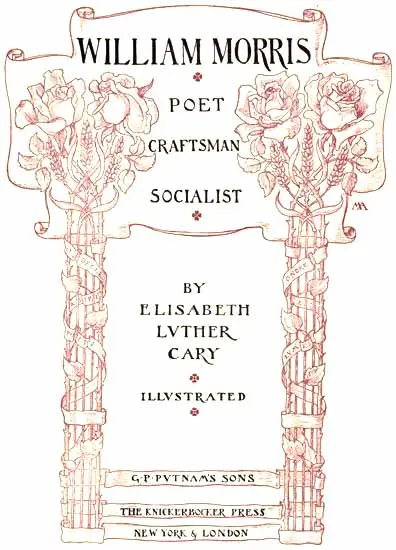
William Morris: Poet, Craftsman, Socialist
Elisabeth Luther Cary
THE CLASSIC COLLECTION · 1909
"Artists Past and Present: Random Studies" by Elisabeth Luther Cary is a collection of art essays written in the early 20th century. The book presents a series of studies on notable artists, including Antoine Louis Barye and Mary Cassatt, exploring their lives and artistic contributions while providing insightful analyses of their works. Through these essays, the author delves into the unique techniques, themes, and emotional depth that characterize each artist's body of work, making it a valuable read for art enthusiasts and historians alike. The opening of the collection begins with a detailed examination of Antoine Louis Barye, a pioneering figure in animal sculpture. Cary discusses Barye's early life and training, his artistic innovations, and his distinctive style that blends scientific accuracy with a sense of life and motion in his sculptures. The narrative highlights Barye's struggles with recognition during his lifetime, emphasizing his dedication to perfection and the profound impact of his works on the art world, particularly in his ability to capture the raw energy and essence of animal subjects. This opening portion effectively sets the stage for the subsequent profiles of other influential artists in the book, offering readers a glimpse into the rich tapestry of art history that Cary aims to illuminate.
Introduction adapted from the source catalogue; source summaries may be automatically generated.
Free to read · English · 34,783 words · No account needed
MAKE TIME FOR A GOOD BOOK
On by default. Untick to stop anonymous reading totals. Each page counts after 10 seconds in view. How this works.
Anonymous counting is on unless you have switched it off.
In still another portrait, he is sitting before his easel, his little girl on one knee, his canvas on the other with the easel serving only as a prop. His eyes are turned toward a mirror which is outside the picture and the reflection in which he is using as a model; the child's eyes are fixed on the canvas watching the growth of the design. These are "self-portraits" in more than the usual sense. It is the rarest thing in art to find a painter representing his own aspect with such complete lack of self-consciousness. No characteristics seem especially to be emphasized, none betray exaggeration, there apparently is neither distortion nor idealization, nor is there any attempt to select a mood that shall preserve a favorable impression of the sitter. Nothing could, however, more favorably present a character to the critical scrutiny of strangers than this superb good faith. The least sentimental of us must recognize with frank delight the wholesome sweetness of the world these kindly faithful records open to us.
Larsson was born at Stockholm in 1853. From the age of thirteen he depended upon his own labors for support; retouching photographs at first. Later he entered the elementary school of the academy where he received honors. He drew from the antique and from the model and began to make drawings for illustration when he was about eighteen. The public knew him first through his drawings for the comic paper called Kasper, and he shortly became a much sought after illustrator for papers and books. The first book illustrated by him was a collection of stories by Richard Gustafsson, the editor of Kasper, the next was Anderson's "Tales." In the latter he succeeded Isidor Toernblom, who died in 1876 after having executed only a few drawings for the first part. He became bold and rapid in improvisation, and light and easy in execution--qualities that he never lost. He was obliged to make of his academic studies a side issue, bread-winning taking necessarily the first place with him. No doubt it is to this necessity that he owes that prompt adaptation of his facility to various uses, that practical application of his freshly acquired knowledge which give to the simple compositions of his earlier period an especial spontaneity. He had no time to fix himself in ruts of practice. To draw from the Antinous one day and the next to press one's Greek outline into service for the representation of little dancing girls and happy babies is to effect that union between art and life which makes the first moving and the second beautiful; the union in which Daumier found the source of his prodigious strength. In his early years Larsson was anything but a realist. His fancy turned to unusual and vast subjects, and his natural impatience caused him to launch himself upon them with very inadequate preliminary study. The first canvas attempted by him during the study-time in Paris (time which he won at the Academy) was nearly ten feet high and represented a scene from the deluge with figures double life size. Naturally, he found himself unable to cope with the difficulties that promptly arose and was obliged to give it up. In 1877, when he was twenty-four years old, he painted a three-quarter length portrait of a woman standing, which was his best work of that period. The genre pictures which he sent home to Stockholm at about the same time awakened little enthusiasm and spread the impression that he had no future as a painter and would be obliged to content himself with illustration. As an illustrator he became thoroughly successful, turning out a large amount of work and gaining for himself in Stockholm the very inappropriate name of "the Swedish Dore." He made enough money in this branch of art to try painting again in Paris, but with almost no success until the Spring of 1883, when he exhibited at the Salon a couple of small water-colors, the subjects taken from the field and garden life of Grez, a little painting village that lies south of the Fontainebleau forest. These pictures won a medal and were bought in Gothenburg. Other similar subjects followed, all distinguished, Nordensvan affirms, by the same pleasing delicacy of handling, the same glow and splendor of sunlight, and the same glad color-harmony. He now was in a position to marry, and pictures of family life presently appeared in great numbers. These are altogether charming--spirited, vivid, original, and full of an indescribable freshness and heartiness. Sometimes he painted his young wife holding her baby, sometimes he painted his two boys parading as mimic soldiers; sometimes it was his little girl hiding under the great, handsome dining-table; or a young people's party in the characteristic dining-room, all the furniture and decorations of which are reproduced with crisp naturalism.
Your reading position is saved on this browser. Take it to another device with a library code. Reading pages adapt to text, rather than matching a printed edition.
Elisabeth Luther Cary
BEHIND THE BOOK
This eBook is for the use of anyone anywhere in the United States and most other parts of the world at no cost and with almost no restrictions whatsoever. You may copy it, give it away or re-use it under the terms of the Project Gutenberg License included with this eBook or online at www.gutenberg.org. If you are not located in the United States, you will have to check the laws of the country where you are located before using this eBook. Read the source licence.
The original source file, including credits and licence, is retained by this library. Request an original-format copy at no charge. Please include the book title and Project Gutenberg identifier #31940.
KEEP YOUR CURIOSITY GOING

David Patterson (Spirit) Hatch

David Patterson (Spirit) Hatch

David Patterson (Spirit) Hatch

Ralph Waldo Emerson

Maurice Baring

Oscar Wilde & James McNeill Whistler