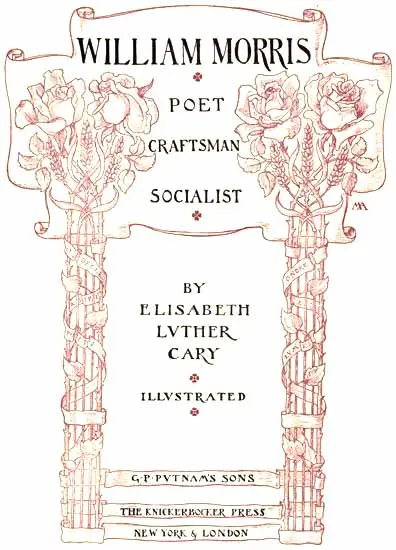
William Morris: Poet, Craftsman, Socialist
Elisabeth Luther Cary
THE CLASSIC COLLECTION · 1909
"Artists Past and Present: Random Studies" by Elisabeth Luther Cary is a collection of art essays written in the early 20th century. The book presents a series of studies on notable artists, including Antoine Louis Barye and Mary Cassatt, exploring their lives and artistic contributions while providing insightful analyses of their works. Through these essays, the author delves into the unique techniques, themes, and emotional depth that characterize each artist's body of work, making it a valuable read for art enthusiasts and historians alike. The opening of the collection begins with a detailed examination of Antoine Louis Barye, a pioneering figure in animal sculpture. Cary discusses Barye's early life and training, his artistic innovations, and his distinctive style that blends scientific accuracy with a sense of life and motion in his sculptures. The narrative highlights Barye's struggles with recognition during his lifetime, emphasizing his dedication to perfection and the profound impact of his works on the art world, particularly in his ability to capture the raw energy and essence of animal subjects. This opening portion effectively sets the stage for the subsequent profiles of other influential artists in the book, offering readers a glimpse into the rich tapestry of art history that Cary aims to illuminate.
Introduction adapted from the source catalogue; source summaries may be automatically generated.
Free to read · English · 34,783 words · No account needed
MAKE TIME FOR A GOOD BOOK
On by default. Untick to stop anonymous reading totals. Each page counts after 10 seconds in view. How this works.
Anonymous counting is on unless you have switched it off.
Among the more interesting pictures acquired by the Metropolitan Museum within the past two years are the panels by Carlo Crivelli, representing respectively St. George and St. Dominic.
Crivelli is one of the fifteenth century Italian masters who show their temperament in their work with extraordinary clearness. His spirit was ardent and his moods were varying. With far less technical skill than his contemporary, Mantegna, he has at once a warmer and more brilliant style and a more modern feeling for natural and significant gesture. His earliest known work that bears a date is the altar-piece in S. Silvestro at Massa near Fermo; but his most recent biographer, Mr. Rushworth, gives to his Venetian period before he left for the Marches, the Virgin and Child now at Verona, and sees in this the strongest evidences of his connection with the School of Padua. Other important pictures by him are at Ascoli, in the Lateran Gallery, Rome, in the Vatican, in the Brera Gallery at Milan, in the Berlin Gallery, in the National Gallery at London, in Frankfurt (the Staedel Gallery), in the Museum of Brussels, in Lord Northbrook's collection, London, in the Boston Museum, in Mrs. Gardiner's collection at Boston, and in Mr. Johnson's collection at Philadelphia. The eight examples in the National Gallery, although belonging for the most part to his later period, show his wide range and his predominating characteristics, which indeed are stamped with such emphasis upon each of his works that despite the many and great differences in these, there seems to be little difficulty in recognizing their authorship. No. 788, The Madonna and Child Enthroned, surrounded by Saints, an altarpiece painted for the Dominican Church at Ascoli in 1476, is the most elaborate and pretentious of the National Gallery compositions, but fails as a whole to give that impression of moral and physical energy, of intense feeling expressed with serene art, which renders the Annunciation (No. 739) both impressive and ingratiating. The lower central compartment is instinct with grace and tenderness. The Virgin, mild-faced and melancholy, is seated on a marble throne. The Child held on her arm, droops his head, heavy with sleep, upon her arm in a babyish and appealing attitude curiously opposed to the dignity of the Child in Mantegna's group which hangs on the opposite wall. His hand clasps his mother's finger and his completely relaxed figure has unquestionably been studied from life. At the right and left of the Virgin are St. Peter and St. John, St. Catherine of Alexandria and St. Dominic, whole-length figures strongly individualized and differentiated. St. John in particular reveals in the beauty of feature and expression Crivelli's power to portray subtleties and refinements of character without sacrificing his sumptuous taste for accessories and ornament. The Saint, wearing his traditional sheep skin and bearing his cross and scroll, bends his head in meditation. His brows are knit, his features, ascetic in mold and careworn, are eloquent of serious thought and moral conviction. By the side of St. Peter resplendent in pontifical robes and enriched with jewels, he wears the look of a young devout novice not yet so familiar with sanctity as to carry it with ease. He stands by the side of a little stream, in a landscape that combines in the true Crivelli manner direct realism with decorative formality. The St. Dominic with book and lily in type resembles the figure in the Metropolitan, but the face is painted with greater skill and has more vigor of expression. Above this lower stage of the altarpiece are four half-length figures of St. Francis, St. Andrew the Apostle, St. Stephen and St. Thomas Aquinas, and over these again are four pictures showing the Archangel Michael trampling on the Dragon, St. Lucy the Martyr, St. Jerome and St. Peter, Martyr, all full length figures of small size and delicately drawn, but which do not belong to the original series. The various parts of the altarpiece were enclosed in a splendid and ornate frame while in the possession of Prince Demidoff in the latter half of the nineteenth century and the whole is a magnificent monument to Crivelli's art. The heavy gold backgrounds and the free use of gold in the ornaments, together with the use of high relief (St. Peter's keys are modeled, for example, almost in the round, so nearly are they detached from the panel) represent his tendency to overload his compositions with archaic and realistic detail, but here as elsewhere the effect is one of harmony and corporate unity of many parts. The introduction of sham jewels, such as those set in the Virgin's crown and in the rings and medallions worn by Peter, fails to destroy the dignity of the execution. It may even be argued that these details enhance it by affording a salient support to the strongly marked emotional faces of the saints and to the vigorous gestures which would be violent in a classic setting.
Your reading position is saved on this browser. Take it to another device with a library code. Reading pages adapt to text, rather than matching a printed edition.
Elisabeth Luther Cary
BEHIND THE BOOK
This eBook is for the use of anyone anywhere in the United States and most other parts of the world at no cost and with almost no restrictions whatsoever. You may copy it, give it away or re-use it under the terms of the Project Gutenberg License included with this eBook or online at www.gutenberg.org. If you are not located in the United States, you will have to check the laws of the country where you are located before using this eBook. Read the source licence.
The original source file, including credits and licence, is retained by this library. Request an original-format copy at no charge. Please include the book title and Project Gutenberg identifier #31940.
KEEP YOUR CURIOSITY GOING

David Patterson (Spirit) Hatch

David Patterson (Spirit) Hatch

David Patterson (Spirit) Hatch

Ralph Waldo Emerson

Maurice Baring

Oscar Wilde & James McNeill Whistler