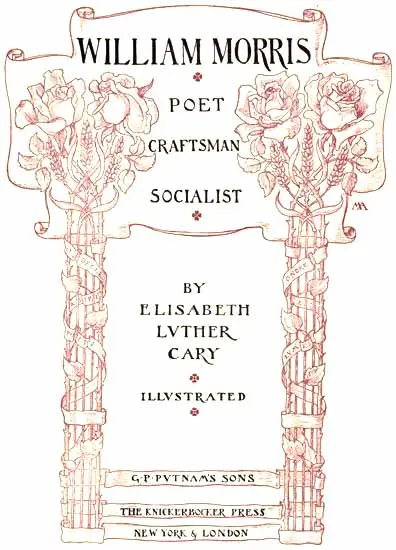
William Morris: Poet, Craftsman, Socialist
Elisabeth Luther Cary
THE CLASSIC COLLECTION · 1909
"Artists Past and Present: Random Studies" by Elisabeth Luther Cary is a collection of art essays written in the early 20th century. The book presents a series of studies on notable artists, including Antoine Louis Barye and Mary Cassatt, exploring their lives and artistic contributions while providing insightful analyses of their works. Through these essays, the author delves into the unique techniques, themes, and emotional depth that characterize each artist's body of work, making it a valuable read for art enthusiasts and historians alike. The opening of the collection begins with a detailed examination of Antoine Louis Barye, a pioneering figure in animal sculpture. Cary discusses Barye's early life and training, his artistic innovations, and his distinctive style that blends scientific accuracy with a sense of life and motion in his sculptures. The narrative highlights Barye's struggles with recognition during his lifetime, emphasizing his dedication to perfection and the profound impact of his works on the art world, particularly in his ability to capture the raw energy and essence of animal subjects. This opening portion effectively sets the stage for the subsequent profiles of other influential artists in the book, offering readers a glimpse into the rich tapestry of art history that Cary aims to illuminate.
Introduction adapted from the source catalogue; source summaries may be automatically generated.
Free to read · English · 34,783 words · No account needed
MAKE TIME FOR A GOOD BOOK
On by default. Untick to stop anonymous reading totals. Each page counts after 10 seconds in view. How this works.
Anonymous counting is on unless you have switched it off.
In 1831 he sent to the Salon of that year the Tiger Devouring a Gavial of the Ganges, a beautiful little bronze, seven and a half inches high, which won a Second Medal and was bought by the Government for the Luxembourg. This was the beginning of his true career. In the same Salon was exhibited his Martyrdom of St. Sebastian, but the powerful realism and energy of the animal group represented what henceforth was to be Barye's characteristic achievement, the realization, that is, of what the Chinese call the "movement of life;" the strange reality of appearance that is never produced by imitation of nature and that makes the greatness of art. The tiger clutches its victim with great gaunt paws, its eyes are fixed upon the prey, its body is drawn together with tense muscles, its tail is curled, the serpent is coiled about the massive neck of its destroyer with large undulating curves. The touch is everywhere certain, the composition is dignified, and the group as an exhibition of extraordinary knowledge is noteworthy.
A lithograph portrait of Barye by Gigoux, made at about this time, shows a fine head, interested eyes, a firm mouth and a determined chin. His chief qualities were perseverance, scientific curiosity, modesty and pride, and that indomitable desire for perfection so rarely encountered and so precious an element in the artist's equipment. He was little of a talker, little of a writer, infinitely studious, somewhat reserved and cold in manner, yet fond of good company and not averse to good dinners. Guillaume said of him that he had the genius of great science and of high morality, which is the best possible definition in a single phrase of his artistic faculty. He had the kind of sensitiveness, or self-esteem, if you will, that frequently goes with a mind confident of its merits, but not indifferent to criticism or sufficiently elevated and aloof to dispense with resentment. In 1832 he sent to the Salon his Lion Crushing a Serpent, and in 1833 he sent a dozen animal sculptures, a group of medallions and six water-colors. That year he was made chevalier of the Legion of Honour, but the following year nine groups made for the Duke of Orleans were rejected by the Salon jury, and again in 1836 several small pieces were rejected, although the Seated Lion, later bought by the government, was accepted. The reasons for the rejections are not entirely clear, but Barye was an innovator, and in the field of art the way of the innovator is far harder than that of the transgressor. Charges of commercialism were among those made against him, and he--the least commercial of men--took them deeply to heart. His bitterness assumed a self-respecting but an inconvenient and unprofitable form, as he made up his mind to exhibit thereafter only in his own workshop, a resolution to which he held for thirteen years. After the rejection of his groups in 1834 he happened to meet Jules Dupre, who expressed his disgust with the decision. "It is quite easy to understand," Barye replied, "I have too many friends on the jury." This touch of cynicism indicates the ease with which he was wounded, but it was equally characteristic of him that in planning his simple revenge he hurt only himself. He did indeed refrain from sending his bronzes to the Salon and he did act as his own salesman, and the result was the incurrence of a heavy debt. To meet this he was obliged to sell all his wares to a founder who wanted them for the purpose of repeating them in debased reproductions. His own care in obtaining the best possible results in each article that he produced, his reluctance to sell anything of the second class, and his perfectly natural dislike to parting with an especially beautiful piece under any circumstances, did not, of course, work to his business advantage, although the amateurs who have bought the bronzes that came from his own refining hand have profited by it immensely. It would be a mistake, however, to think of him as a crushed or even a deeply misfortunate man. He simply was poor and not appreciated by the general public according to his merits. After 1850, however, he had enough orders from connoisseurs, many of them Americans, and also from the French government to make it plain that his importance as an artist was firmly established at least in the minds of a few. He sold his work at low prices which since his death have been trebled and quadrupled, in fact, some of his proofs have increased fifty-fold, but the fact that he was not overwhelmed with orders gave him that precious leisure to spend upon the perfecting of his work which, we may fairly assume, was worth more to him than money.
Your reading position is saved on this browser. Take it to another device with a library code. Reading pages adapt to text, rather than matching a printed edition.
Elisabeth Luther Cary
BEHIND THE BOOK
This eBook is for the use of anyone anywhere in the United States and most other parts of the world at no cost and with almost no restrictions whatsoever. You may copy it, give it away or re-use it under the terms of the Project Gutenberg License included with this eBook or online at www.gutenberg.org. If you are not located in the United States, you will have to check the laws of the country where you are located before using this eBook. Read the source licence.
The original source file, including credits and licence, is retained by this library. Request an original-format copy at no charge. Please include the book title and Project Gutenberg identifier #31940.
KEEP YOUR CURIOSITY GOING

David Patterson (Spirit) Hatch

David Patterson (Spirit) Hatch

David Patterson (Spirit) Hatch

Ralph Waldo Emerson

Maurice Baring

Oscar Wilde & James McNeill Whistler