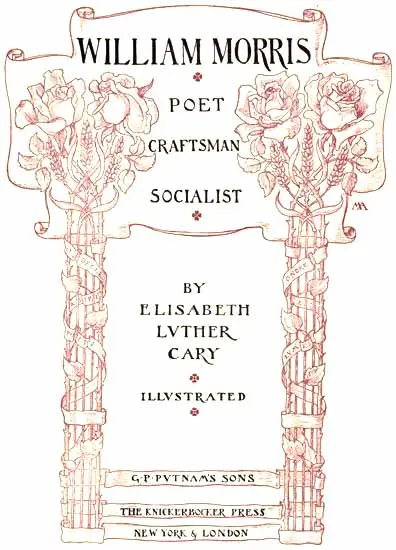
William Morris: Poet, Craftsman, Socialist
Elisabeth Luther Cary
THE CLASSIC COLLECTION · 1909
"Artists Past and Present: Random Studies" by Elisabeth Luther Cary is a collection of art essays written in the early 20th century. The book presents a series of studies on notable artists, including Antoine Louis Barye and Mary Cassatt, exploring their lives and artistic contributions while providing insightful analyses of their works. Through these essays, the author delves into the unique techniques, themes, and emotional depth that characterize each artist's body of work, making it a valuable read for art enthusiasts and historians alike. The opening of the collection begins with a detailed examination of Antoine Louis Barye, a pioneering figure in animal sculpture. Cary discusses Barye's early life and training, his artistic innovations, and his distinctive style that blends scientific accuracy with a sense of life and motion in his sculptures. The narrative highlights Barye's struggles with recognition during his lifetime, emphasizing his dedication to perfection and the profound impact of his works on the art world, particularly in his ability to capture the raw energy and essence of animal subjects. This opening portion effectively sets the stage for the subsequent profiles of other influential artists in the book, offering readers a glimpse into the rich tapestry of art history that Cary aims to illuminate.
Introduction adapted from the source catalogue; source summaries may be automatically generated.
Free to read · English · 34,783 words · No account needed
MAKE TIME FOR A GOOD BOOK
On by default. Untick to stop anonymous reading totals. Each page counts after 10 seconds in view. How this works.
Anonymous counting is on unless you have switched it off.
Two exceptions to this statement come, however, at once to my mind--the delightful Bear in his Trough and the Prancing Bull. The former is the only instance I know of a Barye animal disporting itself with youthful irresponsibility, and the innocence and humor of the little beast make one wish that it had not occupied this unique place in the list of Barye's work. The Prancing Bull also is a conception by itself and one of which Barye may possibly have been a little afraid. With his extraordinary patience it is not probable that he had the opposite quality of ability to catch upon the fly, as it were, a passing motion, an elusive and swiftly fading effect. But in this instance he has rendered with great skill the curvetting spring of the bull into the air and the lightness of the motion in contrast with the weight of the body. This singular lightness or physical adroitness he has caught also in his representation of elephants, the Elephant of Senegal Running, showing to an especial degree the agility of the animal despite its enormous bulk and ponderosity.
While Barye's most important work was accomplished in the field of sculpture, his merits as a painter were great. His devotion to the study of structural expression was too stern to permit him to lapse into mediocrity, whatever medium he chose to use, and the animals he created, or re-created, on canvas are as thoroughly understood, as clearly presented, as artistically significant as those in bronze. With every medium, however, there is, of course, a set of more or less undefinable laws governing its use. Wide as the scope of the artist is there are limits to his freedom, and if he uses water-color, for example, in a manner which does not extract from the medium the highest virtue of which it is capable he is so much the less an artist. It has been said of Barye that his paintings were unsatisfactory on that score. About a hundred pictures in oil and some fifty water-colors have been put on the list of his works. Mr. Theodore Child found his execution heavy, uniform, of equal strength all over, and of a monotonous impasto which destroys all aerial perspective. I have not seen enough of his painting in oils either to contradict or to acquiesce in this verdict; but his water-colors produce a very different impression on my mind. He uses body-color but with restraint and his management of light and shade and his broad, free treatment of the landscape background give to his work in this medium a distinction quite apart from that inseparable from the beautiful drawing. In the painting that we reproduce the soft washes of color over the rocky land bring the background into delicate harmony with the richly tinted figure of the tiger with the effect of variety in unity sought for and obtained by the masters of painting. The weight and roundness of the tiger's body is brought out by the firm broad outline which Barye's contemporary Daumier is so fond of using in his paintings, the interior modeling having none of the emphasis on form that one looks for in a sculptor's work. In his paintings indeed, even more than in his sculpture, Barye shows his interest in the psychological side of his problem. Here if ever he sees his subject whole, in all its relations to life. The vast sweep of woodland or desert in which he places his wild creatures, the deep repose commingled with the potential ferocity of these creatures, their separateness from man in their inarticulate emotions, their inhuman passions, their withdrawn powerfully realized lives, their self-sufficiency, their part in nature--all this becomes vivid to us as we look at his paintings and we are aware that the portrayal of animal life went far deeper with Barye than a mere anatomical grasp of his subject. Corot did not find his tigers sufficiently poetic and altered, it is said, the tiger drawn for one of his own paintings until he succeeded in giving it a more romantic aspect. Barye's poetry, however, was the unalterable poetry of life. He found his inspiration in realities but that is not to say that his realities were external ones. He excluded nothing belonging to the sentiment of his subject and comparison of his work with that of other animal sculptors and painters deepens one's respect for the penetrating insight with which he sought his truths.
Your reading position is saved on this browser. Take it to another device with a library code. Reading pages adapt to text, rather than matching a printed edition.
Elisabeth Luther Cary
BEHIND THE BOOK
This eBook is for the use of anyone anywhere in the United States and most other parts of the world at no cost and with almost no restrictions whatsoever. You may copy it, give it away or re-use it under the terms of the Project Gutenberg License included with this eBook or online at www.gutenberg.org. If you are not located in the United States, you will have to check the laws of the country where you are located before using this eBook. Read the source licence.
The original source file, including credits and licence, is retained by this library. Request an original-format copy at no charge. Please include the book title and Project Gutenberg identifier #31940.
KEEP YOUR CURIOSITY GOING

David Patterson (Spirit) Hatch

David Patterson (Spirit) Hatch

David Patterson (Spirit) Hatch

Ralph Waldo Emerson

Maurice Baring

Oscar Wilde & James McNeill Whistler