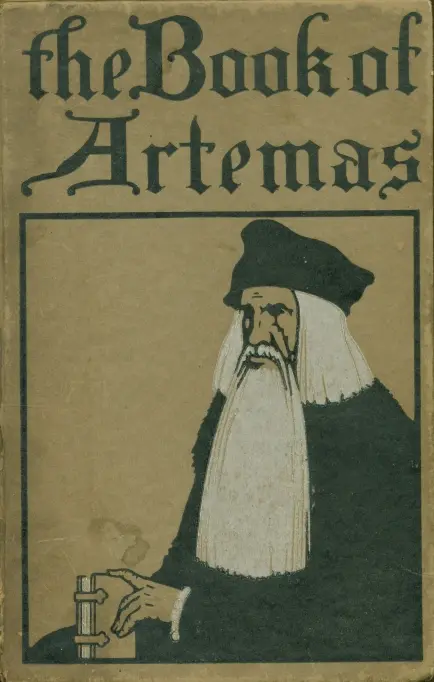
The book of Artemas concerning men, and the things that men did do, at the time when there was war
Andrew Cassels Brown
THE CLASSIC COLLECTION · 1918
"Artemas" by Andrew Cassels Brown is a fictional narrative written in the early 20th century. The story is set against a backdrop of war and delves into the lives and intrigues of various characters in a city called Lon, reflecting societal conflicts and personal dilemmas. The central figure, Artemas, serves as a scribe who embarks on a journey, witnessing and recording the events and conversations around him, thereby offering readers a lens into the complexity of human nature during tumultuous times. The opening of "Artemas" introduces us to the eponymous narrator, Artemas, as he travels to Lon. He finds himself amidst conversations about the ongoing war, where he learns about the political and social dynamics of his society. Through his observations, we are introduced to a variety of characters, including rulers, soldiers, and common folk, each struggling with their own challenges in a world defined by conflict and deception. The narrative's archaic language and rhythm evoke a distinctly historical ambiance, inviting readers to explore themes of power, truth, and the human experience under the weight of adversity.
Introduction adapted from the source catalogue; source summaries may be automatically generated.
Free to read · English · 20,037 words · No account needed
MAKE TIME FOR A GOOD BOOK
On by default. Untick to stop anonymous reading totals. Each page counts after 10 seconds in view. How this works.
Anonymous counting is on unless you have switched it off.
13 And after that I have brought the writing unto him and he hath made his mark upon it, then doth he reward me; and the manner of the reward, it is a kiss.
14 Peradventure in a little time he will make him an arrangement for to meet me afterwards, the better to say unto me all those things that a man, who loveth much, doth speak to the maiden that hath him.
15 And, because thou art my friend, therefore shalt thou be welcome to mine house when the time cometh that we be wed.
16 ¶ And certain of the damsels did don strange apparel, that was like unto the raiment of men. And their nether limbs did stand revealed; yea, their legs, they were no longer hid.
17 And men perceived their shape, that some of them were straight, and some were of a curve; and the others, they knocked them at the knees.
18 And they cursed the war in their hearts because of these things, that it had revealed them. And they prayed that the days of their innocence might be given back unto them and their faith again made whole.
19 ¶ Now there were some amongst the young men that, being with a maid, did wrongly read the tokens of the damsel's love, and the look of it, thinking, Perchance the damsel fasteth over long.
20 And he would say unto her, Let us now seek out a place where we may regale ourselves with meat, and with choice viands.
21 And with a measure of prepared wheat, and with a little wine also, for I perceive that thy stomach, it troubleth thee somewhat.
22 And the damsel, she would make denial of it, and she would be loth for to go in, feigning to be freshly nourished, and abundantly.
23 And he would strive to cajole her; nevertheless, for a long time, she would hearken not unto the voice of his pleadings.
24 But when he was come to the end of his persuasions and she did perceive that the meal, it was in peril, then would she speak unto him earnestly.
25 And she would say unto him, For thy sake will I do this thing; yea, for none other would I eat at a time when I be full up. And after that she was finished speaking, then would she go in.
26 And if she did know that the taste of his mouth was towards sweetness, then would she seek to gain favour in his eyes, and she would say unto him,
27 Take thou the morsel of sugar that be mine, for the need of thy servant, it is nought in comparison with thine.
Your reading position is saved on this browser. Take it to another device with a library code. Reading pages adapt to text, rather than matching a printed edition.
BEHIND THE BOOK
This eBook is for the use of anyone anywhere in the United States and most other parts of the world at no cost and with almost no restrictions whatsoever. You may copy it, give it away or re-use it under the terms of the Project Gutenberg License included with this eBook or online at www.gutenberg.org. If you are not located in the United States, you will have to check the laws of the country where you are located before using this eBook. Read the source licence.
The original source file, including credits and licence, is retained by this library. Request an original-format copy at no charge. Please include the book title and Project Gutenberg identifier #69144.
KEEP YOUR CURIOSITY GOING
Coulson Kernahan

Maurice Baring
Frances Wright
Cécile Tormay

Frederic Jesup Stimson

W. H. P. (William Henry Pope) Jarvis