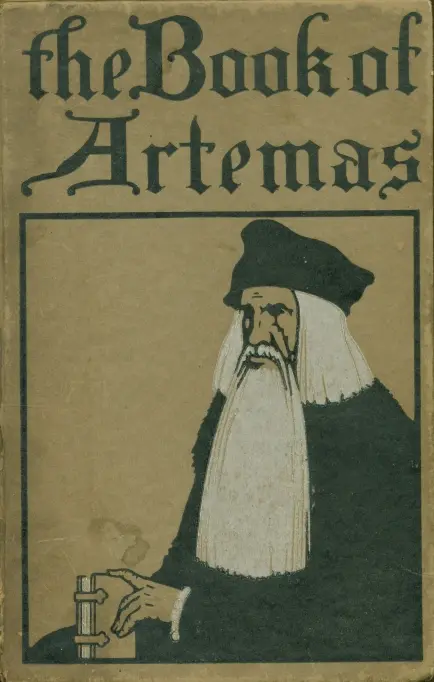
The book of Artemas concerning men, and the things that men did do, at the time when there was war
Andrew Cassels Brown
THE CLASSIC COLLECTION · 1918
"Artemas" by Andrew Cassels Brown is a fictional narrative written in the early 20th century. The story is set against a backdrop of war and delves into the lives and intrigues of various characters in a city called Lon, reflecting societal conflicts and personal dilemmas. The central figure, Artemas, serves as a scribe who embarks on a journey, witnessing and recording the events and conversations around him, thereby offering readers a lens into the complexity of human nature during tumultuous times. The opening of "Artemas" introduces us to the eponymous narrator, Artemas, as he travels to Lon. He finds himself amidst conversations about the ongoing war, where he learns about the political and social dynamics of his society. Through his observations, we are introduced to a variety of characters, including rulers, soldiers, and common folk, each struggling with their own challenges in a world defined by conflict and deception. The narrative's archaic language and rhythm evoke a distinctly historical ambiance, inviting readers to explore themes of power, truth, and the human experience under the weight of adversity.
Introduction adapted from the source catalogue; source summaries may be automatically generated.
Free to read · English · 20,037 words · No account needed
MAKE TIME FOR A GOOD BOOK
On by default. Untick to stop anonymous reading totals. Each page counts after 10 seconds in view. How this works.
Anonymous counting is on unless you have switched it off.
1 Concerning the peace-mongers. 8 Willi speaketh concerning peace. 10 And expoundeth the meaning of the word. 15 Artemas beholdeth a vision. 21 Wherein David slayeth his thousands. 26 And meeteth with Willi and Mud.
Now there were certain men in the land of En, and their talk was for
ever concerning peace.
2 And the manner of its attainment, this considered they not at all; neither did they concern themselves with the price to be paid for the blessings of it.
3 And though they were few in number, nevertheless, they were loud of voice; and a man that shouteth out, he is heard above a thousand that be silent.
4 And there was no reason in them, nor any words in their mouths save only, Peace, peace, peace.
5 And if one said unto them, Will ye crave peace of a tyrant? Then would they make answer, and they would say, Give us only peace.
6 And whosoever questioned them, saying, How long this peace, and in what manner shall it be assured? And would ye that our sons be dead in a lost cause? To him would they make answer, and they would say, Give us only peace.
7 And because there was no other word ready unto their tongues, therefore some called them Boloscheviks, and some did call them mad; but many did call them merely traitors.
8 ¶ Now, when Willi, that was the king of Hu, did speak concerning peace, a certain man that was of Amer, he approached unto him, and he questioned him, saying, Explain me now this peace, and expound its meaning unto me.
9 And tell me also, I beseech thee, what things be requisite of thine enemies that peace may come unto all peoples?
10 ¶ And Willi did expound the meaning of the word, even as the man
of Amer did beseech him. And he spake unto him in these words,
saying,
11 This and that also shall our enemies perform. And they shall return unto us all those lands which they have taken away; and we will behave in like manner unto them, keeping only whatsoever seemeth good unto us.
12 And there shall be a making right of the boundaries that do separate us from our neighbours; peradventure, they shall lose a little in the doing of it.
13 And the might of the Most High Lord of War, it shall be acclaimed of all the world; and afterwards there shall be peace.
14 And the man of Amer, he spake unto Willi, and he said unto him, Verily, the peace, concerning which thou hast spoken unto me, it is indeed the peace that passeth understanding.
Your reading position is saved on this browser. Take it to another device with a library code. Reading pages adapt to text, rather than matching a printed edition.
BEHIND THE BOOK
This eBook is for the use of anyone anywhere in the United States and most other parts of the world at no cost and with almost no restrictions whatsoever. You may copy it, give it away or re-use it under the terms of the Project Gutenberg License included with this eBook or online at www.gutenberg.org. If you are not located in the United States, you will have to check the laws of the country where you are located before using this eBook. Read the source licence.
The original source file, including credits and licence, is retained by this library. Request an original-format copy at no charge. Please include the book title and Project Gutenberg identifier #69144.
KEEP YOUR CURIOSITY GOING
Coulson Kernahan

Maurice Baring
Frances Wright
Cécile Tormay

Frederic Jesup Stimson

W. H. P. (William Henry Pope) Jarvis