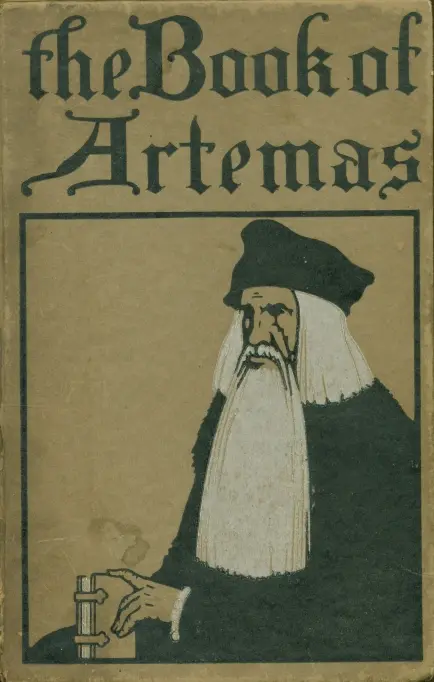
The book of Artemas concerning men, and the things that men did do, at the time when there was war
Andrew Cassels Brown
THE CLASSIC COLLECTION · 1918
"Artemas" by Andrew Cassels Brown is a fictional narrative written in the early 20th century. The story is set against a backdrop of war and delves into the lives and intrigues of various characters in a city called Lon, reflecting societal conflicts and personal dilemmas. The central figure, Artemas, serves as a scribe who embarks on a journey, witnessing and recording the events and conversations around him, thereby offering readers a lens into the complexity of human nature during tumultuous times. The opening of "Artemas" introduces us to the eponymous narrator, Artemas, as he travels to Lon. He finds himself amidst conversations about the ongoing war, where he learns about the political and social dynamics of his society. Through his observations, we are introduced to a variety of characters, including rulers, soldiers, and common folk, each struggling with their own challenges in a world defined by conflict and deception. The narrative's archaic language and rhythm evoke a distinctly historical ambiance, inviting readers to explore themes of power, truth, and the human experience under the weight of adversity.
Introduction adapted from the source catalogue; source summaries may be automatically generated.
Free to read · English · 20,037 words · No account needed
MAKE TIME FOR A GOOD BOOK
On by default. Untick to stop anonymous reading totals. Each page counts after 10 seconds in view. How this works.
Anonymous counting is on unless you have switched it off.
11 Now there was one amongst them, and his mind it was filled with stratagems. And, after they had been gathered together for a length of time, he stood upon his feet, and he spake unto them in these words, saying,
12 Hail to you, my brothers, and, Hail to you, ye men of Israel! And they answered him, saying, Hail! And when he perceived that their ears, they were turned towards him, he continued with a loud voice, and he said unto them,
13 What of Jericho, and what about it? Verily, the city of David, it hath fallen unto Gentile hosts, but the walls of Jericho, behold, they are yet whole. Let us, therefore, contrive the matter.
14 And after that he had reminded them concerning Joshua that behaved in a cunning manner, he commanded them accordingly; and he told each man the thing that he should do.
15 Wherefore it came to pass when the signal was given unto them, that they did blow upon their noses with a loud blast. Yea, they did make a very great noise with their noses because they did do it all at one time.
16 ¶ And when they awoke on the morrow, lo, the walls of Jericho, they were fallen down. And all the children of Israel rejoiced in their tents because they had contrived it; nevertheless, they imparted unto no man the secret of the blowing.
17 ¶ Now there was a certain man in the land of En that was an husbandman and of substance. And he hired him captives of the men of Hu for to plow his fields and to sow his seeds and to do that which was requisite and necessary unto his land.
18 And amongst them there was one that had formerly been wont to shave the beards of his brethren with a razor, and to prepare the heads of them with scissors.
19 Now in the house of the husbandman there were many guest chambers, and they were for ever full. And whensoever it happened that his friends were come for to visit him over the end of a week, then would he send unto the man of Hu.
20 And he would set him at the hair of his friends, and he would bid him take the scissors; yea, whosoever did come for to visit him, the hair of that man's head, assuredly, it was cut short.
21 Neither was there any help in him, for the husbandman, he was resolved that the opportunity which was come, it should not be idly cast away.
22 ¶ Now there was a certain young man and he took unto himself a wife, a comely maid and graceful as a young gazelle.
Your reading position is saved on this browser. Take it to another device with a library code. Reading pages adapt to text, rather than matching a printed edition.
BEHIND THE BOOK
This eBook is for the use of anyone anywhere in the United States and most other parts of the world at no cost and with almost no restrictions whatsoever. You may copy it, give it away or re-use it under the terms of the Project Gutenberg License included with this eBook or online at www.gutenberg.org. If you are not located in the United States, you will have to check the laws of the country where you are located before using this eBook. Read the source licence.
The original source file, including credits and licence, is retained by this library. Request an original-format copy at no charge. Please include the book title and Project Gutenberg identifier #69144.
KEEP YOUR CURIOSITY GOING
Coulson Kernahan

Maurice Baring
Frances Wright
Cécile Tormay

Frederic Jesup Stimson

W. H. P. (William Henry Pope) Jarvis