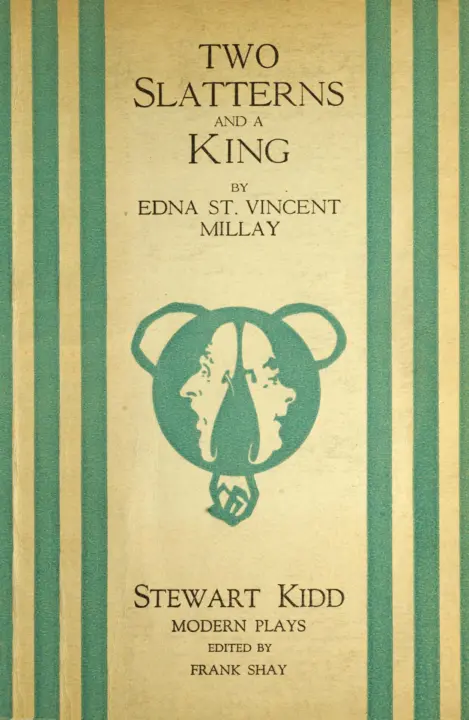
Two Slatterns and a King: A Moral Interlude
Edna St. Vincent Millay
THE CLASSIC COLLECTION · 1920
"Aria da Capo" by Edna St. Vincent Millay is a play in one act written in the early 20th century. This theatrical work presents a whimsical yet poignant narrative that delves into themes of love, the intricacies of relationships, and the contrast between tragedy and farce. Set within a colorful and metaphorical framework, it intertwines elements of both comedy and seriousness, presenting a unique commentary on human emotions and societal expectations. The story unfolds in a two-part structure, beginning with the main characters, Pierrot and Columbine, engaged in a seemingly trivial dining conversation filled with humor and banter. Their light-hearted interaction is interrupted by Cothurnus, a figure representing the weight of tragedy, who attempts to integrate a more serious tone. Meanwhile, shepherds Thyrsis and Corydon illustrate their own narrative of conflict and disillusionment as they quarrel over imaginary boundaries between themselves and their sheep. The play juxtaposes these two dialogues, ultimately leading to a tragic conclusion where misunderstandings and jealousy culminate in violent circumstances, only to be ignored and transformed back into farce by Pierrot and Columbine. This cyclical structure emphasizes the absurdity of life, a reflection on the human condition wrapped in humor and sorrow.
Introduction adapted from the source catalogue; source summaries may be automatically generated.
Free to read · English · 7,320 words · No account needed
MAKE TIME FOR A GOOD BOOK
On by default. Untick to stop anonymous reading totals. Each page counts after 10 seconds in view. How this works.
Anonymous counting is on unless you have switched it off.
CORYDON: Oh, Thyrsis, give me a bowl
Of water!—and I’ll fill the bowl with jewels,
And bring it back!
THYRSIS: Be off, I’m busy now.
[He catches sight of the weed, picks it up and looks
at it, unseen by CORYDON.]
Wait!—Pick me out the finest stones you have . . . I’ll bring you a drink of water presently.
CORYDON: [Goes back and sits down, with the jewels before him.] A bowl of jewels is a lot of jewels.
THYRSIS: [Chopping up the weed.] I wonder if it has a bitter taste.
CORYDON: There’s sure to be a stone or two among them
I have grown fond of, pouring them from one hand
Into the other.
THYRSIS: I hope it doesn’t taste
Too bitter, just at first.
CORYDON: A bowl of jewels
Is far too many jewels to give away
And not get back again.
THYRSIS: I don’t believe
He’ll notice. He’s too thirsty. He’ll gulp it down
And never notice.
CORYDON: There ought to be some way To get them back again. . . . I could give him a necklace, And snatch it back, after I’d drunk the water, I suppose. . . . Why, as for that, of course a necklace. . . .
[He puts two or three of the colored tapes together and tries their strength by pulling them, after which he puts them around his neck and pulls them, gently, nodding to himself. He gets up and goes to the wall, with the colored tapes in his hands.]
[THYRSIS in the meantime has poured the powdered root—black confetti—into the pot which contained the flower and filled it up with wine from the punch‐bowl on the floor. He comes to the wall at the same time, holding the bowl of poison.]
THYRSIS: Come, get your bowl of water, Corydon.
CORYDON: Ah, very good!—and for such a gift as that
I’ll give you more than a bowl of unset stones.
I’ll give you three long necklaces, my friend.
Come closer. Here they are. [Puts the ribbons
about THYRSIS’ neck.]
THYRSIS: [Putting bowl to CORYDON’S mouth.]
I’ll hold the bowl
Until you’ve drunk it all.
CORYDON: Then hold it steady.
For every drop you spill I’ll have a stone back
Out of this chain.
THYRSIS: I shall not spill a drop.
[CORYDON drinks, meanwhile beginning to strangle
THYRSIS.]
THYRSIS: Don’t pull the string so tight.
CORYDON: You’re spilling the water.
THYRSIS: You’ve had enough—you’ve had enough—stop pulling
The string so tight!
CORYDON: Why, that’s not tight at all ...
How’s this?
Your reading position is saved on this browser. Take it to another device with a library code. Reading pages adapt to text, rather than matching a printed edition.
Edna St. Vincent Millay
Edna St. Vincent Millay
Edna St. Vincent Millay
Edna St. Vincent Millay
BEHIND THE BOOK
This eBook is for the use of anyone anywhere in the United States and most other parts of the world at no cost and with almost no restrictions whatsoever. You may copy it, give it away or re-use it under the terms of the Project Gutenberg License included with this eBook or online at www.gutenberg.org. If you are not located in the United States, you will have to check the laws of the country where you are located before using this eBook. Read the source licence.
The original source file, including credits and licence, is retained by this library. Request an original-format copy at no charge. Please include the book title and Project Gutenberg identifier #5790.
KEEP YOUR CURIOSITY GOING
Maurice Baring
W. B. (William Butler) Yeats
Edward Martyn

John Brougham & Charlotte Brontë
Marguerite Merington
Leonid Andreyev