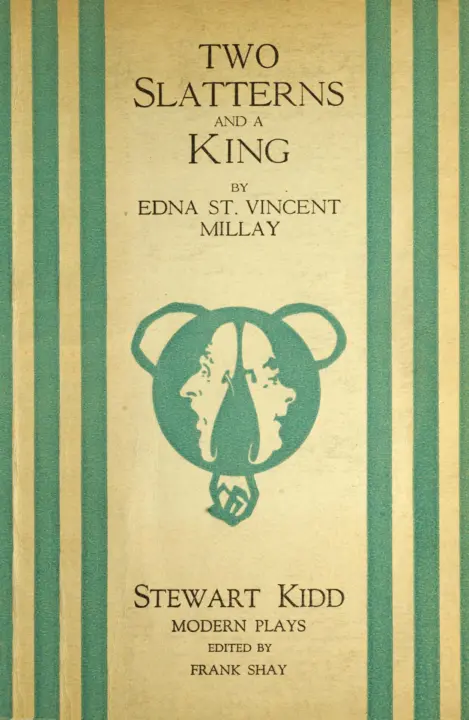
Two Slatterns and a King: A Moral Interlude
Edna St. Vincent Millay
THE CLASSIC COLLECTION · 1920
"Aria da Capo" by Edna St. Vincent Millay is a play in one act written in the early 20th century. This theatrical work presents a whimsical yet poignant narrative that delves into themes of love, the intricacies of relationships, and the contrast between tragedy and farce. Set within a colorful and metaphorical framework, it intertwines elements of both comedy and seriousness, presenting a unique commentary on human emotions and societal expectations. The story unfolds in a two-part structure, beginning with the main characters, Pierrot and Columbine, engaged in a seemingly trivial dining conversation filled with humor and banter. Their light-hearted interaction is interrupted by Cothurnus, a figure representing the weight of tragedy, who attempts to integrate a more serious tone. Meanwhile, shepherds Thyrsis and Corydon illustrate their own narrative of conflict and disillusionment as they quarrel over imaginary boundaries between themselves and their sheep. The play juxtaposes these two dialogues, ultimately leading to a tragic conclusion where misunderstandings and jealousy culminate in violent circumstances, only to be ignored and transformed back into farce by Pierrot and Columbine. This cyclical structure emphasizes the absurdity of life, a reflection on the human condition wrapped in humor and sorrow.
Introduction adapted from the source catalogue; source summaries may be automatically generated.
Free to read · English · 7,320 words · No account needed
MAKE TIME FOR A GOOD BOOK
On by default. Untick to stop anonymous reading totals. Each page counts after 10 seconds in view. How this works.
Anonymous counting is on unless you have switched it off.
THYRSIS: Corydon, listen: if you don’t want your sheep,
Give them to me.
CORYDON: Be off! Go finish your nap.
A red one—and a blue one—and a red one—
And a purple one—give you my sheep, did you say?—
Come, come! What do you take me for, a fool?
I’ve a lot of thinking to do,—and while I’m thinking,
The sheep might just as well be over here
As over there. . . . A blue one—and a red one—
THYRSIS: But they will die!
CORYDON: And a green one—and a couple
Of white ones, for a change.
THYRSIS: Maybe I have
Some jewels on my side.
CORYDON: And another green one—
Maybe, but I don’t think so. You see, this rock
Isn’t so very wide. It stops before
It gets to the wall. It seems to go quite deep,
However.
THYRSIS: [With hatred.] I see.
COLUMBINE: [Off stage.] Look, Pierrot, there’s the moon.
PIERROT: [Off stage.] Nonsense!
THYRSIS: I see.
COLUMBINE: [Off stage.] Sing me an old song, Pierrot,—
Something I can remember.
PIERROT: [Off stage.] Columbine.
Your mind is made of crumbs,—like an escallop
Of oysters,—first a layer of crumbs, and then
An oystery taste, and then a layer of crumbs.
THYRSIS: [Searching.] I find no jewels . . . but I wonder what
The root of this black weed would do to a man
If he should taste it. ... I have seen a sheep die,
With half the stalk still drooling from its mouth.
’Twould be a speedy remedy, I should think,
For a festered pride and a feverish ambition.
It has a curious root. I think I’ll hack it
In little pieces. . . . First I’ll get me a drink;
And then I’ll hack that root in little pieces
As small as dust, and see what the color is
Inside. [Goes to bowl on floor.]
The pool is very clear. I see
A shepherd standing on the brink, with a red cloak
About him, and a black weed in his hand. . . .
’Tis I. [Kneels and drinks.]
CORYDON: [Coming to wall.] Hello, what are you doing, Thyrsis?
THYRSIS: Digging for gold.
CORYDON: I’ll give you all the gold
You want, if you’ll give me a bowl of water.
If you don’t want too much, that is to say.
THYRSIS: Ho, so you’ve changed your mind?—It’s different, Isn’t it, when you want a drink yourself?
CORYDON: Of course it is.
THYRSIS: Well, let me see ... a bowl
Of water,—come back in an hour, Corydon.
I’m busy now.
Your reading position is saved on this browser. Take it to another device with a library code. Reading pages adapt to text, rather than matching a printed edition.
Edna St. Vincent Millay
Edna St. Vincent Millay
Edna St. Vincent Millay
Edna St. Vincent Millay
BEHIND THE BOOK
This eBook is for the use of anyone anywhere in the United States and most other parts of the world at no cost and with almost no restrictions whatsoever. You may copy it, give it away or re-use it under the terms of the Project Gutenberg License included with this eBook or online at www.gutenberg.org. If you are not located in the United States, you will have to check the laws of the country where you are located before using this eBook. Read the source licence.
The original source file, including credits and licence, is retained by this library. Request an original-format copy at no charge. Please include the book title and Project Gutenberg identifier #5790.
KEEP YOUR CURIOSITY GOING
Maurice Baring
W. B. (William Butler) Yeats
Edward Martyn

John Brougham & Charlotte Brontë
Marguerite Merington
Leonid Andreyev