
Dead letters
Maurice Baring
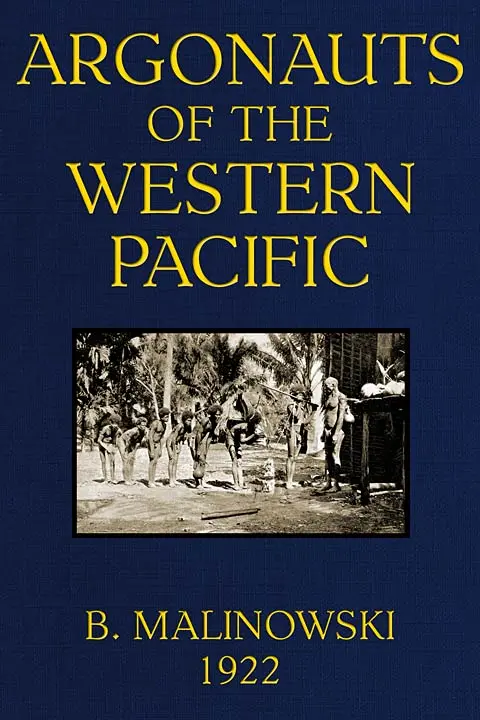
THE CLASSIC COLLECTION · 1922
"Argonauts of the Western Pacific" by Bronisław Malinowski is an ethnography published in 1922. This groundbreaking work documents the Trobriand people of the Kiriwana island chain near New Guinea, focusing on their complex trading system called the kula. Malinowski revolutionized anthropology by practicing "participant observation"—living among his subjects rather than studying them from afar. The book redefined ethnographic fieldwork and established intensive fieldwork as the foundation of modern social anthropology, earning comparison to Shakespeare's impact on literature.
Introduction adapted from the source catalogue; source summaries may be automatically generated.
Free to read · English · 211,401 words · No account needed
MAKE TIME FOR A GOOD BOOK
On by default. Untick to stop anonymous reading totals. Each page counts after 10 seconds in view. How this works.
Anonymous counting is on unless you have switched it off.
I have given so far a short linguistic survey of the canoe spells, dealing first with their initial parts, u'ula, then with their main parts, tapwana, and lastly saying a few words about the dogina. In a still more summary manner, I shall give a short survey of the mwasila (Kula magic) spells, quoted or mentioned in this book, beginning with the u'ula.
In the Yawarapu spell (Chapter VII) we have the beginning:--
Bu'a, bu'a, bovinaygau, vinaygu;
bu'a, bu'a, bomwanaygu, mwanaygu ...
Here the word bu'a (areca-nut) is repeated and used as a prefix bo-, with the antithetic roots -vinay- (female), and -mwanay- (male) and with the suffix -gu (first possessive pronoun).
The Kaymwaloyo (Chapter VII) begins:--
Gala bu'a, gala doga, gala mwayye ...
This is spoken in a solemn manner, and then follows the play on the root mwase, described above in the free translation of this spell.
Another rhythmic beginning, spoken with regular, strongly marked accent is to be found in the Kaykakaya spell (Chapter XIII):
Kaýtutúna íyanâ, márabwága iyanâ ...
Symmetrical arrangements of words, with alliterative prefixing of a particle and with antithetic uses of word couples are to be found in several other spells.
The Talo formula (Chapter XIII):
Talo, talo'udawada, udawada
Talo, talomwaylili, mwaylili ...
The Ta'uya spell (Chapter XIII):
Mwanita, monimwanita;
Deriwa, baderideriwa;
Derima, baderiderima ...
The Ka'ubana'i spell (Chapter XIII):
Mose'una Nikiniki,
Moga'ina Nikiniki ...
The Kwoygapani spell (Chapter XIV):
Kwega, kweganubwa'i, nubwa'i;
Kwega, kweganuwa'i, nuwa'i;
Kwega, kweganuma'i, numa'i ...
I have written them down here without full comment, to show their formal phonetic characteristics, which are indeed in all essentials quite similar to the samples previously quoted and analysed.
Your reading position is saved on this browser. Take it to another device with a library code. Reading pages adapt to text, rather than matching a printed edition.
BEHIND THE BOOK
This eBook is for the use of anyone anywhere in the United States and most other parts of the world at no cost and with almost no restrictions whatsoever. You may copy it, give it away or re-use it under the terms of the Project Gutenberg License included with this eBook or online at www.gutenberg.org. If you are not located in the United States, you will have to check the laws of the country where you are located before using this eBook. Read the source licence.
The original source file, including credits and licence, is retained by this library. Request an original-format copy at no charge. Please include the book title and Project Gutenberg identifier #55822.
KEEP YOUR CURIOSITY GOING
Maurice Baring
Francis Greenleaf Allinson & Anne C. E. (Anne Crosby Emery) Allinson
Stuart Dodgson Collingwood
Percy Keese Fitzhugh
Mary Macleod & Edmund Spenser

Cooke Don-Carlos