THE CLASSIC COLLECTION✦Salve Venetia, gleanings from Venetian history; vol. IICLASSIC FREE BOOKS
Salve Venetia, gleanings from Venetian history; vol. II
F. Marion (Francis Marion) Crawford
THE CLASSIC COLLECTION · 1906
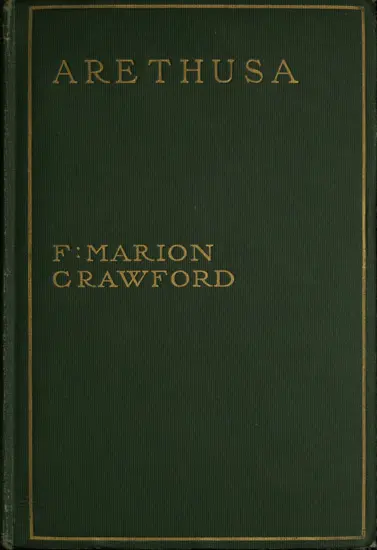
"Arethusa" by F. Marion Crawford is a historical novel written in the early 20th century. Set in 14th century Constantinople, the narrative centers around Carlo Zeno, a Venetian merchant with a colorful past, as he navigates both the complexities of the city and the societal issues of his time, including slavery and intrigue. The story aims to explore themes of identity, survival, and social class through the lens of its characters, particularly focusing on the dynamics between privilege and poverty. At the start of the narrative, we are introduced to Carlo Zeno, who is settling into his life as a merchant in Constantinople after a tumultuous past. He observes the city around him, filled with its vibrant cultures and discord between different nationalities, particularly between Venetians and Genoese. As the plot unfolds, Zeno receives a letter from a friend in Venice, requesting him to purchase a slave girl for his wife, setting the stage for the exploration of human relationships under the conditions of slavery. The narrative simultaneously introduces a young girl named Zoë, living in the depths of poverty with her ailing mother, whose fate is intricately linked to Zeno’s decision about the slave market. This opening serves as a critical setup for the characters' intertwining destinies and the moral dilemmas they face.
Introduction adapted from the source catalogue; source summaries may be automatically generated.
Free to read · English · 101,479 words · No account needed
MAKE TIME FOR A GOOD BOOK
On by default. Untick to stop anonymous reading totals. Each page counts after 10 seconds in view. How this works.
Anonymous counting is on unless you have switched it off.
'Yes. He is gone to dine with Messer Sebastian Polo. He goes there two
or three times a week.'
Zoë watched the secretary's face with amusement; his surprise was
comical.
'Then the man is really an astrologer,' he said, in a wondering tone, 'and star-gazing is not all nonsense!'
'Sebastian Polo's daughter is young and beautiful,' observed Zoë, who apparently did not place implicit faith in astrology.
Omobono's face and gesture expressed a qualified assent, but he said
nothing.
'Tell me at once,' said Zoë, 'that she is thirty, that her complexion resembles the dust when it is pitted by raindrops after a shower----'
'That would not be true,' cried the secretary. 'Giustina Polo is not
supremely beautiful, but she is young and pretty, and as fresh as
roses.'
'But she is very poor,' suggested Zoë. 'She has no dowry.'
'Who says so?' asked Omobono indignantly. 'The house of Sebastian Polo is as prosperous as any in Constantinople! He is as rich as any Venetian here except, perhaps, Marin Cornèr!'
'Then it is true that the master is going to marry his daughter,' Zoë replied, as if stating a fact that could no longer be denied.
She was rapidly working the secretary into a state of excitement in which his Latin grammar went to the winds.
'No, indeed!' he cried. 'It is altogether a lie! Who has told you such
things?'
'She is young, pretty, fresh as roses, and very rich,' said Zoë, recapitulating. 'Did you not say so?'
'Yes----'
'And the master goes to dine in her father's house three times a
week----'
'Perhaps----'
'Do you suppose that Polo would invite the master so often unless he wanted him for his daughter?'
'Perhaps not----'
'Or that the master would wilfully deceive Polo and the girl?'
'What are you saying?'
'Simply that Thominus Carolus is going to marry Thomna Justina.'
'But I tell you----'
'Either you are very simple, or you think I am,' interrupted Zoë, with crushing logic. 'Which shall it be, Master Secretary?'
Omobono thought her a terrible young person just then. He spread out
his hands and looked up to the ceiling in despair, but still
protesting.
'And meanwhile,' she continued, 'what is the master going to do with me? Am I to be locked up here for ever?'
If anything could further disturb Omobono's equanimity it was this question. His gentle temper was beginning to be ruffled.
'How can I tell?' he asked. 'He will do what he thinks best! Ask him
yourself!'
Your reading position is saved on this browser. Take it to another device with a library code. Reading pages adapt to text, rather than matching a printed edition.
F. Marion (Francis Marion) Crawford
F. Marion (Francis Marion) Crawford
F. Marion (Francis Marion) Crawford
F. Marion (Francis Marion) Crawford
BEHIND THE BOOK
This eBook is for the use of anyone anywhere in the United States and most other parts of the world at no cost and with almost no restrictions whatsoever. You may copy it, give it away or re-use it under the terms of the Project Gutenberg License included with this eBook or online at www.gutenberg.org. If you are not located in the United States, you will have to check the laws of the country where you are located before using this eBook. Read the source licence.
The original source file, including credits and licence, is retained by this library. Request an original-format copy at no charge. Please include the book title and Project Gutenberg identifier #41929.
KEEP YOUR CURIOSITY GOING
Cécile Tormay

Moritz Busch
Coulson Kernahan
John L. Ransom

Maurice Baring
Frances Wright