THE CLASSIC COLLECTION✦Salve Venetia, gleanings from Venetian history; vol. IICLASSIC FREE BOOKS
Salve Venetia, gleanings from Venetian history; vol. II
F. Marion (Francis Marion) Crawford
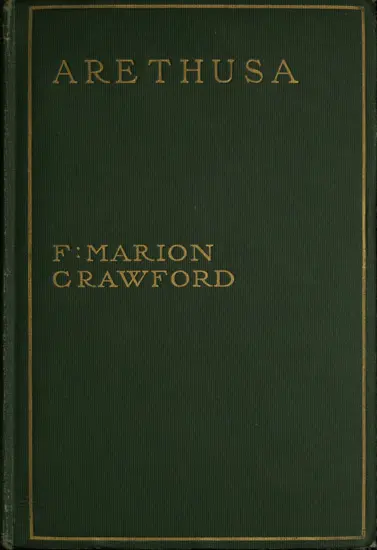
THE CLASSIC COLLECTION · 1906
"Arethusa" by F. Marion Crawford is a historical novel written in the early 20th century. Set in 14th century Constantinople, the narrative centers around Carlo Zeno, a Venetian merchant with a colorful past, as he navigates both the complexities of the city and the societal issues of his time, including slavery and intrigue. The story aims to explore themes of identity, survival, and social class through the lens of its characters, particularly focusing on the dynamics between privilege and poverty. At the start of the narrative, we are introduced to Carlo Zeno, who is settling into his life as a merchant in Constantinople after a tumultuous past. He observes the city around him, filled with its vibrant cultures and discord between different nationalities, particularly between Venetians and Genoese. As the plot unfolds, Zeno receives a letter from a friend in Venice, requesting him to purchase a slave girl for his wife, setting the stage for the exploration of human relationships under the conditions of slavery. The narrative simultaneously introduces a young girl named Zoë, living in the depths of poverty with her ailing mother, whose fate is intricately linked to Zeno’s decision about the slave market. This opening serves as a critical setup for the characters' intertwining destinies and the moral dilemmas they face.
Introduction adapted from the source catalogue; source summaries may be automatically generated.
Free to read · English · 101,479 words · No account needed
MAKE TIME FOR A GOOD BOOK
On by default. Untick to stop anonymous reading totals. Each page counts after 10 seconds in view. How this works.
Anonymous counting is on unless you have switched it off.
And now, fate had placed within her reach the instrument of vengeance, the bravest, rashest, wisest, most desperate of mankind. Her heart had silently and joyfully drunk in every word that Gorlias had said about the man who owned her as he owned the carpet under her feet, the roof over her head, and the clothes that covered her.
He was within her reach, but he was not within her power. Not yet. Her mood had changed, and for a while, not knowing what she dreamt of, she wished that she were indeed one of those Eastern enchantresses of whom she had often heard, without half understanding, who roused men to frenzy, or lulled their lovers to sleep and ruin, as they would; she wished she were that wicked Antonina, for whom brave, pure-hearted Belisarius had humbled himself in the dust; she wished she were Theodora, shamelessly great and fair, an imperial Vision of Sin, compelling to her heel the church-going, priest-haunted master of half the known world--Justinian. She knew the story of her adopted country. What had either of those women that she had not, wherewith to master a man?
Then the tide of shame came back, and she turned her face away from the empty room, as if it had guessed her thoughts; and then, to get away from them, she called her maids, clapping her hands sharply. They came running in and stood before her.
'Go, Yulia,' she said, 'find the secretary and beg him to come to me.'
While she waited, she made Lucilla arrange her veil again so that it hid her face, and this was scarcely done when Omobono was ushered in by the other girl. He bowed to Zoë and gravely stroked his pointed beard.
'What is the Kokóna's pleasure?' he asked, after a pause.
'Do you speak Latin?' Zoë enquired, in that language.
The little man drew himself up proudly, and cleared his throat.
'In my family we have been notaries for five generations,' he answered, in language that was comprehensible but would have filled an average Churchman with vague uneasiness, and would have made Cicero's ashes rattle in their urn.
Zoë was satisfied, however, for though her maids might understand Italian, she was quite sure that Latin was beyond them. She herself spoke it far more correctly than Omobono, though with a rather lisping Greek accent. She could not have helped saying 'vonus' for 'bonus,' 'eyo' for 'ego,' and 'Thominus' for 'Dominus.'
'Where is Thominus Carolus?' she enquired, so suddenly that the secretary was almost taken off his guard.
'He is--he is gone out,' he answered.
Your reading position is saved on this browser. Take it to another device with a library code. Reading pages adapt to text, rather than matching a printed edition.
F. Marion (Francis Marion) Crawford
F. Marion (Francis Marion) Crawford

F. Marion (Francis Marion) Crawford
F. Marion (Francis Marion) Crawford
BEHIND THE BOOK
This eBook is for the use of anyone anywhere in the United States and most other parts of the world at no cost and with almost no restrictions whatsoever. You may copy it, give it away or re-use it under the terms of the Project Gutenberg License included with this eBook or online at www.gutenberg.org. If you are not located in the United States, you will have to check the laws of the country where you are located before using this eBook. Read the source licence.
The original source file, including credits and licence, is retained by this library. Request an original-format copy at no charge. Please include the book title and Project Gutenberg identifier #41929.
KEEP YOUR CURIOSITY GOING
Cécile Tormay

Moritz Busch
Coulson Kernahan
John L. Ransom

Maurice Baring
Frances Wright