
Nobody’s fault
Netta Syrett
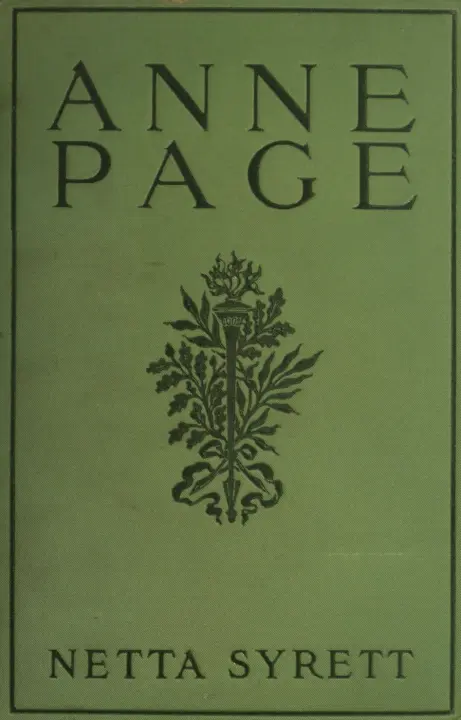
THE CLASSIC COLLECTION · 1909
"Anne Page" by Netta Syrett is a novel written in the early 20th century. The story centers around the character of Anne Page, who is depicted as a graceful and beautiful woman, despite being not young anymore. The narrative begins in her idyllic garden at Fairholme Court, setting a tone of nostalgia and exploration of her relationships with the people around her, particularly the guests who come to dinner at her home. The opening of the novel paints a picturesque image of Anne Page's serene life, highlighting her beauty and the enchanting qualities of her garden at twilight. As she prepares for her dinner guests, including the Vicar, his wife, and her old friend François Fontenelle, we get a sense of Anne's charm and her ability to connect with others. The arrival of François stirs memories and deeper conversations, revealing layers of her character and relationships that provide an intriguing insight into her past and the complexities of her present life. This initial chapter suggests that the novel will explore themes of beauty, love, and the passage of time, along with the social dynamics within her circle of acquaintances.
Introduction adapted from the source catalogue; source summaries may be automatically generated.
Free to read · English · 65,771 words · No account needed
MAKE TIME FOR A GOOD BOOK
On by default. Untick to stop anonymous reading totals. Each page counts after 10 seconds in view. How this works.
Anonymous counting is on unless you have switched it off.
At four o’clock, Sylvia Carfax swung the gate of the Vicarage garden behind her, and stepped into the dusty road.
It was nearly a mile to Fairholme Court, and the sun blazed in a sky of cloudless blue, and beat upon her shoulders protected only by a blouse of thin muslin.
Sylvia was just twenty, tall slim, and, as Miss Page suggested very
pretty.
In her own mind Anne often wondered when she looked at the girl’s rich black hair, which made such a striking contrast to eyes blue as the sky, that from the shelter of the Vicarage and all it represented such a southern, opulent type of beauty should have emerged.
To reach her destination Sylvia had to walk through the village, past the blacksmith’s, and past the baker’s shop, with its quaint carving over the entrance porch.
Dymfield was an ideally beautiful village, to which even the doctor’s motor-car scarcely brought more than a hint of the rush and hurry and ugliness of much of modern life.
In the gardens of the thatched cottages, summer flowers made a blaze of colour. Roses and honeysuckle clambered over porch and roof.
The church, resting peacefully in the green sea of the churchyard, was like some great rock, stained with lichen, crumbling with age, beautiful in its decay.
Near it, under the shade of mighty elms, was a row of almshouses, fine specimens of black-and-white work, and at the end of the rambling street stood the old well, with its canopy of wrought iron, and its ancient moss-grown steps.
As she passed through the village in which from babyhood she had lived, Sylvia recognized its beauty and its peace. It seemed a place where it was always afternoon, and for that reason, to the girl who yearned for the morning, herself in the glad confident morning of life, it was intolerable.
She gave herself an impatient little shake, and hurried on.
Now, across the green, the beeches of Fairholme Court were in sight.
In summer they almost completely screened the house, and made deep shadows in the drive. Thankfully Sylvia plunged into the shade and quickened her steps.
The hall door was wide open, revealing the coolness of the
white-panelled hall, and as she entered, the air was sweet with the
scent of flowers.
She stopped a moment to bend over a great bowl of sweet peas.
“Everything is peaceful here too,” she thought. “But it’s interesting as well. I wonder why?”
The appearance of Burks, immaculate as usual in snowy cap and apron, interrupted her vague musing.
“Mistress is upstairs in her sitting-room. I’ll tell her you’re here,
miss.”
Your reading position is saved on this browser. Take it to another device with a library code. Reading pages adapt to text, rather than matching a printed edition.
BEHIND THE BOOK
This eBook is for the use of anyone anywhere in the United States and most other parts of the world at no cost and with almost no restrictions whatsoever. You may copy it, give it away or re-use it under the terms of the Project Gutenberg License included with this eBook or online at www.gutenberg.org. If you are not located in the United States, you will have to check the laws of the country where you are located before using this eBook. Read the source licence.
The original source file, including credits and licence, is retained by this library. Request an original-format copy at no charge. Please include the book title and Project Gutenberg identifier #73015.
KEEP YOUR CURIOSITY GOING
Coulson Kernahan

Maurice Baring
Frances Wright
Cécile Tormay

Frederic Jesup Stimson

W. H. P. (William Henry Pope) Jarvis