THE CLASSIC COLLECTION✦A dead man’s diaryCLASSIC FREE BOOKS
A dead man’s diary
Coulson Kernahan
THE CLASSIC COLLECTION · 1902
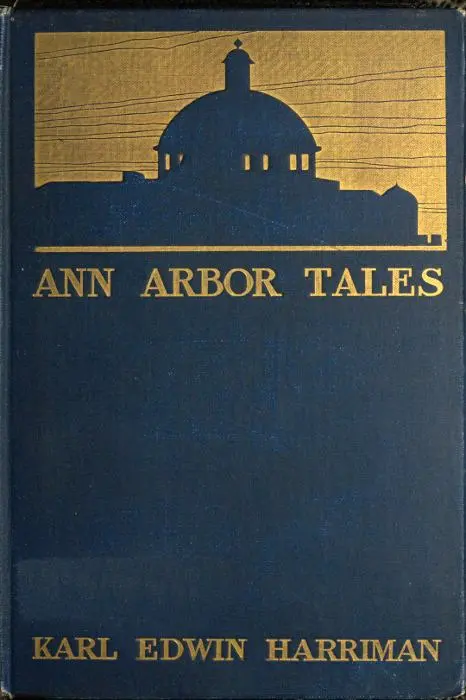
"Ann Arbor Tales" by Karl Edwin Harriman is a collection of stories written in the early 20th century. The narrative introduces characters navigating love, youth, and the complexities of relationships within the backdrop of Ann Arbor. It highlights themes of ambition, romance, and personal growth, especially focusing on characters such as Jack Houston, a young man grappling with his passions and vices, and Florence, a captivating woman intertwined in his life. The opening of the book sets the stage with a vivid and nostalgic portrayal of the youthful atmosphere in Ann Arbor during a summer filled with possibilities. It centers on Jack Houston and his enchantment with Florence, offering a glimpse into their budding romance against the collegiate backdrop. As their relationship develops, various dynamics emerge, including the influence of their peers, Jack's struggles with alcohol, and the contrasting personalities that surround them, particularly the steadfast Jim Crowley. The scene unfolds with a tone of both excitement and melancholy, hinting at the complexities that will define their interactions and the emotional landscape that lies ahead.
Introduction adapted from the source catalogue; source summaries may be automatically generated.
Free to read · English · 59,594 words · No account needed
MAKE TIME FOR A GOOD BOOK
On by default. Untick to stop anonymous reading totals. Each page counts after 10 seconds in view. How this works.
Anonymous counting is on unless you have switched it off.
The dean presided--a large man with reddish hair and pleasant eyes and
a jerky, nervous manner.
Inasmuch as it was assistant professor Lowe who had found Catherwood, gagged and tied, that savant was asked to give his opinion, first.
With much natural evasion of the subject, and a cloud of "ahs" and "aws," he explained as lucidly as his slow moving mind would permit how he had rushed into the room to discover his pupil stowed away upon the bed behind a barricade of chairs.
"And, professor," inquired the dean, "you can throw no light upon the case; you have learned nothing--that is to say--oh--ah--nothing that might serve as a clue to the apprehension of the offenders?"
The room became as still as the royal ante-chamber whilst the king dies
beyond the arras.
The assistant professor fumbled in his pockets and finally drew out the crumpled note that Catherwood had given him, which he offered the dean, meekly, as becomes a serf in the presence of his master.
The dean pursed his lips and looked down at the sheet.
"Oh--ah," he muttered. And then added, passing it back to the assistant professor, "I--oh--ah--make nothing out of this--nothing at all. It is very simple. It shows that Mr.--oh--ah--Catherwood was assaulted by two--two--persons. But, that, gentlemen, we already know. What we now wish to learn is: Who were they?"
The assistant professor shook his head, wearily.
"Yes, yes," he muttered.
At this point an aged man at the rear of the room rose, and clearing his throat asked in a dry, metallic cackle: "Am I to understand that the young gentleman is a member of a fraternity?"
It was quite apparent that no one appreciated clearly the significance of the old gentleman's question.
The dean stared inquiringly over his glasses at the assistant professor
of history.
"He is not----"
"He is not," echoed the dean.
"Oh," cackled the old gentleman and sat down. His prejudice against fraternities was well known. Several of the younger men present, who wore their pins on occasion, glanced at one another and smiled.
"It would--oh--ah--seem to me," began the dean, when he was interrupted by that dry, metallic cackle a second time.
"Does he contemplate joining a fraternity?"
"No," Lowe shouted.
"Oh"--and the old gentleman sat down again.
In the second row there rose a round, boy-faced man with a pompadour, who, after clearing his throat, began:
"It would seem to me, gentlemen, that we are on the wrong track; what? It would seem to me that there is a way--a sure way--of apprehending the villains who seem to have worsted our young friend, Mr. Catherwood; what?"
Your reading position is saved on this browser. Take it to another device with a library code. Reading pages adapt to text, rather than matching a printed edition.
BEHIND THE BOOK
This eBook is for the use of anyone anywhere in the United States and most other parts of the world at no cost and with almost no restrictions whatsoever. You may copy it, give it away or re-use it under the terms of the Project Gutenberg License included with this eBook or online at www.gutenberg.org. If you are not located in the United States, you will have to check the laws of the country where you are located before using this eBook. Read the source licence.
The original source file, including credits and licence, is retained by this library. Request an original-format copy at no charge. Please include the book title and Project Gutenberg identifier #41816.
KEEP YOUR CURIOSITY GOING
Coulson Kernahan

Maurice Baring
Frances Wright
Cécile Tormay

Frederic Jesup Stimson

W. H. P. (William Henry Pope) Jarvis