THE CLASSIC COLLECTION✦A dead man’s diaryCLASSIC FREE BOOKS
A dead man’s diary
Coulson Kernahan
THE CLASSIC COLLECTION · 1902
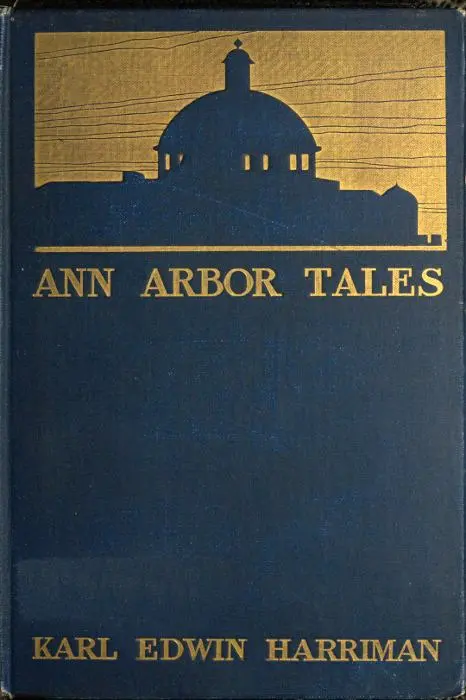
"Ann Arbor Tales" by Karl Edwin Harriman is a collection of stories written in the early 20th century. The narrative introduces characters navigating love, youth, and the complexities of relationships within the backdrop of Ann Arbor. It highlights themes of ambition, romance, and personal growth, especially focusing on characters such as Jack Houston, a young man grappling with his passions and vices, and Florence, a captivating woman intertwined in his life. The opening of the book sets the stage with a vivid and nostalgic portrayal of the youthful atmosphere in Ann Arbor during a summer filled with possibilities. It centers on Jack Houston and his enchantment with Florence, offering a glimpse into their budding romance against the collegiate backdrop. As their relationship develops, various dynamics emerge, including the influence of their peers, Jack's struggles with alcohol, and the contrasting personalities that surround them, particularly the steadfast Jim Crowley. The scene unfolds with a tone of both excitement and melancholy, hinting at the complexities that will define their interactions and the emotional landscape that lies ahead.
Introduction adapted from the source catalogue; source summaries may be automatically generated.
Free to read · English · 59,594 words · No account needed
MAKE TIME FOR A GOOD BOOK
On by default. Untick to stop anonymous reading totals. Each page counts after 10 seconds in view. How this works.
Anonymous counting is on unless you have switched it off.
There was only one who seemed to see the end--Crowley--Houston's room-mate, nearest pal--as unlike him as white is unlike black, and therefore, perhaps, more fondly loving. It was because he loved him as he did that Crowley saw--saw the end as clearly as he saw the printed page before his eyes, and shuddered at the sight. He saw a brilliant mind dethroned; a splendid body ruined; a father killed with grief--and seeing, thus, he was glad that Houston's mother had passed away while he was yet a little, brown-eyed, red-cheeked boy.
His misgivings heavy upon his heart, he spoke of them to Florence. At first, her eyes glinted a cold harsh light, but as he talked on and on, fervently, passionately, that light went out, and another came that burned brighter, as he cried:
"Oh, can't something be done? Something?"
They walked on a way in silence, and then she said, quietly, as was her manner, always: "Do you think I could help?"
He seized her hand and she looked up into his eyes, smiling.
"Oh, if you could!" he cried; and then: "Would you try?" But before she could answer he flung down her hand saying: "But no, you couldn't; what was I thinking of!"
They were walking by the river to the east, where, on the right, the hill rose sheer--a tangle of vivid green--from the heart of which a spring leapt and tinkled over smooth, white pebbles, to lose itself again in the earth below, bubbling noisily.
At his expression, or, more at the tone he employed in its utterance, she shrank from him, and then, regardless of her steps, sped half-way up the hill, beside the spring course. There she flung herself upon a mossy plot, face down.
Crowley called to her from the road, but she did not answer; he went to her, and stooping touched her shoulder. Her whole body, prone before him, quivered. She was crying.
He talked to her a long time, there in the woodland, silence about them save for the calls of the birds.
She turned her wet eyes upon his face.
"Oh, to think every one doubts me!" she murmured. "You laughed at me when I asked you if I could help--you think I'm only a toy-like girl--a sort of great cat to be fondled always."
She seized a stick, broke it impetuously across her knee and rose before
him.
"I will help!" she cried, "I will--and you'll see what I'll do!"
Afterward--long afterward--he remembered her, as she was that moment--her golden hair tumbling upon her shoulders; her eyes blazing, her glorious figure erect, her white hands clenched at her sides.
Your reading position is saved on this browser. Take it to another device with a library code. Reading pages adapt to text, rather than matching a printed edition.
BEHIND THE BOOK
This eBook is for the use of anyone anywhere in the United States and most other parts of the world at no cost and with almost no restrictions whatsoever. You may copy it, give it away or re-use it under the terms of the Project Gutenberg License included with this eBook or online at www.gutenberg.org. If you are not located in the United States, you will have to check the laws of the country where you are located before using this eBook. Read the source licence.
The original source file, including credits and licence, is retained by this library. Request an original-format copy at no charge. Please include the book title and Project Gutenberg identifier #41816.
KEEP YOUR CURIOSITY GOING
Coulson Kernahan

Maurice Baring
Frances Wright
Cécile Tormay

Frederic Jesup Stimson

W. H. P. (William Henry Pope) Jarvis