
Letters to a Friend, Written to Mrs. Ezra S. Carr, 1866-1879
John Muir
THE CLASSIC COLLECTION · 1888
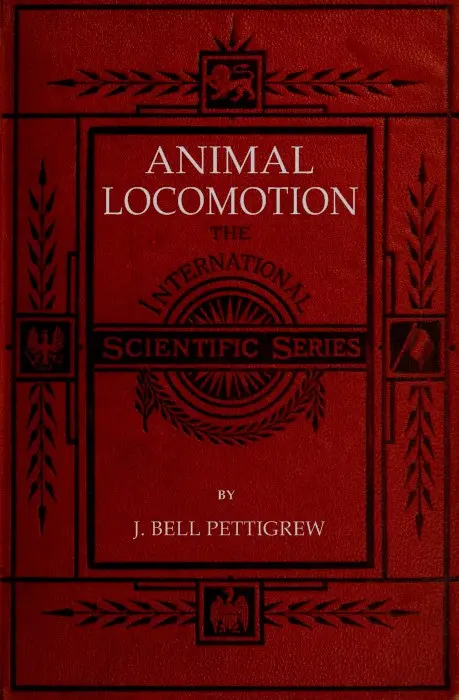
"Animal Locomotion; or, Walking, Swimming, and Flying" by James Bell Pettigrew is a scientific publication written in the late 19th century. This work explores the mechanics of movement in various animals, focusing specifically on their modes of locomotion across different environments—on land, in water, and through the air. The book aims to elucidate the principles underlying the physical forces and structures that enable animals to move effectively and elegantly. The opening of the book introduces the topic of animal locomotion as a fundamental aspect of life that is inherently intertwined with the survival and well-being of creatures. Pettigrew emphasizes that motion is not isolated to the animal kingdom but is a characteristic of all matter, drawing connections between natural phenomena and the potential for artificial movement. Through engaging descriptions, he illustrates the beauty and complexity of animal movement, setting the stage for a detailed examination of walking, swimming, and flying as interconnected themes of progression within the natural world.
Introduction adapted from the source catalogue; source summaries may be automatically generated.
Free to read · English · 96,637 words · No account needed
MAKE TIME FOR A GOOD BOOK
On by default. Untick to stop anonymous reading totals. Each page counts after 10 seconds in view. How this works.
Anonymous counting is on unless you have switched it off.
[18] Lectures “On the Physiology of the Circulation in Plants, in the Lower Animals, and in Man,” by the Author.--Edinburgh Medical Journal for September 1872.
In order to understand the twisting which occurs to a greater or less extent in the bodies and extremities (when present) of all vertebrated animals, it is necessary to reduce the bony and muscular systems to their simplest expression. If motion is desired in a dorsal, ventral, or lateral direction only, a dorsal and ventral or a right and left lateral set of longitudinal muscles acting upon straight bones articulated by an ordinary ball-and-socket joint will suffice. In this case the dorsal, ventral, and right and left lateral muscles form muscular cycles; contraction or shortening on the one aspect of the cycle being accompanied by relaxation or elongation on the other, the bones and joints forming as it were the diameters of the cycles, and oscillating in a backward, forward, or lateral direction in proportion to the degree and direction of the muscular movements. Here the motion is confined to two planes intersecting each other at right angles. When, however, the muscular system becomes more highly differentiated, both as regards the number of the muscles employed, and the variety of the directions pursued by them, the bones and joints also become more complicated. Under these circumstances, the bones, as a rule, are twisted upon themselves, and their articular surfaces present various degrees of spirality to meet the requirements of the muscular system. Between the straight longitudinal muscles, therefore, arranged in dorsal and ventral, and right and left lateral sets, and those which run in a more or less transverse direction, and between the simple joint whose motion is confined to one plane and the ball-and-socket joints whose movements are universal, every degree of obliquity is found in the direction of the muscles, and every possible modification in the disposition of the articular surfaces. In the fish the muscles are for the most part arranged in dorsal, ventral, and lateral sets, which run longitudinally; and, as a result, the movements of the trunk, particularly towards the tail, are from side to side and sinuous. As, however, oblique fibres are also present, and the tendons of the longitudinal muscles in some instances cross obliquely towards the tail, the fish has also the power of tilting or twisting its trunk (particularly the lower half) as well as the caudal fin. In a mackerel which I examined, the oblique muscles were represented by the four lateral masses occurring between the dorsal, ventral, and lateral longitudinal muscles--two of these being found on either side of the fish, and corresponding to the myocommas or “grand muscle latéral” of Cuvier. The muscular system of the fish would therefore seem to be arranged on a fourfold plan,--there being four sets of longitudinal muscles, and a corresponding number of slightly oblique and oblique muscles, the oblique muscles being spiral in their nature and tending to cross or intersect at various angles, an arrest of the intersection, as it appears to me, giving rise to the myocommas and to that concentric arrangement of their constituent parts so evident on transverse section. This tendency of the muscular fibres to cross each other at various degrees of obliquity may also be traced in several parts of the human body, as, for instance, in the deltoid muscle of the arm and the deep muscles of the leg. Numerous other examples of penniform muscles might be adduced. Although the fibres of the myocommas have a more or less longitudinal direction, the myocommas themselves pursue an oblique spiral course from before backwards and from within outwards, i.e. from the spine towards the periphery, where they receive slightly oblique fibres from the longitudinal dorsal, ventral, and lateral muscles. As the spiral oblique myocommas and the oblique fibres from the longitudinal muscles act directly and indirectly upon the spines of the vertebræ, and the vertebræ themselves to which they are specially adapted, and as both sets of oblique fibres are geared by interdigitation to the fourfold set of longitudinal muscles, the lateral, sinuous, and rotatory movements of the body and tail of the fish are readily accounted for. The spinal column of the fish facilitates the lateral sinuous twisting movements of the tail and trunk, from the fact that the vertebræ composing it are united to each other by a series of modified universal joints--the vertebræ supplying the cup-shaped depressions or sockets, the intervertebral substance, the prominence or ball.
Your reading position is saved on this browser. Take it to another device with a library code. Reading pages adapt to text, rather than matching a printed edition.
BEHIND THE BOOK
This eBook is for the use of anyone anywhere in the United States and most other parts of the world at no cost and with almost no restrictions whatsoever. You may copy it, give it away or re-use it under the terms of the Project Gutenberg License included with this eBook or online at www.gutenberg.org. If you are not located in the United States, you will have to check the laws of the country where you are located before using this eBook. Read the source licence.
The original source file, including credits and licence, is retained by this library. Request an original-format copy at no charge. Please include the book title and Project Gutenberg identifier #56427.
KEEP YOUR CURIOSITY GOING
John Muir

Asa Gray
Asa Gray

Florence Nightingale
Elizabeth Robins Pennell
Denison Olmsted