
Letters to a Friend, Written to Mrs. Ezra S. Carr, 1866-1879
John Muir
THE CLASSIC COLLECTION · 1888
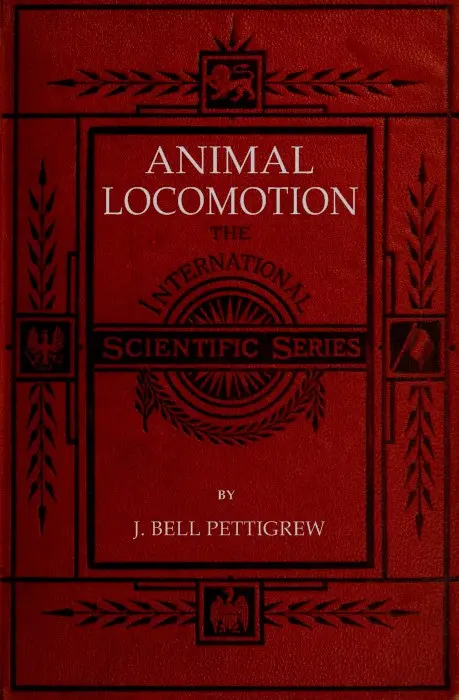
"Animal Locomotion; or, Walking, Swimming, and Flying" by James Bell Pettigrew is a scientific publication written in the late 19th century. This work explores the mechanics of movement in various animals, focusing specifically on their modes of locomotion across different environments—on land, in water, and through the air. The book aims to elucidate the principles underlying the physical forces and structures that enable animals to move effectively and elegantly. The opening of the book introduces the topic of animal locomotion as a fundamental aspect of life that is inherently intertwined with the survival and well-being of creatures. Pettigrew emphasizes that motion is not isolated to the animal kingdom but is a characteristic of all matter, drawing connections between natural phenomena and the potential for artificial movement. Through engaging descriptions, he illustrates the beauty and complexity of animal movement, setting the stage for a detailed examination of walking, swimming, and flying as interconnected themes of progression within the natural world.
Introduction adapted from the source catalogue; source summaries may be automatically generated.
Free to read · English · 96,637 words · No account needed
MAKE TIME FOR A GOOD BOOK
On by default. Untick to stop anonymous reading totals. Each page counts after 10 seconds in view. How this works.
Anonymous counting is on unless you have switched it off.
The force of muscles, according to the experiments of Schwann, increases with their length, and vice versa. It is a curious circumstance, and worthy the attention of those interested in homologies, that the voluntary muscles of the superior and inferior extremities, and more especially of the trunk, are arranged in longitudinal, transverse, and oblique spiral lines, and in layers or strata precisely as in the ventricles of the heart and hollow muscles generally.[17] If, consequently, I eliminate the element of bone from these several regions, I reproduce a typical hollow muscle; and what is still more remarkable, if I compare the bones removed (say the bones of the anterior extremity of a quadruped or bird) with the cast obtained from the cavity of a hollow muscle (say the left ventricle of the heart of the mammal), I find that the bones and the cast are twisted upon themselves, and form elegant screws, the threads or ridges of which run in the same direction. This affords a proof that the involuntary hollow muscles supply the type or pattern on which the voluntary muscles are formed. Fig. 6 represents the bones of the wing of the bird; fig. 7 the bones of the anterior extremity of the elephant; and fig. 8 the cast or mould of the cavity of the left ventricle of the heart of the deer.
[17] “On the Arrangement of the Muscular Fibres in the Ventricles of the Vertebrate Heart, with Physiological Remarks,” by the Author.--Philosophical Transactions, 1864.
“On the Muscular Arrangements of the Bladder and Prostate, and the manner in which the Ureters and Urethra are closed,” by the Author.--Philosophical Transactions, 1867.
“On the Muscular Tunics in the Stomach of Man and other Mammalia,” by the Author.--Proceedings Royal Society of London, 1867.
It has been the almost invariable custom in teaching anatomy, and such parts of physiology as pertain to animal movements, to place much emphasis upon the configuration of the bony skeleton as a whole, and the conformation of its several articular surfaces in particular. This is very natural, as the osseous system stands the wear and tear of time, while all around it is in a great measure perishable. It is the link which binds extinct forms to living ones, and we naturally venerate and love what is enduring. It is no marvel that Oken, Goethe, Owen, and others should have attempted such splendid generalizations with regard to the osseous system--should have proved with such cogency of argument that the head is an expanded vertebra. The bony skeleton is a miracle of design very wonderful and very beautiful in its way. But when all has been said, the fact remains that the skeleton, when it exists, forms only an adjunct of locomotion and motion generally. All the really essential movements of an animal occur in its soft parts. The osseous system is therefore to be regarded as secondary in importance to the muscular, of which it may be considered a differentiation. Instead of regarding the muscles as adapted to the bones, the bones ought to be regarded as adapted to the muscles. Bones have no power either of originating or perpetuating motion. This begins and terminates in the muscles. Nor must it be overlooked, that bone makes its appearance comparatively late in the scale of being; that innumerable creatures exist in which no trace either of an external or internal skeleton is to be found; that these creatures move freely about, digest, circulate their nutritious juices and blood when present, multiply, and perform all the functions incident to life. While the skeleton is to be found in only a certain proportion of the animals existing on our globe, the soft parts are to be met with in all; and this appears to me an all-sufficient reason for attaching great importance to the movements of soft parts, such as protoplasm, jelly masses, involuntary and voluntary muscles, etc.[18] As the muscles of vertebrates are accurately applied to each other, and to the bones, while the bones are rigid, unyielding, and incapable of motion, it follows that the osseous system acts as a break or boundary to the muscular one,--and hence the arbitrary division of muscles into extensors and flexors, pronators and supinators, abductors and adductors. This division although convenient is calculated to mislead. The most highly organized animal is strictly speaking to be regarded as a living mass whose parts (hard, soft, and otherwise) are accurately adapted to each other, every part reciprocating with scrupulous exactitude, and rendering it difficult to determine where motion begins and where it terminates. Fig. 9 shows the more superficial of the muscular masses which move the bones or osseous levers of the horse, as seen in the walk, trot, gallop, etc. A careful examination of these carneous masses or muscles will show that they run longitudinally, transversely, and obliquely, the longitudinal and transverse muscles crossing each other at nearly right angles, the oblique ones tending to cross at various angles, as in the letter X. The crossing is seen to most advantage in the deep muscles.
Your reading position is saved on this browser. Take it to another device with a library code. Reading pages adapt to text, rather than matching a printed edition.
BEHIND THE BOOK
This eBook is for the use of anyone anywhere in the United States and most other parts of the world at no cost and with almost no restrictions whatsoever. You may copy it, give it away or re-use it under the terms of the Project Gutenberg License included with this eBook or online at www.gutenberg.org. If you are not located in the United States, you will have to check the laws of the country where you are located before using this eBook. Read the source licence.
The original source file, including credits and licence, is retained by this library. Request an original-format copy at no charge. Please include the book title and Project Gutenberg identifier #56427.
KEEP YOUR CURIOSITY GOING
John Muir

Asa Gray
Asa Gray

Florence Nightingale
Elizabeth Robins Pennell
Denison Olmsted