THE CLASSIC COLLECTION✦History of HollandCLASSIC FREE BOOKS
History of Holland
George Edmundson
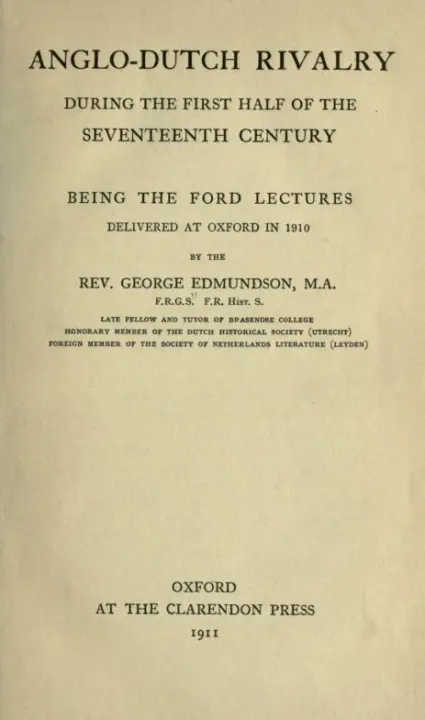
THE CLASSIC COLLECTION · 1911
"Anglo-Dutch Rivalry During the First Half of the Seventeenth Century" by George Edmundson is a historical account written in the early 20th century. The work examines the complex relationships and conflicts between England and the Dutch Republic during a pivotal period marked by maritime and commercial competition. Specifically, the book aims to analyze the causes and developments of the ongoing rivalry that eventually led to open hostilities between the two seafaring nations. The opening of the text sets the tone for an in-depth investigation into the political and economic dynamics that ignited tensions between England and the Netherlands. Edmundson introduces the backdrop of maritime prowess and trade interests that characterized both nations during the late 16th and early 17th centuries, emphasizing the shared history against a common enemy, Spain, while foreshadowing the inevitable conflicts that arose from their competitive spirits. He highlights key events, such as the Dutch wars and the interactions between influential leaders, which laid the groundwork for the escalating rivalry over fishing rights and trade supremacy. This initial exploration establishes the foundational context for the detailed analysis that follows in subsequent chapters.
Introduction adapted from the source catalogue; source summaries may be automatically generated.
Free to read · English · 50,252 words · No account needed
MAKE TIME FOR A GOOD BOOK
On by default. Untick to stop anonymous reading totals. Each page counts after 10 seconds in view. How this works.
Anonymous counting is on unless you have switched it off.
[9] A Pollitique Platt, by Robert Hitchcock, 1580.
Observations made upon the Dutch fishery about the year 1601, by John Keymer. Ralegh, Works, i. 144.
Sir Thomas Overbury's observations in his travels in 1609: Harleian
Misc. viii. 349.
Discourse addressed to the King by Sir Nicholas Hales, on the benefit derived by the Dutch from English fisheries. Terms suggested for granting them a licence to fish for twenty-one years. Calendar of State Papers, Dom. Ser., 1603-10, p. 509.
[10] Cal. State Papers, Dom. Ser., 1603-10, p. 509.
[11] Statutes of the Realm, iv. 2, p. 1058.
[12] Letter of Salisbury to Cornwallis, June 8, 1609. Winwood's
State Papers, iii. 44-50.
[13] Fruin's Verspreide Geschriften, vol. iii, pp. 408-45.
Delayed by various causes, it was not till April 16, 1610, that the embassy from the States set sail from Brill for England. The object of the mission was ostensibly a complimentary one--to thank the King for the active part he had taken, as a mediator, in bringing the truce negotiations to a favourable issue. The two matters which called for serious discussion were: (1) the critical situation which had arisen in the Jülich-Cleves Duchies owing to a disputed succession; (2) the proclamation about the fisheries. The importance of the last question was revealed by the fact that all the five envoys originally selected were representatives of the two maritime provinces. One of the five died at Brill just before starting. The four who actually sailed (April 16) were: Johan Berck, pensionary of Dort; Albert de Veer, pensionary of Amsterdam; Elias van Oldenbarneveldt, pensionary of Rotterdam; and a Zeelander, Albert Joachimi, who was later to show himself a skilful diplomatist during the twenty-five years that he was resident Dutch ambassador in London. Elias van Oldenbarneveldt was the brother of the Advocate of Holland. According to a letter from Sir Ralph Winwood[14] to Lord Salisbury he had special charge of the fishery question, a proof of the peculiar interest felt by the Advocate in the issue raised. With them was joined the resident ambassador, Noel Caron. Their instructions required them to seek from His Majesty an explanation of his intentions in the proclamation, 'since their High Mightinesses the States-General could not believe that he meant to include the inhabitants of the United Netherlands among those who were bidden to pay for a licence to fish, since this was contrary to the ancient treaties subsisting between them and the Crowns of England and Scotland. After audiences with the King (April 27) and with the Privy Council (May 8), it was arranged that a Conference on the fisheries question should be held, with a Committee of the Council, two of whose members were Sir Julius Caesar, Chancellor of the Exchequer, and Sir Thomas Parry, Chancellor of the Duchy of Lancaster. The Conference opened on May 16, and the points in dispute were argued at length. The Dutch case was presented in a memorandum drawn up with much skill, probably by the hand of Hugo Grotius himself. The freedom of fishing was claimed on two grounds: (1) that of the privileges granted by ancient treaties still in force; (2) that of abstract right, because the sea, like the air, is for the common use of all and cannot be private property. The weak point of the case lay in the fact that these two grounds, that of treaty right and that of the Mare Liberum, seemed to be in a certain sense contradictory. The English, however, would not admit that the question of the immemorial claim of the Kings of England to sovereignty and jurisdiction in the seas adjoining the British coasts was open to discussion, and seizing upon the argument placed in their hands by the Dutch memorandum itself, pleaded with great force that the granting of privileges implied the power to take them away or modify them, should the King deem such a step necessary to protect the interests of his own subjects. The Conference therefore effected nothing more than the bringing out in relief of the differences of view of the two parties. But reflection brought wisdom. There was no wish on either side to press matters to extremities. Already on May 10 the States-General, unwilling to run the risk of making James an enemy, at a time when they were very anxious to secure his help in the settlement of the Jülich-Cleves succession question[15], had sent instructions to their ambassadors not to make difficulties or unpleasantness about the fisheries, but rather to propose that the execution of the proclamation should be postponed for two years, in order that the question might be thoroughly investigated. There were several claimants to the Jülich-Cleves inheritance, Protestant and Catholic, and it was of vital importance to the States, and also to a lesser extent to all Protestant princes in Germany and to James, that this frontier territory on the Rhine should not fall under the rule of a Catholic sovereign. But the Archduke Leopold had seized the fortress of Jülich, and Henry IV of France, jealous of the power of the House of Habsburg in Europe, had put himself at the head of a coalition to secure the succession to the Elector of Brandenburg, and William, Count Palatine of Neuburg, as joint possessors. There was a general desire to avoid hostilities, but Henry IV had pushed forward his preparations for a great campaign, and war seemed inevitable. At this moment the assassination of the French king at the very time the Conference was being held in London changed the whole aspect of affairs. The new French Government was favourably disposed to Spain. The Dutch therefore were left face to face with the task of expelling the Archduke from Jülich, and they felt that all other matters were for the moment of secondary importance to that of having the friendly co-operation of James in case of the outbreak of war. Their attitude to the fisheries question was therefore considerably modified. It became much more conciliatory, and for precisely similar reasons a like change took place in the attitude of the English King. He too felt that the friendship of the Dutch was essential to him at such a critical juncture, and at a meeting with the Earls of Salisbury and Northampton, May 24, the Dutch envoys were agreeably surprised to find that the King, while not formally abating one jot of his sovereign rights in the matter of issuing licences for fishing, was willing to postpone the execution of his edict for two years. The ambassadors took leave of the King the same day and started on their return journey. Of this audience the Lords of the Council, in a letter to Winwood, dated May 18, 1610 (o.s.), write:
Your reading position is saved on this browser. Take it to another device with a library code. Reading pages adapt to text, rather than matching a printed edition.
BEHIND THE BOOK
This eBook is for the use of anyone anywhere in the United States and most other parts of the world at no cost and with almost no restrictions whatsoever. You may copy it, give it away or re-use it under the terms of the Project Gutenberg License included with this eBook or online at www.gutenberg.org. If you are not located in the United States, you will have to check the laws of the country where you are located before using this eBook. Read the source licence.
The original source file, including credits and licence, is retained by this library. Request an original-format copy at no charge. Please include the book title and Project Gutenberg identifier #48697.
KEEP YOUR CURIOSITY GOING
Cécile Tormay

Moritz Busch
John L. Ransom
Frances Wright
Cécile Tormay

Mabel Potter Daggett