THE CLASSIC COLLECTION✦History of HollandCLASSIC FREE BOOKS
History of Holland
George Edmundson
THE CLASSIC COLLECTION · 1911
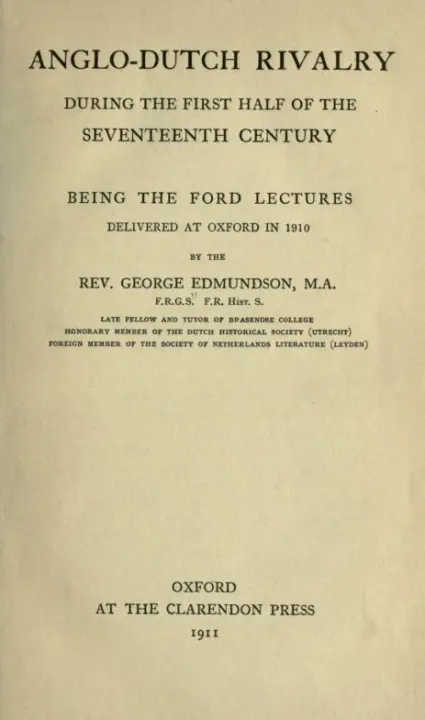
"Anglo-Dutch Rivalry During the First Half of the Seventeenth Century" by George Edmundson is a historical account written in the early 20th century. The work examines the complex relationships and conflicts between England and the Dutch Republic during a pivotal period marked by maritime and commercial competition. Specifically, the book aims to analyze the causes and developments of the ongoing rivalry that eventually led to open hostilities between the two seafaring nations. The opening of the text sets the tone for an in-depth investigation into the political and economic dynamics that ignited tensions between England and the Netherlands. Edmundson introduces the backdrop of maritime prowess and trade interests that characterized both nations during the late 16th and early 17th centuries, emphasizing the shared history against a common enemy, Spain, while foreshadowing the inevitable conflicts that arose from their competitive spirits. He highlights key events, such as the Dutch wars and the interactions between influential leaders, which laid the groundwork for the escalating rivalry over fishing rights and trade supremacy. This initial exploration establishes the foundational context for the detailed analysis that follows in subsequent chapters.
Introduction adapted from the source catalogue; source summaries may be automatically generated.
Free to read · English · 50,252 words · No account needed
MAKE TIME FOR A GOOD BOOK
On by default. Untick to stop anonymous reading totals. Each page counts after 10 seconds in view. How this works.
Anonymous counting is on unless you have switched it off.
[7] The Zeelanders in the seventeenth century, though they sent out many fishermen to the Dogger Bank, to Greenland and Spitzbergen, did not take much part in the herring fishery. See note.
[8] Groot Placaet-Boek (July 19, 1606).
The step taken by King James had, however, from the English point of view much to recommend it. The English people saw the growing maritime strength and rapidly increasing commercial prosperity of the Dutch with jealous eyes. Their practical monopoly of the British fisheries was deeply resented. Pamphlets were written lamenting the decadence of English shipping and trade.[9] It was felt that the ancient claim of England to the sovereignty and dominion of the narrow seas was being challenged, and that its maintenance depended upon the numbers and the experience of the sea-faring population, for whom the fisheries were the best and most practical school. A petition is extant from the fishermen of the Cinque Ports to the King, showing that the Netherlanders drive them from their fishing, and sell fresh fish contrary to the laws, and beseeching His Majesty to impose on them a tax of fifteen shillings upon every last of fish, the same as they imposed on the English.[10] James was far from indisposed to listen to their complaints. Early in his reign, in 1604, an attempt had been made to enforce the eating of fish in England on fast-days, and the motive of it was plainly stated. It had little to do with religious observances. It was 'for the better increase of Seamen, to be readie at all times to serve in the Kings Majesties Navie, of which the fishermen of England have euer been the chiefest Seminarie and Nurserie.'[11] The suggestion that licences should be required for which a tax or toll should be paid naturally presented itself to the King, at this time in sore straits for money and at his wit's end how to obtain it, as a welcome expedient. It also afforded a means by which the sovereignty and jurisdiction of the British King in the British seas could be asserted and his regalities safeguarded.[12] The large revenue derived by Christian IV of Denmark from the tolls in the Sound had no doubt often made the impecunious James envious of his brother-in-law, whose right to levy such an import in Danish waters differed in no way from the right, which as King of Great Britain and Ireland he was now asserting, to demand a licence from all foreigners who desired to fish on the British coasts. His decision to issue the proclamation was confirmed by the appearance in March, 1609, of the famous treatise of Hugo Grotius, entitled Mare Liberum. The argument in this work seemed to be directed against the principle of a dominium maris such as the English Kings had claimed for centuries in the 'narrow seas', and its publication at this time aroused the resentment of James, always tenaciously jealous of any infringement of his sovereign prerogatives. As a matter of fact, as has been shown by the late Professor Robert Fruin[13], the Mare Liberum was originally a chapter of a larger unpublished work of Grotius, written to prove that the Portuguese had no exclusive rights in the Indian Ocean but that the Eastern seas and all others were open to the traders of every nation. The most burning question in the negotiations for the twelve years' truce, then just drawing to a close, had been that of the liberty to trade in the Indies, demanded with insistence by the Dutch, refused up to the very last peremptorily by the Spanish King, and conceded by him finally not directly but by a kind of subterfuge. The Mare Liberum of Grotius saw the light at a time when it was hoped that his learned arguments might tend to allay the acuteness of the dispute by showing the reasonableness and legality of the position taken up by the Dutch. It is clear now that these arguments, though their application was general, had their special reference to Portuguese and not to British pretensions. Curiously enough, as will be seen later, it was in the long succession of Anglo-Dutch negotiations over the fisheries in the seas over which the Crown of England claimed paramount sovereignty and jurisdiction that the thesis put forward by the author of the Mare Liberum was destined to be the source of embittered controversy. The acute mind of King James was quick in grasping its importance.
Your reading position is saved on this browser. Take it to another device with a library code. Reading pages adapt to text, rather than matching a printed edition.
BEHIND THE BOOK
This eBook is for the use of anyone anywhere in the United States and most other parts of the world at no cost and with almost no restrictions whatsoever. You may copy it, give it away or re-use it under the terms of the Project Gutenberg License included with this eBook or online at www.gutenberg.org. If you are not located in the United States, you will have to check the laws of the country where you are located before using this eBook. Read the source licence.
The original source file, including credits and licence, is retained by this library. Request an original-format copy at no charge. Please include the book title and Project Gutenberg identifier #48697.
KEEP YOUR CURIOSITY GOING
Cécile Tormay

Moritz Busch
John L. Ransom
Frances Wright
Cécile Tormay

Mabel Potter Daggett