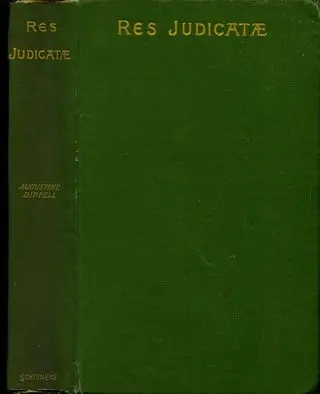
Res Judicatæ: Papers and Essays
Augustine Birrell
THE CLASSIC COLLECTION · 1905
"Andrew Marvell" by Augustine Birrell is a biographical account written in the early 20th century. This work delves into the life and legacy of Andrew Marvell, a prominent poet, politician, and contemporary of Milton, who played an influential role during the English Commonwealth and Restoration periods. The biography explores Marvell's multifaceted character as a writer, scholar, and civil servant, focusing on his contributions to poetry and politics. The opening of the biography introduces Marvell's early life, highlighting his upbringing in a scholarly household and his education, which laid the foundation for his future pursuits. Augustine Birrell reflects on Marvell's elusive nature as a historical figure, noting that while many details of his life, such as his education at Cambridge, his poetry, and his political endeavors, are well-documented, there remains a profound lack of personal insight into Marvell's character. Birrell presents the poignant context of Marvell's life against the backdrop of 17th-century England, setting the stage for a detailed exploration of his influential works and political involvement as the narrative unfolds.
Introduction adapted from the source catalogue; source summaries may be automatically generated.
Free to read · English · 75,195 words · No account needed
MAKE TIME FOR A GOOD BOOK
On by default. Untick to stop anonymous reading totals. Each page counts after 10 seconds in view. How this works.
Anonymous counting is on unless you have switched it off.
"April 14, 1670."
[77:1] Clarendon's Life, vol. ii. p. 442.
[79:1] The clerks, however, only counted the members who voted, and kept no record of their names. Mr. Gladstone remembered the alteration being made in 1836, and how unpopular it was. The change was a greater revolution than the Reform Bill. See The Unreformed House of Commons by Edward Posselt, vol. i. p. 587.
"And a Parliament had lately met
Without a single Bankes."--Praed.
[82:1] See Dr. Halley's Lancashire--its Puritanism and Nonconformity, vol. ii. pp. 1-140, a most informing book.
[88:1] Clarendon's History, vol. vi. p. 249.
[90:1] An Historical Poem.--Grosart, vol. i. p. 343.
[92:1] Macaulay's History, vol. i. p. 154.
[95:1] I am acquainted with the romantic story which would have us believe that Lady Fauconberg, foretelling the time to come, had caused some other body than her father's to be buried in the Abbey (see Notes and Queries, 5th October 1878, and Waylen's House of Cromwell, p. 341).
[96:1] See The Unreformed House of Commons, by Edward Porritt, vol. i. p. 51. Marvell's old enemy, Parker, Bishop of Oxford, in his History of his own Time, composed after Marvell's death, reviles his dead antagonist for having taken this payment which, the bishop says, was made by a custom which "had a long time been antiquated and out of date." "Gentlemen," says the bishop, "despised so vile a stipend," yet Marvell required it "for the sake of a bare subsistence, although in this mean poverty he was nevertheless haughty and insolent." In Parker's opinion poor men should be humble.
[98:1] Parliamentary History, vol. iv., App. No. III.
[104:1] Mr. Gladstone's testimony is that no real improvement was effected until within the period of his own memory. 'Our services were probably without a parallel in the world for their debasement.' (See Gleanings, vi. p. 119.)
[106:1] There is a copy in the library of the Athenaeum, London: "A Relation of Three Embassies from his sacred Majestie Charles II. to the Great Duke of Muscovie, the King of Sweden, and the King of Denmark. Performed by the Right Ho^ble the Earle of Carlisle in the Years 1663 and 1664. Written by an Attendant on the Embassies, and published with his Lordship's approbation. London. Printed for John Starkie at the Miter in Fleet Street, near Temple Barr, 1669."
[109:1] "I have mentioned the dignity of his manners.... He was at his very best on occasion of Durbars, investitures, and the like.... It irritated him to see men giggling or jeering instead of acting their parts properly."--Life of Lord Dufferin, vol. ii. p. 317.
[116:1] Hist. MSS. Com., Portland Papers, vol. iii. p. 296.
[116:2] See above, vol. iii. p. 294.
[118:1] Sir Walter Besant doubted this. See his London.
Your reading position is saved on this browser. Take it to another device with a library code. Reading pages adapt to text, rather than matching a printed edition.
Augustine Birrell
Augustine Birrell
Augustine Birrell
Augustine Birrell
BEHIND THE BOOK
This eBook is for the use of anyone anywhere in the United States and most other parts of the world at no cost and with almost no restrictions whatsoever. You may copy it, give it away or re-use it under the terms of the Project Gutenberg License included with this eBook or online at www.gutenberg.org. If you are not located in the United States, you will have to check the laws of the country where you are located before using this eBook. Read the source licence.
The original source file, including credits and licence, is retained by this library. Request an original-format copy at no charge. Please include the book title and Project Gutenberg identifier #17388.
KEEP YOUR CURIOSITY GOING
John L. Ransom

Herman W. Mudgett

Harriet Monroe
Daniel Dulany Addison
Charles Lanman

Harold Rosher