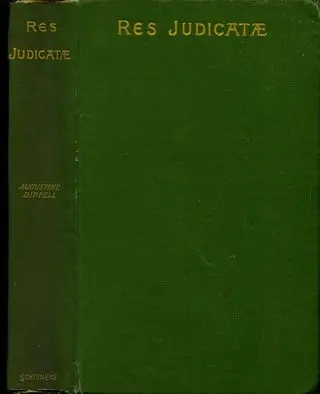
Res Judicatæ: Papers and Essays
Augustine Birrell
THE CLASSIC COLLECTION · 1905
"Andrew Marvell" by Augustine Birrell is a biographical account written in the early 20th century. This work delves into the life and legacy of Andrew Marvell, a prominent poet, politician, and contemporary of Milton, who played an influential role during the English Commonwealth and Restoration periods. The biography explores Marvell's multifaceted character as a writer, scholar, and civil servant, focusing on his contributions to poetry and politics. The opening of the biography introduces Marvell's early life, highlighting his upbringing in a scholarly household and his education, which laid the foundation for his future pursuits. Augustine Birrell reflects on Marvell's elusive nature as a historical figure, noting that while many details of his life, such as his education at Cambridge, his poetry, and his political endeavors, are well-documented, there remains a profound lack of personal insight into Marvell's character. Birrell presents the poignant context of Marvell's life against the backdrop of 17th-century England, setting the stage for a detailed exploration of his influential works and political involvement as the narrative unfolds.
Introduction adapted from the source catalogue; source summaries may be automatically generated.
Free to read · English · 75,195 words · No account needed
MAKE TIME FOR A GOOD BOOK
On by default. Untick to stop anonymous reading totals. Each page counts after 10 seconds in view. How this works.
Anonymous counting is on unless you have switched it off.
The Conventicle Act Marvell refers to was a stringent measure, imposing pecuniary fines upon any persons of sixteen years of age or upwards who "under pretence of religion" should be present at any meeting of more than five persons, or more than those of the household, "in other manner than allowed by the Liturgy and practice of the Church of England." Heavier fines were imposed upon the preachers. The poet Waller, who was "nursed in Parliaments," having been first returned from Amersham in 1621, made a very sensible remark on the second reading: "Let them alone and they will preach against each other; by this Bill they will incorporate as being all under one calamity."[145:1] But by 144 to 78 the Bill was read, though it did not become law until the following session. An indignant Member of Parliament once told Cromwell that he would take the "sense" of the House against some proposal. "Very well," said Cromwell, "you shall take the 'sense' of the House, and I will take the 'nonsense,' and we will see who tells the most votes."
In February 1670 the king opened a new session, and in March Marvell wrote a private letter to a relative at Bordeaux, in which he "lends his mind out," after a fashion forbidden him in his correspondence with his constituents:--
"DEAR COUSIN,-- ... You know that we having voted the King, before Christmas, four hundred thousand pounds, and no more; and enquiring severely into ill management, and being ready to adjourn ourselves till February, his Majesty, fortified by some undertakers of the meanest of our House, threw up all as nothing, and prorogued us from the first of December till the fourteenth of February. All that interval there was great and numerous caballing among the courtiers. The King also all the while examined at council the reports from the Commissioners of Accounts, where they were continually discountenanced, and treated rather as offenders than judges. In this posture we met, and the King, being exceedingly necessitous for money, spoke to us stylo minaci et imperatorio; and told us the inconveniences which would fall on the nation by want of a supply, should not ly at his door; that we must not revive any discord betwixt the Lords and us; that he himself had examined the accounts, and found every penny to have been employed in the war; and he recommended the Scotch union. The Garroway party appeared with the usual vigour, but the country gentlemen appeared not in their true number the first day: so, for want of seven voices, the first blow was against them. When we began to talk of the Lords, the King sent for us alone, and recommended a rasure of all proceedings. The same thing you know that we proposed at first. We presently ordered it, and went to tell him so the same day, and to thank him. At coming down, (a pretty ridiculous thing!) Sir Thomas Clifford carryed Speaker and Mace, and all members there, into the King's cellar, to drink his health. The King sent to the Lords more peremptoryly, and they, with much grumbling, agreed to the rasure. When the Commissioners of Accounts came before us, sometimes we heard them pro forma, but all falls to dirt. The terrible Bill against Conventicles is sent up to the Lords; and we and the Lords, as to the Scotch busyness, have desired the King to name English Commissioners to treat, but nothing they do to be valid, but on a report to Parliament, and an act to confirm. We are now, as we think, within a week of rising. They are making mighty alterations in the Conventicle Bill (which, as we sent up, is the quintessence of arbitrary malice), and sit whole days, and yet proceed but by inches, and will, at the end, probably affix a Scotch clause of the King's power in externals. So the fate of the Bill is uncertain, but must probably pass, being the price of money. The King told some eminent citizens, who applyed to him against it, that they must address themselves to the Houses, that he must not disoblige his friends; and if it had been in the power of their friends, he had gone without money. There is a Bill in the Lords to encourage people to buy all the King's fee-farm rents; so he is resolved once more to have money enough in his pocket, and live on the common for the future. The great Bill begun in the Lords, and which makes more ado than ever any Act in this Parliament did, is for enabling Lord Ros, long since divorced in the spiritual court, and his children declared illegitimate by Act of Parliament, to marry again. Anglesey and Ashly, who study and know their interests as well as any gentlemen at court, and whose sons have marryed two sisters of Ros, inheritrixes if he has no issue, yet they also drive on the Bill with the greatest vigour. The King is for the Bill: the Duke of York, and all the Papist Lords, and all the Bishops, except Cosins, Reynolds, and Wilkins, are against it. They sat all Thursday last, without once rising, till almost ten at night, in most solemn and memorable debate, whether it should be read the second time, or thrown out. At last, at the question, there were forty-two persons and six proxys against it, and forty-one persons and fifteen proxys for it. If it had not gone for it, the Lord Arlington had a power in his pocket from the King to have nulled the proxys, if it had been to the purpose. It was read the second time yesterday, and, on a long debate whether it should be committed, it went for the Bill by twelve odds, in persons and proxys. The Duke of York, the bishops, and the rest of the party, have entered their protests, on the first day's debate, against it. Is not this fine work? This Bill must come down to us. It is my opinion that Lauderdale at one ear talks to the King of Monmouth, and Buckingham at the other of a new Queen. It is also my opinion that the King was never since his coming in, nay, all things considered, no King since the Conquest, so absolutely powerful at home, as he is at the present; nor any Parliament, or places, so certainly and constantly supplyed with men of the same temper. In such a conjuncture, dear Will, what probability is there of my doing any thing to the purpose? The King would needs take the Duke of Albemarle out of his son's hand to bury him at his own charges. It is almost three months, and he yet lys in the dark unburyed, and no talk of him. He left twelve thousand pounds a year, and near two hundred thousand pounds in money. His wife dyed some twenty days after him; she layed in state, and was buryed, at her son's expence, in Queen Elizabeth's Chapel. And now,
Your reading position is saved on this browser. Take it to another device with a library code. Reading pages adapt to text, rather than matching a printed edition.
Augustine Birrell
Augustine Birrell
Augustine Birrell
Augustine Birrell
BEHIND THE BOOK
This eBook is for the use of anyone anywhere in the United States and most other parts of the world at no cost and with almost no restrictions whatsoever. You may copy it, give it away or re-use it under the terms of the Project Gutenberg License included with this eBook or online at www.gutenberg.org. If you are not located in the United States, you will have to check the laws of the country where you are located before using this eBook. Read the source licence.
The original source file, including credits and licence, is retained by this library. Request an original-format copy at no charge. Please include the book title and Project Gutenberg identifier #17388.
KEEP YOUR CURIOSITY GOING
John L. Ransom

Herman W. Mudgett

Harriet Monroe
Daniel Dulany Addison
Charles Lanman

Harold Rosher