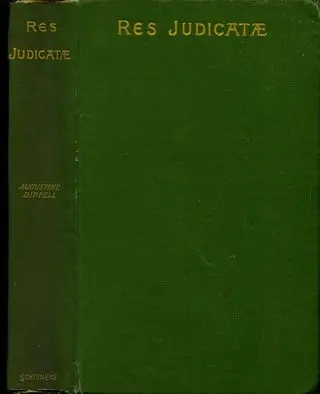
Res Judicatæ: Papers and Essays
Augustine Birrell
THE CLASSIC COLLECTION · 1905
"Andrew Marvell" by Augustine Birrell is a biographical account written in the early 20th century. This work delves into the life and legacy of Andrew Marvell, a prominent poet, politician, and contemporary of Milton, who played an influential role during the English Commonwealth and Restoration periods. The biography explores Marvell's multifaceted character as a writer, scholar, and civil servant, focusing on his contributions to poetry and politics. The opening of the biography introduces Marvell's early life, highlighting his upbringing in a scholarly household and his education, which laid the foundation for his future pursuits. Augustine Birrell reflects on Marvell's elusive nature as a historical figure, noting that while many details of his life, such as his education at Cambridge, his poetry, and his political endeavors, are well-documented, there remains a profound lack of personal insight into Marvell's character. Birrell presents the poignant context of Marvell's life against the backdrop of 17th-century England, setting the stage for a detailed exploration of his influential works and political involvement as the narrative unfolds.
Introduction adapted from the source catalogue; source summaries may be automatically generated.
Free to read · English · 75,195 words · No account needed
MAKE TIME FOR A GOOD BOOK
On by default. Untick to stop anonymous reading totals. Each page counts after 10 seconds in view. How this works.
Anonymous counting is on unless you have switched it off.
"And I hope, Sir, you will incline the Bench to consider whether I am able or whether it be fit for me to urge it beyond that point. Yet it is not all his (Wise's) Parliament men and relations that have wrought me in the least, but what I simply conceive as the state of things now to be possible and satisfactory. What would you have more of a soldier than to run away and have him cashiered as to any command in your garrison? The first he hath done and the second he must submit to. And I assure you whatsoever he was among you, he is here a kind of decrepit young gentleman and terribly crest-fallen."
The letter concludes thus:--
"For I assure you they use all the civility imaginable to you, and as we sat there drinking a cup of sack with the General, Colonel Legge[141:1] chancing to be present, there were twenty good things said on all hands tending to the good fame, reputation, and advantage of the Town, an occasion that I was heartily glad of."
Corporations may not have souls to save and bodies to kill, but evidently they have vanities to tickle.
In November 1669 the House is still busy over the accounts. Sir George Carteret was Treasurer of the Navy. Marvell refers to him in The Last Instructions to a Painter as:--
"Carteret the rich did the accountants guide
And in ill English all the world defied."
The following letter of Marvell's gives an excellent account of House of Commons business, both how it is conducted, and how often it gets accidentally interrupted by other business unexpectedly cropping up:--
"November 20, 1669.
"GENTLEMEN, MY VERY WORTHY FRIENDS,--Returning after our adjournment to sit upon Wednesday, the House having heard what Sir G. Cartaret could say for himselfe, and he then commended to withdraw, after a considerable debate, put it to the question, whether he were guilty of misdemeanour upon the Commissioners first observation, the words of which were, That all monyes received by him out of His Majesty's Exchequer are by the privy seales assigned for particular services, but no such thing observed or specified in his payments, whereby he hath assumed to himselfe a liberty to make use of the King's treasure for other uses then is directed. The House dividing upon the question, the ayes went out, and wondered why they were kept out so extraordinary a time. The ayes proved 138 and the noes 129; and the reason of the long stay then appeared; the tellers for the ayes chanced to be very ill reckoners, so that they were forced to tell severall times over in the House, and when at last the tellers for the ayes would have agreed the noes to be 142, the noes would needs say that they were 143, whereupon those for the ayes would tell once more and then found the noes to be indeed but 129; and the ayes then coming in proved to be 138; whereas if the noes had been content with the first error of the tellers, Sir George had been quit upon that observation. This I have told you so minutely because it is the second fatall and ominous accident that hath fain out in the divisions about Sir G. Cartaret. Thursday was ordered for the second observation, the words of which are, Two hundred and thirty thousand seven hundred thirty and one thousand pounds thirteen shillings and ninepence, claimed as payd, and deposited for security of interest, and yet no distinct specification of time appeares either on his receits or payments, whereby no judgment can be made how interest accrues; so that we cannot yet allow the same. But this day was diverted and wholy taken up by a speciall report orderd by the Committee for the Bill of Conventicles, that the House be informed of severall Conventicles in Westminster which might be of dangerous consequences. From hence arose much discourse; also of a report that Ludlow was in England, that Commonwealths-men flock about the town, and there were meetings said to be, where they talkt of New Modells of Government; so that the House ordered a Committee to receive informations both concerning Conventicles and these other dangerous meetings; and then entered a resolution upon their books without putting it to the question, That this House will adhere to His Majesty, and the Government of Church and State as now established, against all its enemyes. Friday having bin appointed, as I told you in my former letter, for the House to sit in a grand Committee upon the motion for the King's supply, was spent wholy in debate, whether they should do so or no, and concluded at last in a consent, that the sitting in a grand Committee upon the motion for the King's supply should be put of till Friday next, and so it was ordered. The reason of which kind of proceeding, lest you should thinke to arise from an indisposition of the House, I shall tell you as they appeare to me, to have been the expectation of what Bill will come from the Lords in stead of that of ours which they threw out, and a desire to redresse and see thoroughly into the miscarriages of mony before any more should be granted. To-day the House hath bin upon the second observation, and after a debate till foure a'clock, have voted him guilty also of misdemeanor in that particular. The Commissioners are ordered to attend the House again on Munday, which is done constantly for the illustration of any matter in their report, wherein the House is not cleare. And to say the truth, the House receives great satisfaction from them, and shows them extraordinary respect. These are the things of principall notice since my last."
Your reading position is saved on this browser. Take it to another device with a library code. Reading pages adapt to text, rather than matching a printed edition.
Augustine Birrell
Augustine Birrell
Augustine Birrell
Augustine Birrell
BEHIND THE BOOK
This eBook is for the use of anyone anywhere in the United States and most other parts of the world at no cost and with almost no restrictions whatsoever. You may copy it, give it away or re-use it under the terms of the Project Gutenberg License included with this eBook or online at www.gutenberg.org. If you are not located in the United States, you will have to check the laws of the country where you are located before using this eBook. Read the source licence.
The original source file, including credits and licence, is retained by this library. Request an original-format copy at no charge. Please include the book title and Project Gutenberg identifier #17388.
KEEP YOUR CURIOSITY GOING
John L. Ransom

Herman W. Mudgett

Harriet Monroe
Daniel Dulany Addison
Charles Lanman

Harold Rosher