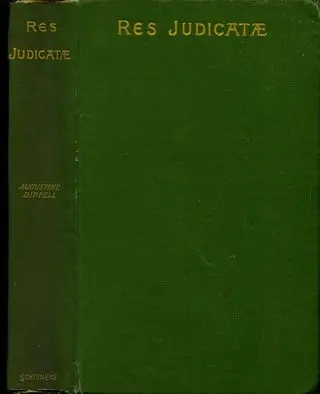
Res Judicatæ: Papers and Essays
Augustine Birrell
THE CLASSIC COLLECTION · 1905
"Andrew Marvell" by Augustine Birrell is a biographical account written in the early 20th century. This work delves into the life and legacy of Andrew Marvell, a prominent poet, politician, and contemporary of Milton, who played an influential role during the English Commonwealth and Restoration periods. The biography explores Marvell's multifaceted character as a writer, scholar, and civil servant, focusing on his contributions to poetry and politics. The opening of the biography introduces Marvell's early life, highlighting his upbringing in a scholarly household and his education, which laid the foundation for his future pursuits. Augustine Birrell reflects on Marvell's elusive nature as a historical figure, noting that while many details of his life, such as his education at Cambridge, his poetry, and his political endeavors, are well-documented, there remains a profound lack of personal insight into Marvell's character. Birrell presents the poignant context of Marvell's life against the backdrop of 17th-century England, setting the stage for a detailed exploration of his influential works and political involvement as the narrative unfolds.
Introduction adapted from the source catalogue; source summaries may be automatically generated.
Free to read · English · 75,195 words · No account needed
MAKE TIME FOR A GOOD BOOK
On by default. Untick to stop anonymous reading totals. Each page counts after 10 seconds in view. How this works.
Anonymous counting is on unless you have switched it off.
"in his shirt against the Dutch is pressed.
Often, dear Painter, have I sat and mused
Why he should be on all adventures used.
Whether his valour they so much admire,
Or that for cowardice they all retire,
As heaven in storms, they call, in gusts of state,
On Monk and Parliament--yet both do hate.
...
Ruyter, the while, that had our ocean curbed,
Sailed now amongst our rivers undisturbed;
Surveyed their crystal streams and banks so green,
And beauties ere this never naked seen."
His flags fly from the topmasts of his ships, but where is the enemy?
"So up the stream the Belgic navy glides,
And at Sheerness unloads its stormy sides."
Chatham was but a few miles further up.
"There our sick ships unrigged in summer lay, Like moulting fowl, a weak and easy prey, For whose strong bulk earth scarce could timber find, The ocean water, or the heavens wind. Those oaken giants of the ancient race, That ruled all seas, and did our channel grace; The conscious stag, though once the forest's dread, Flies to the wood, and hides his armless head. Ruyter forthwith a squadron doth untack; They sail securely through the river's track. An English pilot too (O, shame! O, sin!) Cheated of 's pay, was he that showed them in."
The chain at Gillingham is broken, to the dismay of Monk, who
"from the bank that dismal sight does view; Our feather gallants, who came down that day To be spectators safe of the new play, Leave him alone when first they hear the gun, (Cornbury,[131:1] the fleetest) and to London run. Our seamen, whom no danger's shape could fright, Unpaid, refuse to mount their ships for spite, Or to their fellows swim on board the Dutch, Who show the tempting metal in their clutch."
Upnor Castle avails nought.
"And Upnor's Castle's ill-deserted wall
Now needful does for ammunition call."
The Royal Charles is captured before Monk's face.
"That sacred Keel that had, as he, restored
Its excited sovereign on its happy board,
Now a cheap spoil and the mean victor's slave
Taught the Dutch colours from its top to wave."
Horrors accumulate.
"Each doleful day still with fresh loss returns, The loyal London now a third time burns, And the true Royal Oak and Royal James, Allied in fate, increase with theirs her flames. Of all our navy none shall now survive, But that the ships themselves were taught to dive, And the kind river in its creek them hides. Freighting their pierced keels with oozy tides."
The situation was indeed serious enough. One wiseacre in command in London declared his belief that the Tower was no longer "tenable."
Your reading position is saved on this browser. Take it to another device with a library code. Reading pages adapt to text, rather than matching a printed edition.
Augustine Birrell
Augustine Birrell
Augustine Birrell
Augustine Birrell
BEHIND THE BOOK
This eBook is for the use of anyone anywhere in the United States and most other parts of the world at no cost and with almost no restrictions whatsoever. You may copy it, give it away or re-use it under the terms of the Project Gutenberg License included with this eBook or online at www.gutenberg.org. If you are not located in the United States, you will have to check the laws of the country where you are located before using this eBook. Read the source licence.
The original source file, including credits and licence, is retained by this library. Request an original-format copy at no charge. Please include the book title and Project Gutenberg identifier #17388.
KEEP YOUR CURIOSITY GOING
John L. Ransom

Herman W. Mudgett

Harriet Monroe
Daniel Dulany Addison
Charles Lanman

Harold Rosher