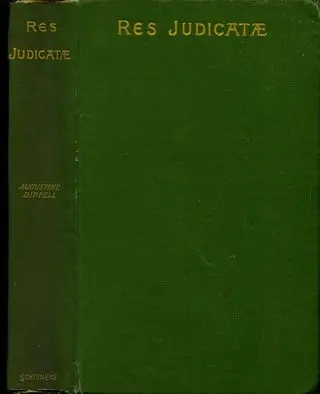
Res Judicatæ: Papers and Essays
Augustine Birrell
THE CLASSIC COLLECTION · 1905
"Andrew Marvell" by Augustine Birrell is a biographical account written in the early 20th century. This work delves into the life and legacy of Andrew Marvell, a prominent poet, politician, and contemporary of Milton, who played an influential role during the English Commonwealth and Restoration periods. The biography explores Marvell's multifaceted character as a writer, scholar, and civil servant, focusing on his contributions to poetry and politics. The opening of the biography introduces Marvell's early life, highlighting his upbringing in a scholarly household and his education, which laid the foundation for his future pursuits. Augustine Birrell reflects on Marvell's elusive nature as a historical figure, noting that while many details of his life, such as his education at Cambridge, his poetry, and his political endeavors, are well-documented, there remains a profound lack of personal insight into Marvell's character. Birrell presents the poignant context of Marvell's life against the backdrop of 17th-century England, setting the stage for a detailed exploration of his influential works and political involvement as the narrative unfolds.
Introduction adapted from the source catalogue; source summaries may be automatically generated.
Free to read · English · 75,195 words · No account needed
MAKE TIME FOR A GOOD BOOK
On by default. Untick to stop anonymous reading totals. Each page counts after 10 seconds in view. How this works.
Anonymous counting is on unless you have switched it off.
"I reply, saith he, that I sent no such paper into the Embassy-office, but upon the desire of his Tzarskoy Majesty's Councellor Evan Offonassy Pronchissof, I delivered it to him, not being a paper of State, nor written in the English Language wherein I treat, nor put into the hands of the near Boyars and Councellors of his Tzarskoy majesty, nor subscribed by my self, nor translated into Russe by my Interpreter, but only as a piece of curiosity, which is now restored me, and I am possessed of it; so that herein his Tzarskoy majestie's near Boyars and Councellors are doubtless ill grounded. But again I say concerning the value of the words Illustrissimus and Serenissimus compared together, seeing we must here from affaires of State, fall into Grammatical contests concerning the Latin tongue; that the word Serenus signifieth nothing but still and calm; and, therefore, though of late times adopted into the Titles of great Princes by reason of that benigne tranquility which properly dwells in the majestick countenance of great Princes, and that venerable stillness of all the Attendants that surround them, of which I have seen an excellent example when I was in the presence of his Tzarskoy majesty, yet is more properly used concerning the calmness of the weather, or season. So that even the night is elegantly called Serena by the best Authors, Cicero in Arato 12, Lucretius i. l. 29. 'Serena nox'; and upon perusing again what I have writ in this paper, I finde that I have out of the customariness of that expression my self near the beginning said, And that most serene night, &c. Whereas on the contrary Illustris in its proper derivation and signification expresseth that which is all resplendent, lightsome, and glorious, as well without as within, and that not with a secondary but with a primitive and original light. For if the Sun be, as he is, the first fountain of light, and Poets in their expressions (as is well known) are higher by much than those that write in Prose, what else is it when Ovid in the 2. of the Metamorphoses saith of Phoebus speaking with Phaethon, Qui terque quaterque concutiens Illustre caput, and the Latin Orators, as Pliny, Ep. 139, when they would say the highest thing that can be exprest upon any subject, word it thus, Nihil Illustrius dicere possum. So that hereby may appear to his Tzarskoy Majestie's near Boyars and Counsellors what diminution there is to his Tzarskoy Majesty (which farr be it from my thoughts) if I appropriate Serenissimus to my Master and Illustrissimus to Him than which nihil dici potest Illustrius. But because this was in the time of the purity of the Latin tongue, when the word Serenus was never used in the Title of any Prince or Person, I shall go on to deale with the utmost candor, forasmuch as in this Nation the nicety of that most eloquent language is not so perfectly understood, which gives occasion to these mistakes. I confess therefore that indeed in the declination of the Latin tongue, and when there scarce could be found out words enough to supply the modern ambition of Titles, Serenissimus as several other words hath grown in fashion for a compellation of lesser as well as greater Princes, and yet befits both the one and the other. So there is Serenissima Respublica Veneta, Serenitates Electoriae, Serenitates Regiae, even as the word Highness or Celsitudo befits a Duke, a Prince, a King, or an Emperour, adjoyning to it the respective quality, and so the word Illustris. But suppose it were by modern use (which I deny) depressed from the undoubted superiority that it had of Serenus in the purest antiquity, yet being added in the transcendent degree to the word Emperour, the highest denomination that a Prince is capable of, it becomes of the same value. So that to interpret Illustrissimus unto diminution is to find a positive in a superlative, and in the most orient light to seek for darkness. And I would, seeing the near Boyars and Counsellors of his Tzarskoy Majesty are pleased to mention the Title given to his Tzarskoy Majesty by his Cesarian Majesty, gladly be satisfied by them, whether ever any Cesarian Majesty writ formerly hither in High-Dutch, and whether then they styled his Tzarskoy Majesty Durchluchtigste which is the same with Illustrissimus, and which I believe the Caesar hath kept for Himself. But to cut short, his Royal Majesty hath used the word to his Tzarskoy Majesty in his Letter, not out of imitation of others, although even in the Dutch Letter to his Tzarskoy Majesty of 16 June 1663, I finde Durchlauchtigste the same (as I said) with Illustrissimus, but out of the constant use of his own Court, further joyning before it Most High, Most Potent, and adding after it Great Lord Emperour, which is an higher Title than any Prince in the World gives his Tzarskoy Majesty, and as high a Title of honour as can be given to any thing under the Divinity. For the King my Master who possesses as considerable Dominions, and by as high and self-dependent a right as any Prince in the Universe, yet contenting Himself with the easiest Titles, and satisfying Himself in the essence of things, doth most willingly give to other Princes the Titles which are appropriated to them, but to the Tzarskoy Majesties of Russia his Royal Ancestors, and to his present Tzarskoy Majesty his Royal Majesty himself, have usually and do gladly pay Titles even to superfluity out of meer kindness. And upon that reason He added the word most Illustrious, and so did I use it in the Latin of my speech. Yet, that You may find I did not out of any criticisme of honor, but for distinction sake use it as I did, You may see in one place of the same speech Serenitas, speaking of his Tzarskoy Majesty: and I would have used Serenissimus an hundred times concerning his Tzarskoy Majesty, had I thought it would have pleased Him better. And I dare promise You that his Majesty will upon the first information from me stile him Serenissimus, and I (notwithstanding what I have said) shall make little difficulty of altering the word in that speech, and of delivering it so to You, with that protestation that I have not in using that word Illustrissimus erred nor used any diminution (which God forbid) to his Tzarskoy Majesty, but on the contrary after the example of the King my Master intended and shewed him all possible honor. And so God grant all happiness to His most high, most Potent, most Illustrious, and most Serene Tzarskoy Majesty, and that the friendship may daily increase betwixt His said Majesty and his most Serene Majesty my Master."
Your reading position is saved on this browser. Take it to another device with a library code. Reading pages adapt to text, rather than matching a printed edition.
Augustine Birrell
Augustine Birrell
Augustine Birrell
Augustine Birrell
BEHIND THE BOOK
This eBook is for the use of anyone anywhere in the United States and most other parts of the world at no cost and with almost no restrictions whatsoever. You may copy it, give it away or re-use it under the terms of the Project Gutenberg License included with this eBook or online at www.gutenberg.org. If you are not located in the United States, you will have to check the laws of the country where you are located before using this eBook. Read the source licence.
The original source file, including credits and licence, is retained by this library. Request an original-format copy at no charge. Please include the book title and Project Gutenberg identifier #17388.
KEEP YOUR CURIOSITY GOING
John L. Ransom

Herman W. Mudgett

Harriet Monroe
Daniel Dulany Addison
Charles Lanman

Harold Rosher