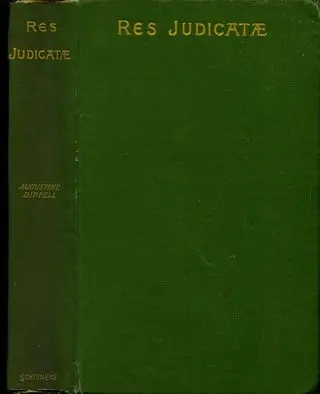
Res Judicatæ: Papers and Essays
Augustine Birrell
THE CLASSIC COLLECTION · 1905
"Andrew Marvell" by Augustine Birrell is a biographical account written in the early 20th century. This work delves into the life and legacy of Andrew Marvell, a prominent poet, politician, and contemporary of Milton, who played an influential role during the English Commonwealth and Restoration periods. The biography explores Marvell's multifaceted character as a writer, scholar, and civil servant, focusing on his contributions to poetry and politics. The opening of the biography introduces Marvell's early life, highlighting his upbringing in a scholarly household and his education, which laid the foundation for his future pursuits. Augustine Birrell reflects on Marvell's elusive nature as a historical figure, noting that while many details of his life, such as his education at Cambridge, his poetry, and his political endeavors, are well-documented, there remains a profound lack of personal insight into Marvell's character. Birrell presents the poignant context of Marvell's life against the backdrop of 17th-century England, setting the stage for a detailed exploration of his influential works and political involvement as the narrative unfolds.
Introduction adapted from the source catalogue; source summaries may be automatically generated.
Free to read · English · 75,195 words · No account needed
MAKE TIME FOR A GOOD BOOK
On by default. Untick to stop anonymous reading totals. Each page counts after 10 seconds in view. How this works.
Anonymous counting is on unless you have switched it off.
This correspondence, which if we include in it, as we well may, the letters to the Worshipful Society of Masters and Pilots of the Trinity House in Hull, numbers upwards of 350 letters, and with but one considerable gap (from July 1663 to October 1665) covers the whole period of Marvell's membership, is, I believe, unique in our public records. The letters are preserved at Hull, where I hope care is taken to preserve them from the autograph hunter and the autograph thief. Captain Thompson printed a great part of this correspondence in 1776, and Mr. Grosart gave the world the whole of it in the second volume of his edition of Marvell's complete works.
An admission may as well be made at once. This correspondence is not so interesting as it might have been expected to prove. Marvell did not write letters for his biographer, nor to instruct posterity, nor to serve any party purpose, nor even to exhibit honest emotion, but simply to tell his employers, whose wages he took, what was happening at Westminster. He kept his reflections either to himself or for his political broadsheets, and indeed they were seldom of the kind it would have been safe to entrust to the post.
Good Mr. Grosart fusses and frets terribly over Marvell's astonishing capacity for chronicling in sombre silence every kind of legislative abomination. It is at times a little hard to understand it, for Hull was what may be called a Puritan place. No doubt caution dictated some of the reticence--but the reserve of Marvell's character is one of the few traits of his personality that has survived. He was a satirist, not an enthusiast.
I will give the first letter in extenso to serve as a specimen, and a very favourable one, of the whole correspondence:--
"Nov. 17, 1660.
"GENTLEMEN, MY WORTHY FRIENDS,--Although during the necessary absence of my partner, Mr. Ramsden, I write with but halfe a penn, and can scarce perswade myselfe to send you so imperfect an account of your own and the publick affairs, as I needs must for want of his assistance; yet I had rather expose mine own defects to your good interpretation, then excuse thereby a totall neglect of my duty, and that trust which is divided upon me. At my late absence out of Town I had taken such order that if you had commanded me any thing, I might soon haue received it, and so returned on purpose to this place to haue obeyed you. But hearing nothing of that nature howeuer, I was present the first day of the Parliament's sitting, and tooke care to write to Mr. Maior what work we had cut out. Since when, we have had little new, but onely been making a progresse in those things I then mentioned. There is yet brought in an Act in which of all others your corporation is the least concerned: that is, where wives shall refuse to cohabit with their husbands, that in such case the husband shall not be liable to pay any debts which she may run into, for clothing, diet, lodging, or other expenses. I wish with all my heart you were no more touched in a vote that we haue made for bringing in an Act of a new Assessment for six moneths, of 70,000li. per mensem, to begin next January. The truth is, the delay ere monyes can be got in, eats up a great part of all that is levying, and that growing charge of the Army and Navy doubles upon us. And that is all that can be said for excuse of ourselues to the Country, to whom we had giuen our own hopes of no further sessment to be raised, but must now needs incurre the censure of improvidence before or prodigality now, though it becomes no private member, the resolution having passed the House, to interpose further his own judgment in a thing that can not be remedied; and it will be each man's ingenuity not to grudge an after-payment for that settlement and freedome from Armyes and Navyes, which before he would haue been glad to purchase with his whole fortune. There remain some eight Regiments to be disbanded, but those all horse in a manner, and some seauenteen shipps to be payd of, that haue laid so long upon charge in the harbour, beside fourscore shipps which are reckoned to us for this Winter guard. But after that, all things are to go upon his Majestye's own purse out of the Tunnage and Poundage and his other revenues. But there being so great a provision made for mony, I doubt not but ere we rise, to see the whole army disbanded, and according to the Act, hope to see your Town once more ungarrisond, in which I should be glad and happy to be instrumentall to the uttermost. For I can not but remember, though then a child, those blessed days when the youth of your own town were trained for your militia, and did, methought, become their arms much better than any soldiers that I haue seen there since. And it will not be amisse if you please (now that we are about a new Act of regulating the Militia, that it may be as a standing strength, but not as ill as a perpetuall Army to the Nation) to signify to me any thing in that matter that were according to your ancient custome and desirable for you. For though I can promise little, yet I intend all things for your service. The Act for review of the Poll bill proceeds, and that for making this Declaration of his Majesty a Law in religious matters. Order likewise is giuen for drawing up all the votes made during our last sitting, in the businesse of Sales of Bishops' and Deans' and Chapters' lands into an Act, which I should be glad to see passed. The purchasers the other day offerd the house 600,000li. in ready mony, and to make the Bishops', etc., revenue as good or better then before. But the House thought it not fit or seasonable to hearken to it. We are so much the more concernd to see that great interest of the purchasers satisfyed and quieted, at least in that way which our own votes haue propounded. On Munday next we are to return to the consideration of apportioning 100,000li. per annum upon all the lands in the nation, in lieu of the Court of Wards. The debate among the Countyes, each thinking it self overrated, makes the successe of that businesse something casuall, and truly I shall not assist it much for my part, for it is little reason that your Town should contribute in that charge. The Excise bill for longer continuance (I wish it proue not too long) will come in also next weeke. And I foresee we shall be called upon shortly to effect our vote made the former sitting, of raising his Majestie's revenue to 1,200,000li. per Annum. I do not love to write so much of this mony news. But I think you haue observed that Parliaments have been always made use of to that purpose, and though we may buy gold too deare, yet we must at any rate be glad of Peace, Freedom, and a good Conscience. Mr. Maior tells me, your duplicates of the Poll are coming up. I shall go with them to the Exchequer and make your excuse, if any be requisite. My long silence hath made me now trespasse on the other hand in a long letter, but I doubt not of your good construction of so much familiarity and trouble from, Gentlemen, your most affectionate friend and servant,
Your reading position is saved on this browser. Take it to another device with a library code. Reading pages adapt to text, rather than matching a printed edition.
Augustine Birrell
Augustine Birrell
Augustine Birrell
Augustine Birrell
BEHIND THE BOOK
This eBook is for the use of anyone anywhere in the United States and most other parts of the world at no cost and with almost no restrictions whatsoever. You may copy it, give it away or re-use it under the terms of the Project Gutenberg License included with this eBook or online at www.gutenberg.org. If you are not located in the United States, you will have to check the laws of the country where you are located before using this eBook. Read the source licence.
The original source file, including credits and licence, is retained by this library. Request an original-format copy at no charge. Please include the book title and Project Gutenberg identifier #17388.
KEEP YOUR CURIOSITY GOING
John L. Ransom

Herman W. Mudgett

Harriet Monroe
Daniel Dulany Addison
Charles Lanman

Harold Rosher