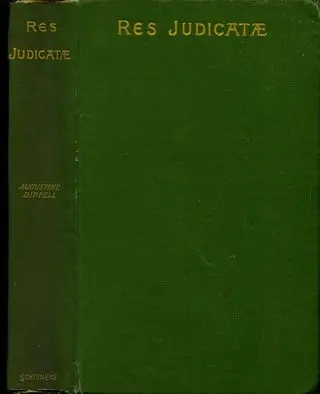
Res Judicatæ: Papers and Essays
Augustine Birrell
THE CLASSIC COLLECTION · 1905
"Andrew Marvell" by Augustine Birrell is a biographical account written in the early 20th century. This work delves into the life and legacy of Andrew Marvell, a prominent poet, politician, and contemporary of Milton, who played an influential role during the English Commonwealth and Restoration periods. The biography explores Marvell's multifaceted character as a writer, scholar, and civil servant, focusing on his contributions to poetry and politics. The opening of the biography introduces Marvell's early life, highlighting his upbringing in a scholarly household and his education, which laid the foundation for his future pursuits. Augustine Birrell reflects on Marvell's elusive nature as a historical figure, noting that while many details of his life, such as his education at Cambridge, his poetry, and his political endeavors, are well-documented, there remains a profound lack of personal insight into Marvell's character. Birrell presents the poignant context of Marvell's life against the backdrop of 17th-century England, setting the stage for a detailed exploration of his influential works and political involvement as the narrative unfolds.
Introduction adapted from the source catalogue; source summaries may be automatically generated.
Free to read · English · 75,195 words · No account needed
MAKE TIME FOR A GOOD BOOK
On by default. Untick to stop anonymous reading totals. Each page counts after 10 seconds in view. How this works.
Anonymous counting is on unless you have switched it off.
"It is not to be imagined, how small things, in this case, even members of great estates will stoop at, and most of them will do as much for hopes as others for fruition, but if their patience be tired out, they grow at last mutinous, and revolt to the country, till some better occasion offer.
"Among these are some men of the best understanding were they of equal integrity, who affect to ingross all business, to be able to quash any good motion by parliamentary skill, unless themselves be the authors, and to be the leading men of the House, and for their natural lives to continue so. But these are men that have been once fooled, most of them, and discovered, and slighted at Court, so that till some turn of State shall let them in their adversaries' place, in the mean time they look sullen, make big motions, and contrive specious bills for the subject, yet only wait the opportunity to be the instruments of the same counsels which they oppose in others.
"There is a third part still remaining, but as contrary in themselves as light and darkness; those are either the worst, or the best of men; the first are most profligate persons, they have neither estates, consciences, nor good manners, yet are therefore picked out as the necessary men, and whose votes will go furthest; the charges of their elections are defrayed, whatever they amount to, tables are kept for them at Whitehall, and through Westminster, that they may be ready at hand, within call of a question: all of them are received into pension, and know their pay-day, which they never fail of: insomuch that a great officer was pleased to say, 'That they came about him like so many jack-daws for cheese at the end of every Session.' If they be not in Parliament, they must be in prison, and as they are protected themselves, by privilege, so they sell their protections to others, to the obstruction so many years together of the law of the land, and the publick justice; for these it is, that the long and frequent adjournments are calculated, but all whether the court, or the monopolizers of the country party, or those that profane the title of old cavaliers, do equally, though upon differing reasons, like death apprehend a dissolution. But notwithstanding these, there is an handful of salt, a sparkle of soul, that hath hitherto preserved this gross body from putrefaction, some gentlemen that are constant, invariable, indeed Englishmen; such as are above hopes, or fears, or dissimulation, that can neither flatter, nor betray their king or country: but being conscious of their own loyalty and integrity, proceed throw good and bad report, to acquit themselves in their duty to God, their prince, and their nation; although so small a scantling in number, that men can scarce reckon of them more than a quorum; insomuch that it is less difficult to conceive how fire was first brought to light in the world than how any good thing could ever be produced out of an House of Commons so constituted, unless as that is imagined to have come from the rushing of trees, or battering of rocks together, by accident, so these, by their clashing with one another, have struck out an useful effect from so unlikely causes. But whatsoever casual good hath been wrought at any time by the assimilation of ambitious, factious and disappointed members, to the little, but solid, and unbiassed party, the more frequent ill effects, and consequences of so unequal a mixture, so long continued, are demonstrable and apparent. For while scarce any man comes thither with respect to the publick service, but in design to make and raise his fortune, it is not to be expressed, the debauchery, and lewdness, which, upon occasion of election to Parliaments, are now grown habitual thorow the nation. So that the vice, and the expence, are risen to such a prodigious height, that few sober men can indure to stand to be chosen on such conditions. From whence also arise feuds, and perpetual animosities, over most of the counties and corporations, while gentlemen of worth, spirit, and ancient estates and dependances, see themselves overpowered in their own neighbourhood by the drunkness and bribery, of their competitors. But if nevertheless any worthy person chance to carry the election, some mercenary or corrupt sheriff makes a double return, and so the cause is handed to the Committee of elections, who ask no better, but are ready to adopt his adversary into the House if he be not legitimate. And if the gentleman agrieved seek his remedy against the sheriff in Westminster-Hall, and the proofs be so palpable, that the King's Bench cannot invent how to do him injustice, yet the major part of the twelve judges shall upon better consideration vacate the sheriff's fine and reverse the judgement; but those of them that dare dissent from their brethren are in danger to be turned off the bench without any cause assigned. While men therefore care not thus how they get into the House of Commons, neither can it be expected that they should make any conscience of what they do there, but they are only intent how to reimburse themselves (if their elections were at their own charge) or how to bargain their votes for a place or a pension. They list themselves straightways into some Court faction, and it is as well-known among them, to what Lord each of them retain, as when formerly they wore coats and badges. By this long haunting so together, they are grown too so familiar among themselves, that all reverence of their own Assembly is lost, that they live together not like Parliament men, but like so many good fellows met together in a publick house to make merry. And which is yet worse, by being so thoroughly acquainted, they understand their number and party, so that the use of so publick a counsel is frustrated, there is no place for deliberation, no perswading by reason, but they can see one another's votes through both throats and cravats before they hear them.
Your reading position is saved on this browser. Take it to another device with a library code. Reading pages adapt to text, rather than matching a printed edition.
Augustine Birrell
Augustine Birrell
Augustine Birrell
Augustine Birrell
BEHIND THE BOOK
This eBook is for the use of anyone anywhere in the United States and most other parts of the world at no cost and with almost no restrictions whatsoever. You may copy it, give it away or re-use it under the terms of the Project Gutenberg License included with this eBook or online at www.gutenberg.org. If you are not located in the United States, you will have to check the laws of the country where you are located before using this eBook. Read the source licence.
The original source file, including credits and licence, is retained by this library. Request an original-format copy at no charge. Please include the book title and Project Gutenberg identifier #17388.
KEEP YOUR CURIOSITY GOING
John L. Ransom

Herman W. Mudgett

Harriet Monroe
Daniel Dulany Addison
Charles Lanman

Harold Rosher