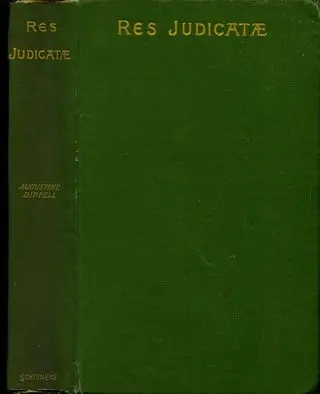
Res Judicatæ: Papers and Essays
Augustine Birrell
THE CLASSIC COLLECTION · 1905
"Andrew Marvell" by Augustine Birrell is a biographical account written in the early 20th century. This work delves into the life and legacy of Andrew Marvell, a prominent poet, politician, and contemporary of Milton, who played an influential role during the English Commonwealth and Restoration periods. The biography explores Marvell's multifaceted character as a writer, scholar, and civil servant, focusing on his contributions to poetry and politics. The opening of the biography introduces Marvell's early life, highlighting his upbringing in a scholarly household and his education, which laid the foundation for his future pursuits. Augustine Birrell reflects on Marvell's elusive nature as a historical figure, noting that while many details of his life, such as his education at Cambridge, his poetry, and his political endeavors, are well-documented, there remains a profound lack of personal insight into Marvell's character. Birrell presents the poignant context of Marvell's life against the backdrop of 17th-century England, setting the stage for a detailed exploration of his influential works and political involvement as the narrative unfolds.
Introduction adapted from the source catalogue; source summaries may be automatically generated.
Free to read · English · 75,195 words · No account needed
MAKE TIME FOR A GOOD BOOK
On by default. Untick to stop anonymous reading totals. Each page counts after 10 seconds in view. How this works.
Anonymous counting is on unless you have switched it off.
The trial of William Penn and William Mead at the Old Bailey for a tumultuous assembly, written by themselves, may be read in the State Trials, vol. vi. The trial was the occasion of Penn's famous remark to the Recorder of London, who, driven wellnigh distracted by Penn's dialectics, exclaimed, "If I should suffer you to ask questions till to-morrow morning you would never be the wiser." "That," replied Penn, "would be according as the answers are."
To William Ramsden, Esq. (Undated.)
"DEAR WILL,--The Parliament are still proceeding, but not much advanced on their eight hundred thousand pounds Bill on money at interest, offices, and lands; and the Excise Bills valued at four hundred thousand pounds a year. The first for the navy, which scarce will be set out. The last to be for paying one million three hundred thousand pounds, which the King owes at interest, and perhaps may be given for four, five, or six years, as the House chances to be in humour. But an accident happened which liked to have spoiled all: Sir John Coventry having moved for an imposition on the playhouses, Sir John Berkenhead, to excuse them, sayed they had been of great service to the King. Upon which Sir John Coventry desired that gentleman to explain whether he meant the men or the women players. Hereupon it is imagined, that, the House adjourning from Tuesday before till Thursday after Christmas-day, on the very Tuesday night of the adjournment, twenty-five of the Duke of Monmouth's troop, and some few foot, layed in wait from ten at night till two in the morning, by Suffolk-street, and as he returned from the Cock, where he supped, to his own house, they threw him down, and with a knife cut off almost the end of his nose; but company coming made them fearful to finish it, so they marched off. Sir Thomas Sands, lieutenant of the troop, commanded the party; and O'Brian, the Earl of Inchequin's son, was a principal actor. The Court hereupon sometimes thought to carry it with a high hand, and question Sir John for his words, and maintain the action. Sometimes they flagged in their counsels. However, the King commanded Sir Thomas Clarges, and Sir W. Pultney, to release Wroth and Lake, who were two of the actors, and taken. But the night before the House met they surrendered them again. The House being but sullen the next day, the Court did not oppose adjourning for some days longer till it was filled. Then the House went upon Coventry's busyness, and voted that they would go upon nothing else whatever till they had passed a Bill, as they did, for Sands, O'Brian, Parry, and Reeves, to come in by the sixteenth of February, or else be condemned, and never to be pardoned, but by an express Act of Parliament, and their names therein inserted, for fear of being pardoned in some general act of grace. Farther of all such actions, for the future on any man, felony, without clergy; and who shall otherwise strike or wound any parliament-man, during his attendance, or going or coming, imprisonment for a year, treble damages, and incapacity. This Bill having in some few days been dispatched to the Lords, the House has since gone on in grand Committee upon the first eight hundred thousand pounds Bill, but are not yet half way. But now the Lords, instead of the sixteenth of February, put twenty-five days after the King's royal assent, and that registered in their journal; they disagree in several other things, but adhere in that first, which is most material. Adhere, in this place, signifies not to be retracted, and excludes a free conference. So that this week the Houses will be in danger of splitting, without much wisdom or force. For considering that Sir Thomas Sands was the very person sent to Clarges and Pultney, that O'Brian was concealed in the Duke of Monmouth's lodgings, that Wroth and Lake were bayled at the sessions by order from Mr. Attorney, and that all persons and things are perfectly discovered, that act will not be passed without great consequence. George's father obliges you much in Tangier. Prince Edgar is dying. The Court is at the highest pitch of want and luxury, and the people full of discontent, Remember me to yourselves."
Your reading position is saved on this browser. Take it to another device with a library code. Reading pages adapt to text, rather than matching a printed edition.
Augustine Birrell
Augustine Birrell
Augustine Birrell
Augustine Birrell
BEHIND THE BOOK
This eBook is for the use of anyone anywhere in the United States and most other parts of the world at no cost and with almost no restrictions whatsoever. You may copy it, give it away or re-use it under the terms of the Project Gutenberg License included with this eBook or online at www.gutenberg.org. If you are not located in the United States, you will have to check the laws of the country where you are located before using this eBook. Read the source licence.
The original source file, including credits and licence, is retained by this library. Request an original-format copy at no charge. Please include the book title and Project Gutenberg identifier #17388.
KEEP YOUR CURIOSITY GOING
John L. Ransom

Herman W. Mudgett

Harriet Monroe
Daniel Dulany Addison
Charles Lanman

Harold Rosher