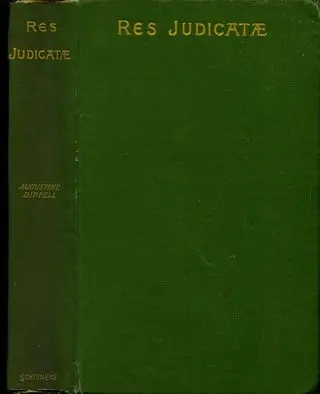
Res Judicatæ: Papers and Essays
Augustine Birrell
THE CLASSIC COLLECTION · 1905
"Andrew Marvell" by Augustine Birrell is a biographical account written in the early 20th century. This work delves into the life and legacy of Andrew Marvell, a prominent poet, politician, and contemporary of Milton, who played an influential role during the English Commonwealth and Restoration periods. The biography explores Marvell's multifaceted character as a writer, scholar, and civil servant, focusing on his contributions to poetry and politics. The opening of the biography introduces Marvell's early life, highlighting his upbringing in a scholarly household and his education, which laid the foundation for his future pursuits. Augustine Birrell reflects on Marvell's elusive nature as a historical figure, noting that while many details of his life, such as his education at Cambridge, his poetry, and his political endeavors, are well-documented, there remains a profound lack of personal insight into Marvell's character. Birrell presents the poignant context of Marvell's life against the backdrop of 17th-century England, setting the stage for a detailed exploration of his influential works and political involvement as the narrative unfolds.
Introduction adapted from the source catalogue; source summaries may be automatically generated.
Free to read · English · 75,195 words · No account needed
MAKE TIME FOR A GOOD BOOK
On by default. Untick to stop anonymous reading totals. Each page counts after 10 seconds in view. How this works.
Anonymous counting is on unless you have switched it off.
The Second Part is not all raillery. There is much wisdom in it and a
trace of Machiavelli:--
"But because you are subject to misconstrue even true English, I will explain my self as distinctly as I can, and as close as possible, what is mine own opinion in this matter of the magistrate and government; that, seeing I have blamed you where I thought you blame-worthy, you may have as fair hold of me too, if you can find where to fix your accusation.
"The power of the magistrate does most certainly issue from the divine authority. The obedience due to that power is by divine command; and subjects are bound, both as men and as Christians, to obey the magistrate actively in all things where their duty to God intercedes not, and however passively, that is, either by leaving their countrey, or if they cannot do that (the magistrate, or the reason of their own occasions hindring them), then by suffering patiently at home, without giving the least publick disturbance. But the dispute concerning the magistrate's power ought to be superfluous; for that it is certainly founded upon his commission from God, and for the most part sufficiently fortified with all humane advantages. There are few soveraign princes so abridged, but that, if they be not contented, they may envy their own fortune. But the modester question (if men will needs be medling with matters above them) would be, how far it is advisable for a prince to exert and push the rigour of that power which no man can deny him; for princes, as they derive the right of succession from their ancestors, so they inherit from that ancient and illustrious extraction a generosity that runs in the blood above the allay of the rest of mankind. And being moreover at so much ease of honour and fortune, that they are free from the gripes of avarice and twinges of ambition, they are the more disposed to an universal benignity toward their subjects. What prince that sees so many millions of men, either labouring industriously toward his revenue, or adventuring their lives in his service, and all of them performing his commands with a religious obedience, but conceives at the same time a relenting tenderness over them, whereof others out of the narrowness of their minds cannot be capable? But whoever shall cast his eye thorow the history of all ages, will find that nothing has alwayes succeeded better with princes then the clemency of government; and that those, on the contrary, who have taken the sanguinary course, have been unfortunate to themselves and the people, the consequences not being separable. For whether that royal and magnanimous gentleness spring from a propensity of their nature, or be acquired and confirmed by good and prudent consideration, it draws along with it all the effects of Policy. The wealth of a shepherd depends upon the multitude of his flock, the goodness of their pasture, and the quietness of their feeding; and princes, whose dominion over mankind resembles in some measure that of men over other creatures, cannot expect any considerable increase to themselves, if by continual terrour they amaze, shatter, and hare their people, driving them into woods, and running them upon precipices. If men do but compute how charming an efficacy one word, and more, one good action has from a superior upon those under him, it can scarce be reckon'd how powerful a magick there is in a prince who shall, by a constant tenour of humanity in government, go on daily gaining upon the affections of his people. There is not any privilege so dear, but it may be extorted from subjects by good usage, and by keeping them alwayes up in their good humour. I will not say what one prince may compass within his own time, or what a second, though surely much may be done; but it is enough if a great and durable design be accomplish'd in the third life; and supposing an hereditary succession of any three taking up still where the other left, and dealing still in that fair and tender way of management, it is impossible but that, even without reach or intention upon the prince's part, all should fall into his hand, and in so short a time the very memory or thoughts of any such thing as publick liberty would, as it were by consent, expire and be for ever extinguish'd. So that whatever the power of the magistrate be in the institution, it is much safer for them not to do that with the left hand which they may do with the right, nor by an extraordinary, what they may effect by the ordinary, way of government. A prince that goes to the top of his power is like him that shall go to the bottom of his treasure."[178:1]
Your reading position is saved on this browser. Take it to another device with a library code. Reading pages adapt to text, rather than matching a printed edition.
Augustine Birrell
Augustine Birrell
Augustine Birrell
Augustine Birrell
BEHIND THE BOOK
This eBook is for the use of anyone anywhere in the United States and most other parts of the world at no cost and with almost no restrictions whatsoever. You may copy it, give it away or re-use it under the terms of the Project Gutenberg License included with this eBook or online at www.gutenberg.org. If you are not located in the United States, you will have to check the laws of the country where you are located before using this eBook. Read the source licence.
The original source file, including credits and licence, is retained by this library. Request an original-format copy at no charge. Please include the book title and Project Gutenberg identifier #17388.
KEEP YOUR CURIOSITY GOING
John L. Ransom

Herman W. Mudgett

Harriet Monroe
Daniel Dulany Addison
Charles Lanman

Harold Rosher